 Guide On Map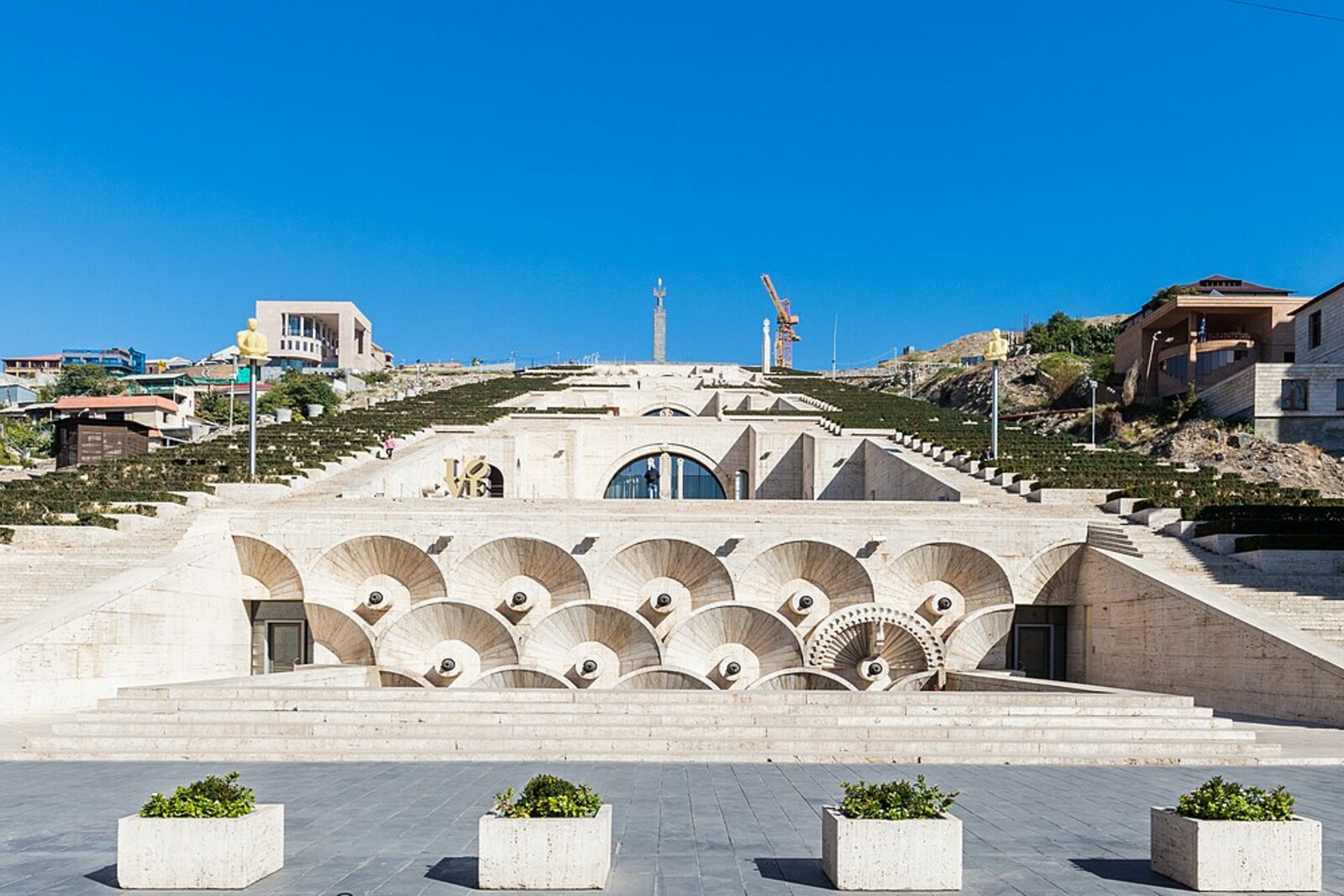
Look around first
What to notice
- Outdoor staircases
- Open terraces
- Fountains and gardens
- Fernando Botero’s Black Cat
The story of the place
In two thousand two, Gerard Cafesjian, an American publisher of Armenian descent and collector, took on the unfinished Yerevan Cascade. The foundation he created received the complex itself and the adjoining land on the condition that it restore the structure, open a museum here, and house Cafesjian’s collection in it.
He earned the money for this plan far from Yerevan. Cafesjian was born in Brooklyn to a family of Armenian emigrants, served in the navy, received a legal education after the war, and then went into publishing reference books for lawyers. At West Publishing, he helped create a computer system for searching court decisions. After the company was sold in nineteen ninety-six, Cafesjian acquired a fortune and decided to bring the art he had collected to Armenia—the country of his parents.
By then, the staircase had stood unfinished for more than ten years. Back in the twenties, the architect Alexander Tamanian conceived a descent from the northern plateau to the center through gardens and waterfalls arranged one below another. The name “Cascade” came from that sequence of terraces and water. In the late seventies, Yerevan’s chief architect, Jim Torosyan, and his colleagues turned the earlier idea into a project for a vast outdoor staircase. Inside, they provided for escalators, courtyards, and exhibition halls. After the earthquake of nineteen eighty-eight and the collapse of the Soviet Union, construction was halted.
It is those interior halls that explain why Cafesjian chose this structure for his collection. The museum could extend through the entire staircase: a person goes up by escalator, with galleries opening out on either side; outside, their roofs become terraces, fountains, and gardens.
The first work Cafesjian brought here in two thousand two was the bronze Black Cat by the Colombian sculptor Fernando Botero. Then the stairs, halls, and park were renovated for seven years. In November two thousand nine, Cafesjian attended the opening of the arts center, with a sculpture garden and ten galleries.
He was unable to build the upper museum that was meant to complete the ascent. Cafesjian planned to allocate about thirty million dollars for it, while the developed project required more than one hundred million. After the global financial crisis, work was halted. The lower and middle sections were able to open, the collection received a permanent home, and the center itself was named after the man who brought it here.
Botero’s Black Cat still stands at the foot of the staircase—where, in two thousand two, the first work was delivered for a museum that did not yet exist.
Useful on site
Outdoor steps and the park — according to actual access; the Escalator Gallery daily 08:00–20:00. The upper areas may change because of the completion project.
Checked: June 24, 2026. Check the official source before visiting.You do not have to take all the steps in sequence: choose accessible terraces or the indoor ascent, and check the actual closures.