 Guide On Map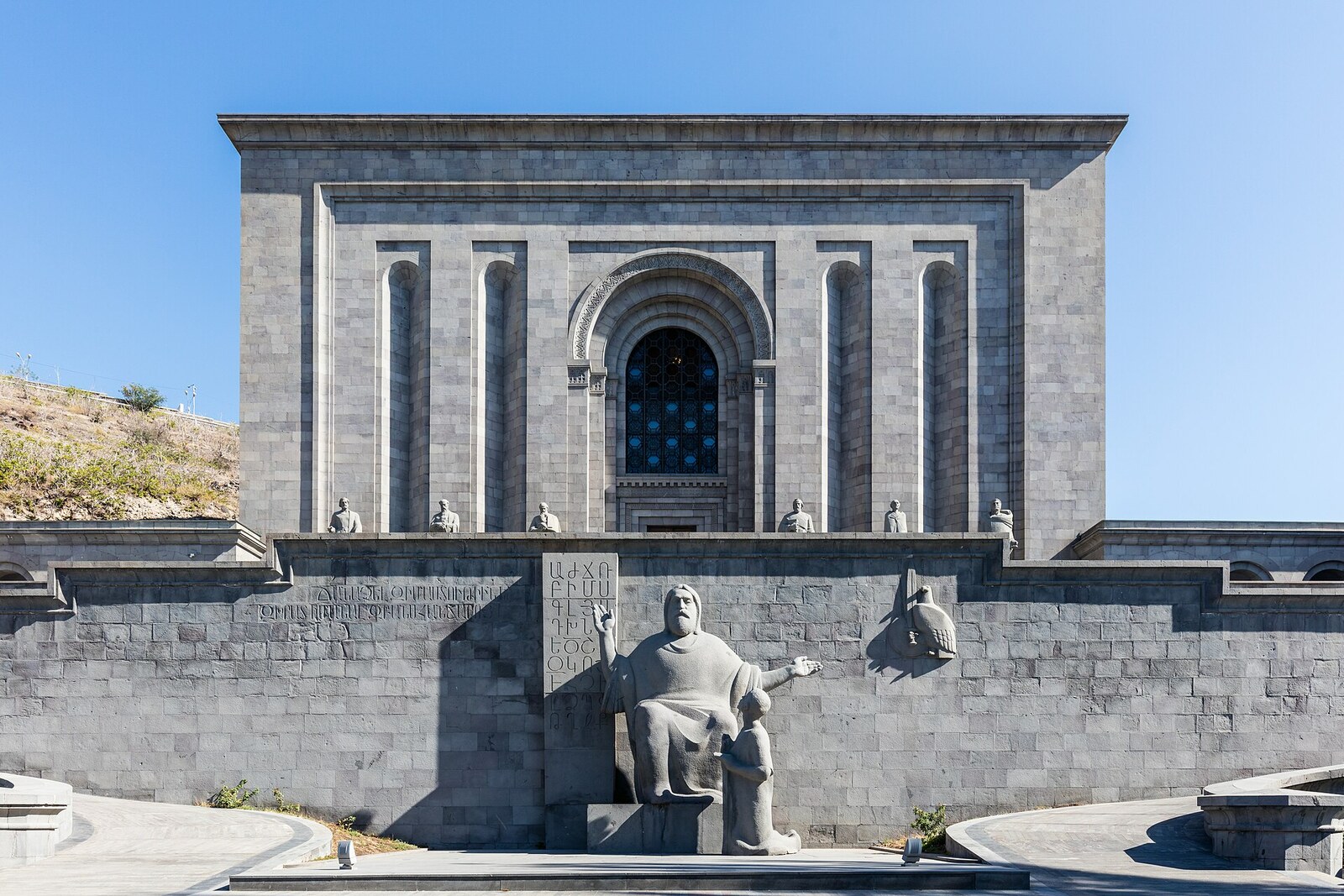
Look around first
What to notice
- Gray basalt facade
- Broad staircase
- Sculptures of Mesrop Mashtots and Koryun
- Inscription on the wall
The story of the place
Here, manuscripts are not merely shown to the public: they are collected, described, restored, and published, while the holdings and offices occupy the neighboring new building. The old building repeats the proportions of a gavit, a roofed monastic hall where people gathered, read, and kept books; the main hall inside is arranged after four-pillar rooms. Before the broad steps stand Mesrop Mashtots and Koryun, the student who recorded his teacher’s history, while the beginning of the Armenian written tradition is carved on the wall.
The gray basalt building at the top of the staircase grew out of a dispute over what a research institute holding medieval Armenian books should be.
In nineteen thirty-nine, the collection of manuscripts was transferred from Etchmiadzin to Yerevan. It was already called the Matenadaran: in Armenian, this means a repository of manuscripts. Architect Mark Grigorian was commissioned to design a dedicated building with holdings, restoration workshops, reading rooms, and exhibition halls. Academician Joseph Orbeli, head of the recently established Academy of Sciences of Armenia and an advocate of a separate home for the collection, proposed a site on the slope at the end of the avenue. From here, the building terminates a long urban vista.
Grigorian was then serving as Yerevan’s chief architect and worked only on state commissions: decisions by his superiors determined both his position and his next projects. First, he went to Leningrad to study the layout of modern book depositories. The war halted the work, and in nineteen forty-three the architect was required to return to the drawings quickly. Grigorian felt that he still did not understand how to combine technical requirements with the purpose of the Matenadaran.
He asked the daughter of the researcher of Armenian architecture Toros Toramanian to give him access to her father’s archive. It contained measured drawings of buildings in the medieval capital of Ani. Grigorian then traveled to the monasteries of Haghpat, Sanahin, and Tatev, studying old gavits—roofed halls before a church entrance, where people gathered, read, and kept books.
In the autumn of nineteen forty-four, the architect exhibited twenty-four large sheets of the design. The discussion lasted three days. Colleagues disputed the chosen site, the composition, and the turn to medieval architecture. Grigorian retained the design and then personally supervised the construction, down to the drawings for the doors and furniture.
The punishment came while the building was still unfinished. In nineteen fifty-six, the Central Committee of the Communist Party of Armenia issued Grigorian a severe reprimand “for allowing excesses in architecture and design.” By then he was already heading the republican design institute, so the party disciplinary action struck at his professional standing. For several decades, architectural publications mentioned the Matenadaran only in passing or reproached its author for deliberate archaization.
Grigorian nevertheless saw the project through. In nineteen fifty-nine, the collection was moved here and the research institute opened. The facade in front of the staircase repeats the main proportions of the gavit of the Church of the Holy Apostles in Ani, while the main hall inside is arranged after four-pillar monastic rooms. The forms for which the architect received the reprimand have remained almost unchanged. The museum is now housed in the old building; Matenadaran staff continue to collect, describe, restore, and publish manuscripts, while the holdings and offices also occupy the neighboring new building.
The institute received its name in nineteen sixty-two, in honor of Mesrop Mashtots, a monk and teacher of the early fifth century who sought to make it possible to translate Christian books and teach people in Armenian. With the support of Catholicos Sahak Partev and King Vramshapuh, Mashtots created the Armenian alphabet, after which his students began translating and copying books.
Originally, sculptor Ara Sargsyan prepared Mashtots together with Sahak Partev for the square in front of the Matenadaran: they held an open book. The nearly completed composition was forbidden to be installed because they did not want to place a figure of a Catholicos beside a Soviet institute. Its place was taken by a work by Ghukas Chubaryan—Mashtots and the kneeling Koryun, a student, translator, and the first biographer of his teacher. Carved on the wall beside them is the opening phrase of the Armenian written tradition: “To know wisdom and instruction, to understand the sayings of reason.”
Sargsyan’s composition of Mashtots and Sahak Partev was installed in front of Yerevan State University only in two thousand two. Here, Mashtots and Koryun remained: the creator of letters and the man who recorded his history.
Useful on site
The museum is open Tuesday through Saturday 10:00–17:50; closed Sunday, Monday, public holidays, and commemorative days. A safe time to buy or collect a ticket is by 16:50 because of a discrepancy between the official pages.
Checked: June 24, 2026. Check the official source before visiting.The facade is accessible for exterior viewing, but the manuscripts are in the exhibition; plan and check a museum visit separately.