 Guide On Map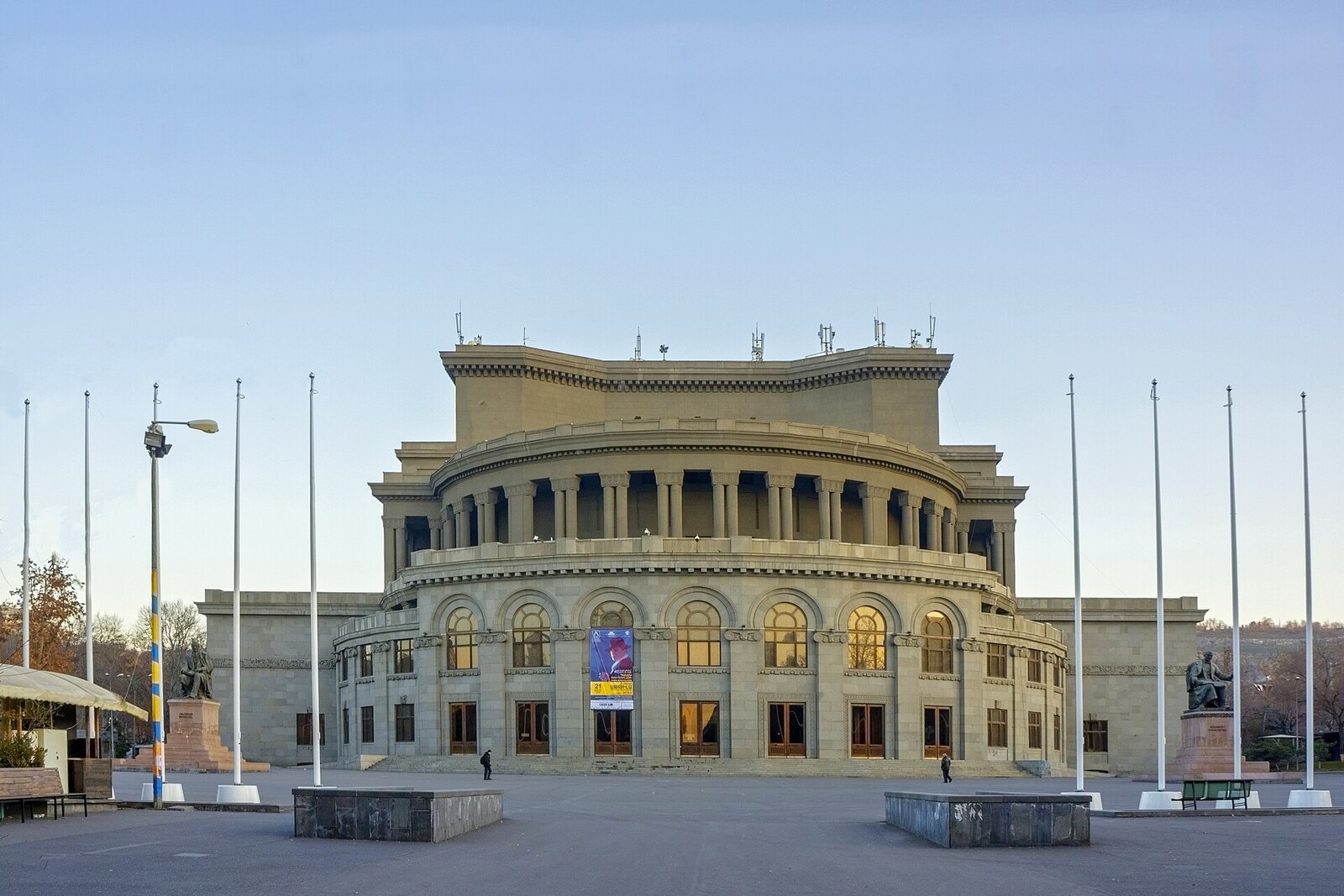
Look around first
What to notice
- The theatre's semicircular facade
- Monument to Hovhannes Tumanyan
- Monument to Alexander Spendiaryan
- Grave of Alexander Spendiaryan
The story of the place
The theatre's facade is built in a semicircle, and present-day Freedom Square lies in front of the main entrance. The theatre was designed as the Yerevan Opera Theatre with a hall for productions; the city did not yet have an opera stage at the time. The semicircle in front of the entrance was laid out at the same time as the building and was called Theatre Square for many years. Today people gather here for concerts and other city events, using the facade as a stage backdrop.
On either side of the main entrance stand the two men whose meeting began the history of this theatre. On the right is the composer and conductor Alexander Spendiaryan, whose name the Yerevan Opera Theatre bears. On the left, with a book on his knees, is the poet Hovhannes Tumanyan. The bronze figures appeared here in nineteen fifty-seven, while the men they depict met four decades earlier.
In nineteen sixteen, Spendiaryan was looking for a subject for an Armenian opera. He did not know Armenian, so Tumanyan read his poems to him and immediately explained the passages Spendiaryan did not understand. The composer chose The Capture of Tmkaberd—a story of a military commander, his wife Almast, and the betrayal that doomed the fortress's defenders. The Russian poet Sophia Parnok turned the poem into a libretto, and over the next ten years Spendiaryan wrote and revised the score. Almast remained his only opera.
In nineteen twenty-four, the composer moved from Sudak to Yerevan at the invitation of the republic's leaders. His everyday work became teaching at the young conservatory and creating its symphony orchestra. There was still no opera theatre in the city, and there was nowhere here to stage the four-act Almast.
In the spring of nineteen twenty-eight, Spendiaryan fell ill with lobar pneumonia and died without seeing a Yerevan production. Alexander Tamanian, the architect designing the Yerevan Opera Theatre for the city with a theatre hall, proposed burying the composer in a garden beside the future building. Thus the grave appeared here before the theatre admitted its first audience member.
On January twentieth, nineteen thirty-three, the curtain rose at the new Yerevan Opera Theatre. The first production was Almast. A few years later, the theatre was named after Spendiaryan: the inscription on the facade preserved the name of the composer whose score began the work of the entire company.
The semicircle in front of the main entrance was created together with the theatre. In Soviet years, it was simply called Theatre Square. It is now Freedom Square; city concerts and other public events take place here, and the building serves as their ready-made stage backdrop.
To the left of the doors, Tumanyan still sits with a book; to the right stands Spendiaryan; the composer's grave lies in the surrounding garden; and between the two monuments opens the entrance to the theatre, where their Almast was the first production.
Useful on site
The square is accessible around the clock; entry to the theatre and concert hall is by ticket for an event or under a separate schedule.
Checked: June 24, 2026. Check the official source before visiting.The main story can be understood from outside; a performance or concert should be treated as a separate visit.