 Guide On Map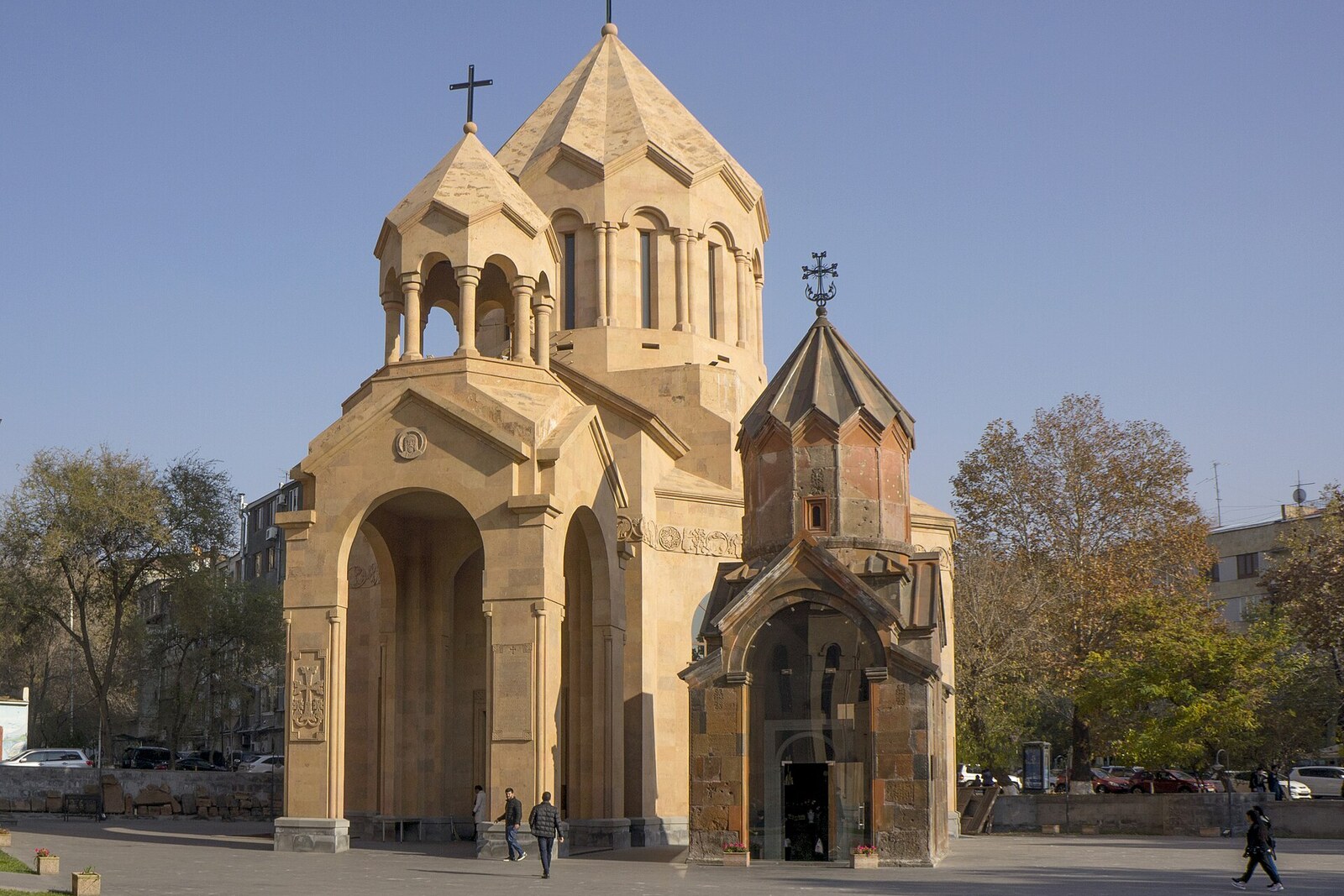
Look around first
What to notice
- The small dome
- Stone walls with inscriptions
- The intersection of Abovyan Street and Sayat-Nova Street
The story of the place
In the summer of nineteen twenty, the former Astafyev Street was renamed in honor of Khachatur Abovian. He taught and wrote for readers to whom literary Old Armenian had already become alien. Abovian wrote the novel Wounds of Armenia in spoken Eastern Armenian; for this work, he is called the founder of modern Armenian literature.
At the corner of Abovyan Street and Sayat-Nova Street stands the small Katoghike Holy Mother of God Church. Its present size is the result of an unfinished demolition.
In December nineteen thirty-six, the Yerevan City Council began dismantling the larger Holy Mother of God Church from the late seventeenth century that stood here. The site was designated for new development. The Institute of History and Literature approved the work on one condition: the dismantling had to proceed under the daily supervision of an archaeologist, so that inscribed stones and old parts of the building would not disappear.
Karo Ghafadaryan, a young archaeologist and specialist in inscriptions, was appointed supervisor. He spent every working day at the site and halted the dismantling whenever anything was found. Later, Ghafadaryan wrote that because of these stoppages, it took twice as long as planned—until March of the following year.
Beneath the later masonry, a small thirteenth-century domed church came to light. It had not stood beside the larger church: seventeenth-century builders incorporated it into the new building and turned it into the main altar. No one could see a separate church from outside anymore. The earliest inscription on its walls dates to twelve sixty-four.
Ghafadaryan's supervision protected finds as the dismantling proceeded. Professor Ashkharbek Kalantar sought to stop all the work. He taught archaeology at Yerevan State University and served as scholarly secretary of the Committee for the Protection of Antiquities. On January nineteenth, nineteen thirty-seven, Kalantar wrote to Amatuni, the first secretary of the Armenian Communist Party—the republic's top party leader. The professor warned that barely two or three old monuments remained in Yerevan, and that in such haste it was impossible to study the newly uncovered paintings, inscriptions, and masonry. He asked for the demolition to be stopped and for a commission of specialists to be assembled immediately.
The letter was sent for review, but the issue was never considered by the party bureau. By March, the larger church had been dismantled. Kalantar was not arrested for this letter: in March nineteen thirty-eight, he was accused of treason in the fabricated “Professors' Case.” His death sentence was commuted to eight years' imprisonment. In June nineteen forty-two, the archaeologist died in Siberian exile; he was later fully exonerated posthumously.
The institute's academic council preserved the medieval church discovered by Ghafadaryan. It was freed from the remains of the later basilica, and its damaged parts were restored. The larger Katoghike disappeared, while the small altar church remained an active church and inherited its name. “Katoghike” means the principal, cathedral church—now this name is borne by a building measuring only a little more than five by seven and a half meters.
Useful on site
An active church; no single official visiting schedule has been published. The courtyard is usually accessible during the day, and services take priority.
Checked: June 24, 2026. Check the official source before visiting.Look around the church quietly and without loud audio; during a service, the community's needs take priority over the tour stop.