 Guide On Map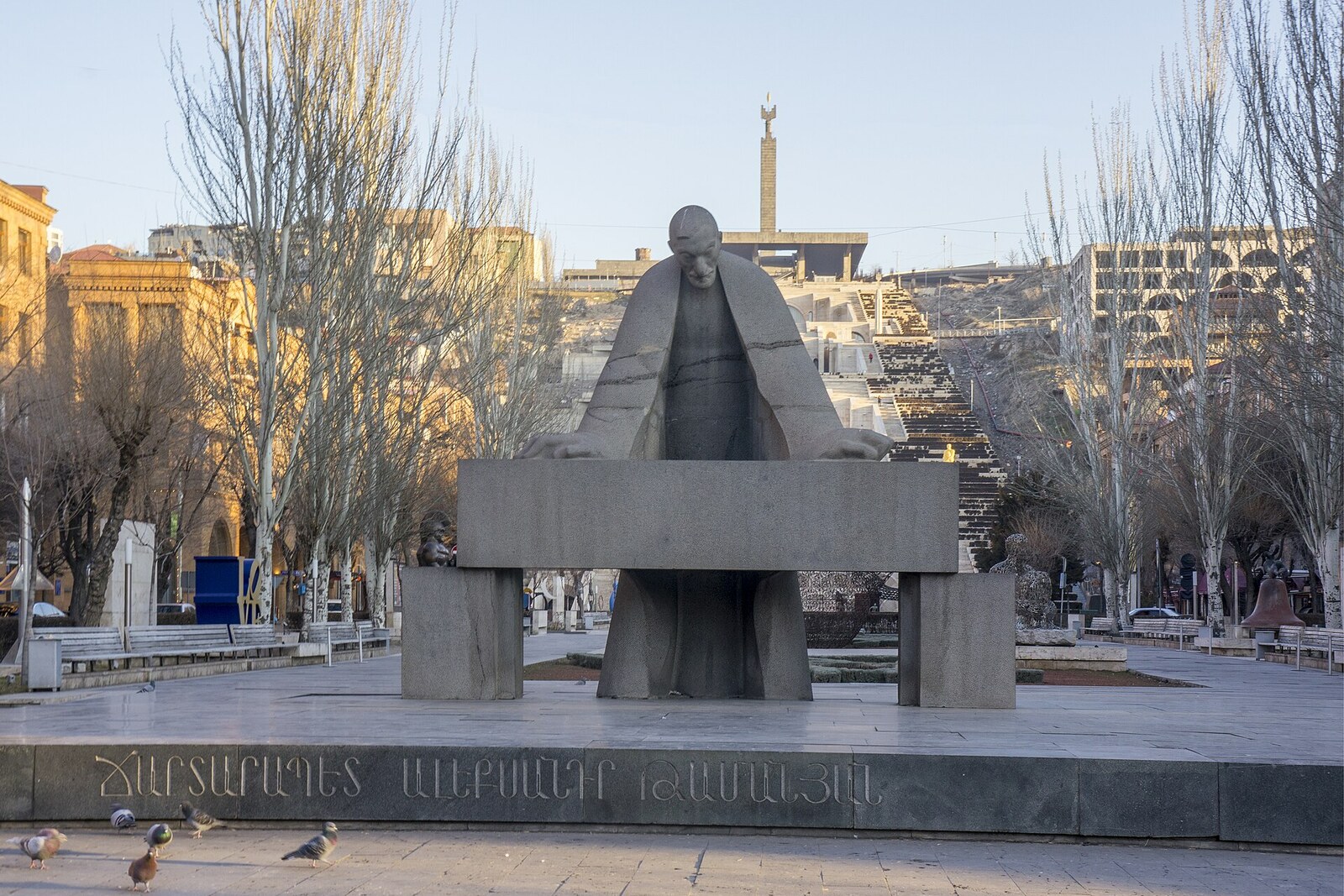
Look around first
What to notice
- Basalt figure of the architect
- Three stones
- Carved fragment of the master plan
- Ascent to the Yerevan Cascade
The story of the place
The basalt man in front of the park is Alexander Tamanian, the architect of the first master plan of modern Yerevan. In the plan approved in nineteen twenty-four, he laid out from here to the northern heights a broad green line with gardens and water. A sculpture park and the Yerevan Cascade now lie along this line. That is why both Tamanyan Park and Tamanyan Street at its foot are named after Tamanian, and a fragment of that very plan is carved beside the architect's figure.
The present monument appeared after several refusals by its author. In the nineteen sixties, the young sculptor Artashes Hovsepyan studied at the Leningrad Academy of Arts and won two Armenian competitions at once—for monuments to Tamanian and Karl Marx. He was offered the chance to remain for postgraduate study, but Hovsepyan refused: it was time to earn a living as a sculptor.
According to Hovsepyan's recollections, the creation of monuments to Armenian figures was soon temporarily prohibited. Of the two winning projects, he was allowed to carry out only the bust of Marx. His victory in the competition for the Tamanian monument remained without a monument.
Seven years later, the restriction was lifted. Hovsepyan was summoned to the Central Committee of the Communist Party of Armenia, where major state commissions were approved, and ordered to finish the monument for the architect's anniversary. Five months remained until the appointed date. The sculptor considered such a time frame impossible and refused again.
Jim Torosyan persuaded him—an architect who, in those same years, continued the northern line of Tamanian's plan. After that, the work took about four years. Hovsepyan sculpted life-size versions, remained dissatisfied with them, and asked students to smash the models. This continued until he found a composition with three stones.
The monument was unveiled on June twenty-sixth, nineteen seventy-four. Hovsepyan explained that the outer stones represent old and new architecture, while Tamanian connects them. That is why the architect is shown bent over his work, without a ceremonial pose.
None of the full-size models that Hovsepyan ordered smashed remain. The only one he preserved stands here: Tamanian leans on three stones, his plan is carved nearby, and behind the monument begins the ascent to the northern part of the city envisioned by that plan.
Useful on site
Open city park; access around the clock.
Checked: June 24, 2026. Check the official source before visiting.Look at the composition from the front and from the side: only then does the role of the stones on either side of Tamanian become clear.