 Guide On Map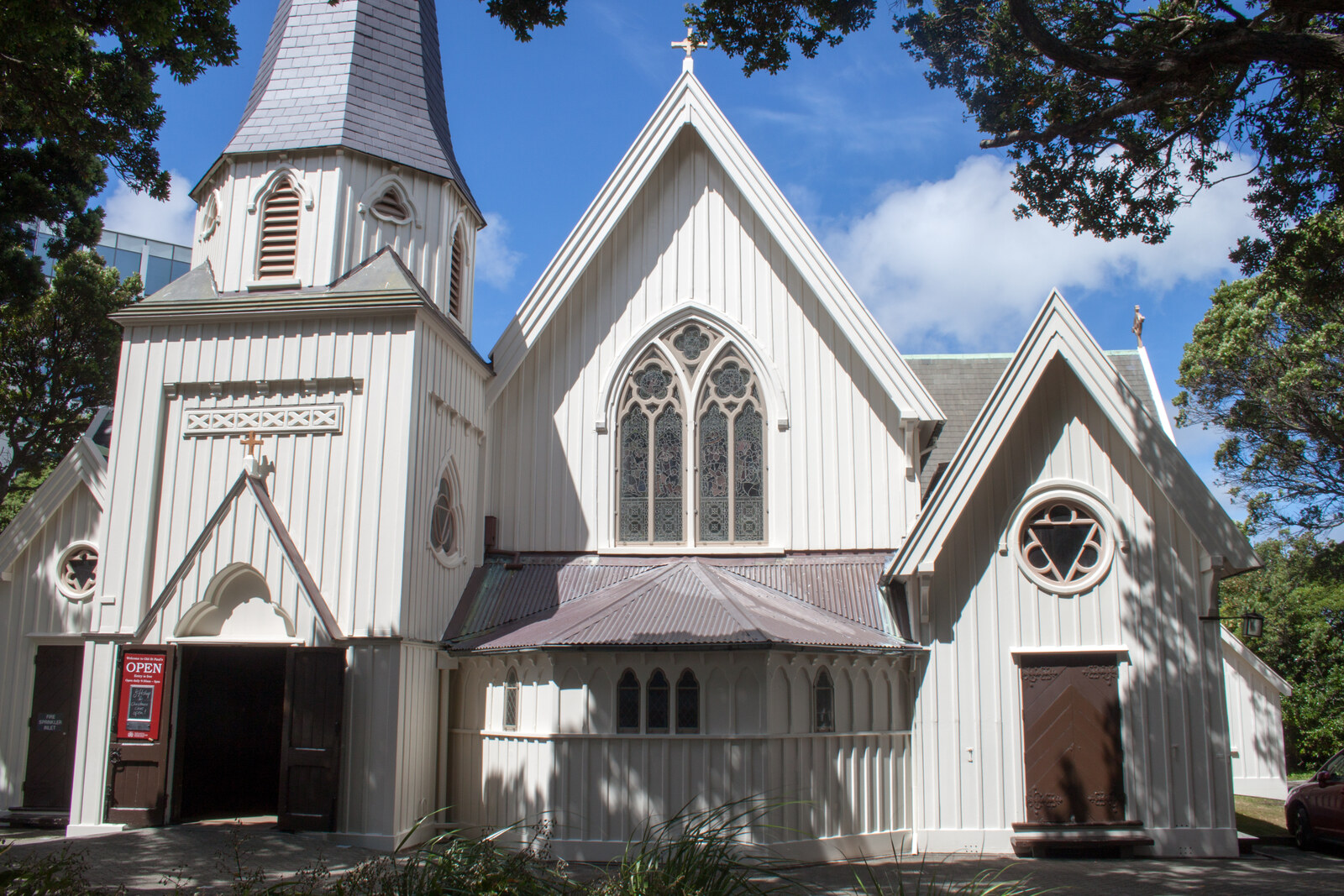
Look around first
What to notice
- Wooden nave
- Open rafters
- Pulpit
- Font
The story of the place
The name is dedicated to the Apostle Paul, a preacher of early Christianity. The church began to be called “Old” in nineteen sixty-four, when the congregation moved to Wellington Cathedral of St Paul, built a block farther on.
Before that, for ninety-eight years the wooden church combined two roles: it was Thorndon’s parish church and the temporary cathedral of the Diocese of Wellington. The bishop’s chair stood here, although the city did not yet have a permanent Anglican cathedral. By the middle of the twentieth century, the building was considered too cramped. Church leaders decided to move the episcopal seat and incorporate part of the old church—the altar and several bays of the nave—into the new cathedral as a small chapel. The rest of the wooden structure was to be dismantled. Then moving it out of town and demolishing it for an administrative building were discussed.
The first public objection came from Jock Beere, an architect and parishioner who argued for preserving the building intact. In nineteen fifty-four, he published an article in an architectural journal. Beere explained that the altar, pulpit, font, posts, and rafters were designed for this space: the removed eastern section would preserve the boards, but lose the church’s structure.
His argument was taken up by Roger Gibb, an architect with the government’s Ministry of Works. He earned his living through design work and gave his free time to a campaign that at first almost no one wanted to support. According to Gibb’s recollections, newspapers refused to print appeals, and some Anglicans considered the defenders an obstacle to building the new cathedral. Together with parishioner Dorothy Tanner, he founded the Save Old St Paul's Society. Gibb spent two years reconstructing the building’s history from documents; then he and Tanner sent it to newspapers, architects, and the newly established New Zealand Historic Places Trust. The dispute over the old church thus acquired a concrete focus: the city could lose one of the rare large interiors built entirely from New Zealand timber species.
In nineteen sixty-four, services ceased, but the building was not dismantled: the campaign had already gained broad support. Two years later, the bishop and dean of the new cathedral went to the prime minister and proposed selling the old church to the state. Cabinet agreed on condition that it be preserved on this very site and used for dignified ceremonies. The deal was completed in nineteen sixty-seven, and the Ministry of Works, where Gibb worked, took on the restoration. The defenders’ society became Friends of Old St Paul's and continued raising funds for the building’s upkeep.
There is no longer a parish community here, but the church remains consecrated. Weddings, funerals, baptisms, concerts, and exhibitions are held in it. For these events, the entire wooden nave is opened—the very one that was to be cut up and retained in parts.
Useful on site
Usually open daily 10:00–16:00; closed Good Friday, Christmas Day, and until 13:00 on Anzac Day, as well as for short private events.
Checked: June 27, 2026. Check the official source before visiting.Even when the entrance is closed, it is worth walking around the publicly accessible area outside. If a service or ceremony is taking place inside, look around quietly and without disruption.