 Guide On Map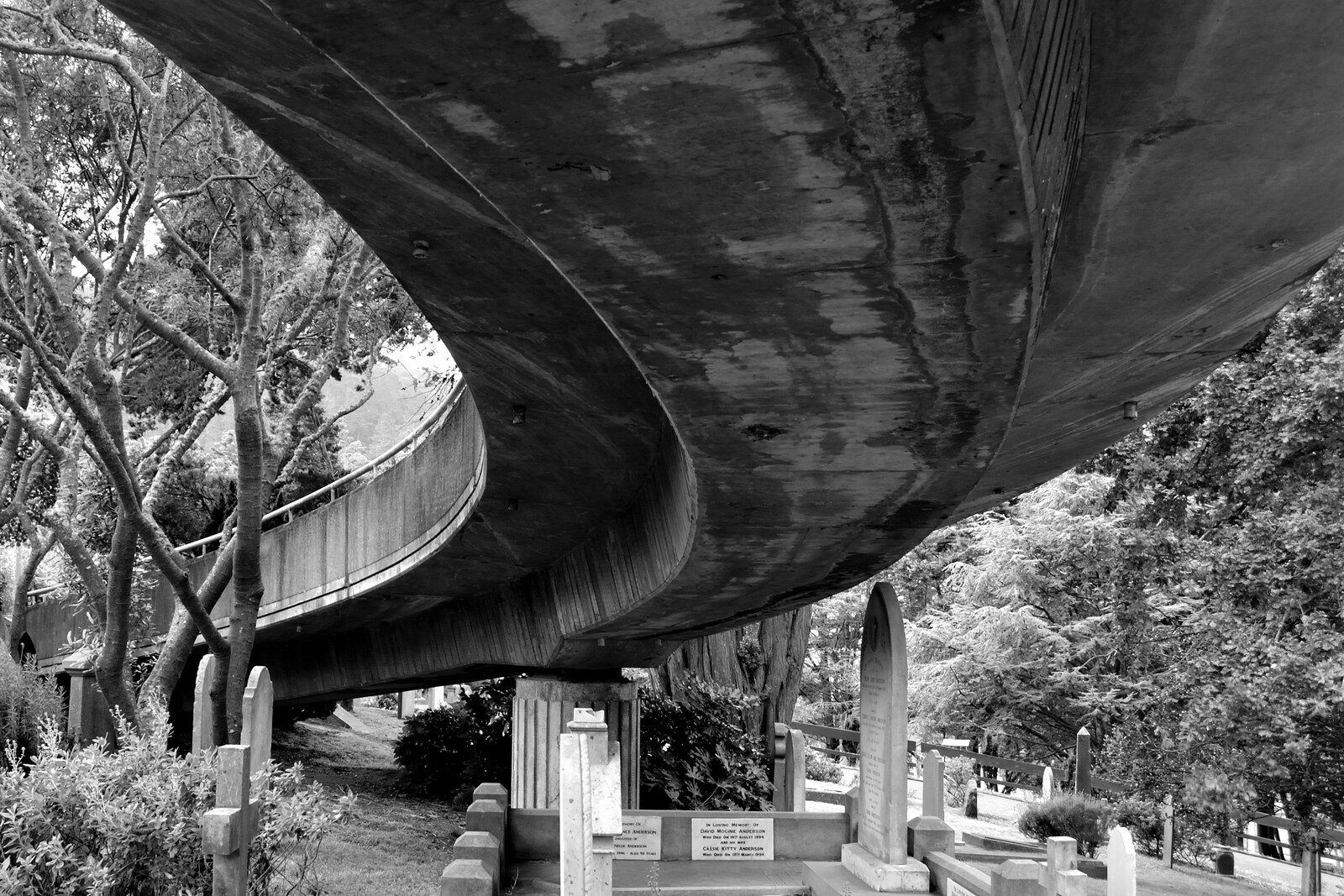
Look around first
What to notice
- Returned headstones
- Early Settlers Memorial Lawn
- Pedestrian bridge over the motorway
- “Alington Trail” sign
The story of the place
Three old cemetery sections lie on the green slope, and over time they received the shared name Bolton Street. In the early years of the European town, a common burial ground for people of different faiths was set aside here, and it was later divided among Anglicans, the municipal Sydney Street Cemetery, and the Jewish community. When houses surrounded the slope, new burials were moved to Karori. Stone slabs among the grass do not always mark the grave directly beneath them: far from everything from the cemetery's former layout has survived.
Beginning in nineteen sixty-eight, City Corporation workers removed headstones here and exhumed graves. They needed to clear a strip for a motorway. But old registers recorded far from every burial: before the middle of the nineteenth century, the location of each grave was not recorded at all, and cheap wooden markers had long since rotted away. Human remains kept emerging from the ground that did not appear on the plan. Over three years, the workers reinterred about three thousand seven hundred people.
The cemetery was established alongside European Wellington. Bolton Street was named after the sailing ship Bolton, which brought settlers here in the spring of eighteen forty. The following summer, the governor approved a single burial ground on the edge of the new town for people of different faiths. Ten years later, it was divided into Bolton Street Anglican Cemetery, Sydney Street Cemetery, and a Jewish cemetery. Over time, the present name was extended to all three sections.
In eighteen ninety-two, the cemetery was closed: houses had surrounded the slope, there was hardly any space left, and the main burials were moved to Karori. Seventy years later, this circumstance helped road planners. The only approach to central Wellington along Hutt Road could not cope with the flow of cars, while the closed cemetery lay directly in the path of a new route through the western part of the city.
Mayor Frank Kitts, who defended this route, said that the prominent townspeople buried here would not have wished to stand in the way of progress. In nineteen sixty-four, residents formed the Bolton Street Cemetery Preservation Society and tried to secure a bypass route. The Society even appealed to the prime minister, but the City Council, the National Roads Board, and the Ministry of Works continued their preparations. Three years later, Parliament passed a law permitting construction.
Most of the exhumed remains were placed in a communal vault beneath the Early Settlers Memorial Lawn. Several families asked for their relatives to be moved to Karori or Makara. About eight hundred forty removed headstones were sent into storage. They intended to return only some of them and set them out without a strict connection to their former sections.
The Ministry of Works asked librarian and historian Margaret Alington to record the history of the doomed part of the cemetery. Photographs of the removed stones proved insufficient: worn inscriptions were almost unreadable in the images. Alington then gathered volunteers. In the winter of nineteen seventy-four, they deciphered inscriptions on slabs stacked in ten rows each Sunday. The wooden spacers between the stones were falling out, the heavy slabs were leaning toward one another, and moving them was forbidden. The volunteers reached the letters with brushes, flashlights, and talcum powder, sometimes returning to the same stone in different light.
Over three years, Alington's group read one thousand one hundred eighty-six inscriptions. These records made it possible to prove which part of the cemetery the stones had come from, and Alington secured the return of all surviving headstones. Their bases and fences had mostly disappeared, so many slabs now stand far from the remains of the people whose names are carved on them. The copies compiled by the volunteers became the basis for today's map and burial list; some letters on the stones themselves have disappeared since then.
The motorway opened in nineteen seventy-eight. The builders replaced the promised broad platform above the road with a narrow pedestrian bridge, which still connects the two halves of the cemetery today. And since two thousand eight, among the returned headstones in the upper Anglican section stands a sign reading “Alington Trail”—the name of the woman who secured their return.
Useful on site
The cemetery is open dawn to dusk; check museum hours separately.
Checked: June 26, 2026. Check the official source before visiting.Speak quietly, do not step on graves, and do not lean on fragile monuments. Remember that many slabs were moved and do not stand above their original burials.