 Guide On Map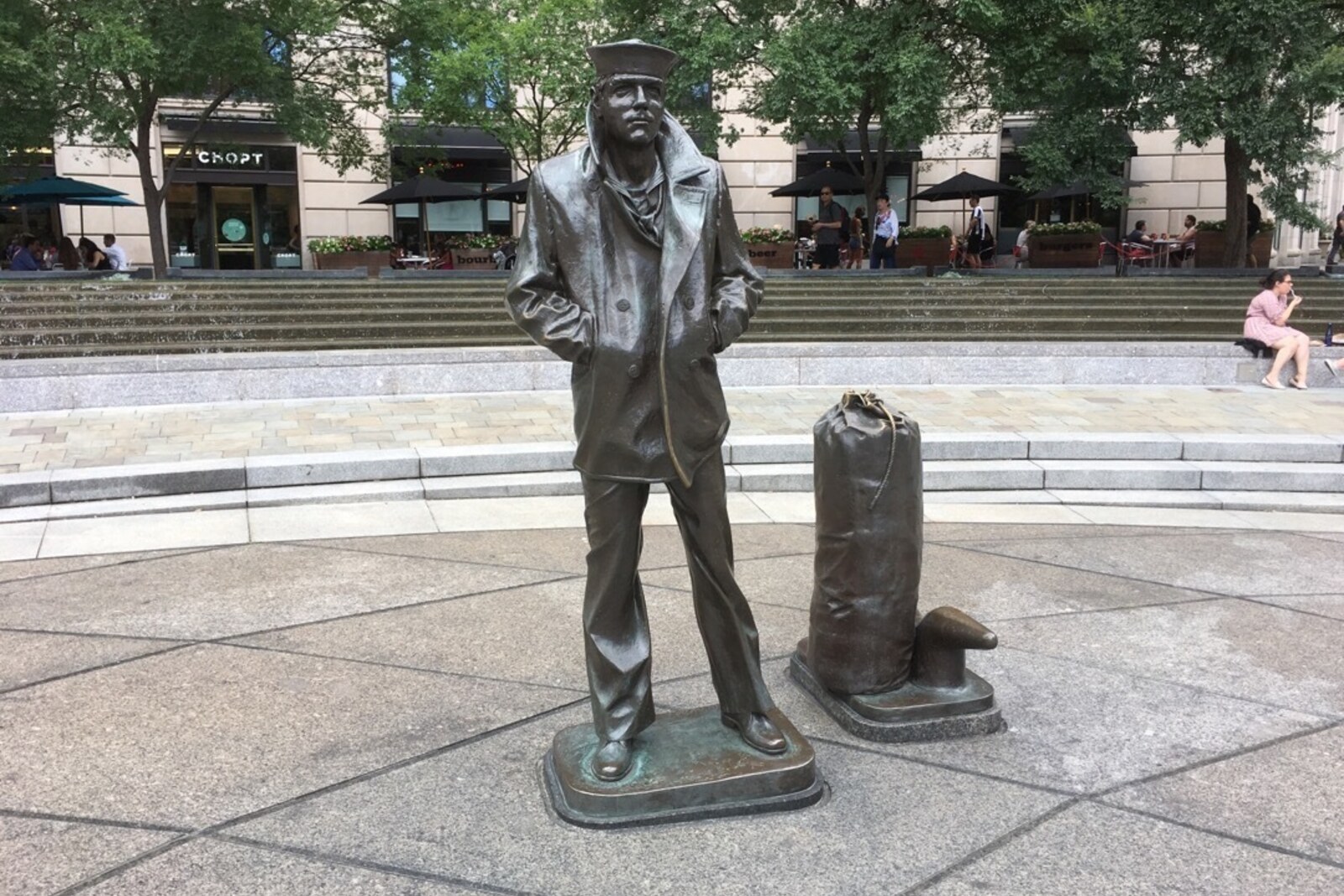
Look around first
What to notice
- Bronze sailor
- Granite map of the world
- Sea bag
- Fountains
The story of the place
The United States Navy Memorial occupies an open, round plaza by the sidewalk: a granite circle underfoot is ringed by water and fountains, and beside it stands a bronze figure of a sailor with a sea bag. This site was once Market Square; later, it was included in the renewal of the city's main boulevard between the United States Capitol and the White House. The space was left without a fence so that bands, veterans, and active crews could gather here. Today, oaths are taken here, promotions are marked, and former shipmates meet.
William Thompson found the idea for a round map of the world underfoot on a glass ashtray. By then, the retired rear admiral headed a private foundation seeking a national memorial for American sailors. United States Congress allowed it to occupy a site in central Washington, but imposed a condition: construction could be paid for only with private donations. If Thompson did not raise money from service members, veterans, and their friends, the authorization would remain only on paper.
The site was then called Market Square. It was chosen together with the Pennsylvania Avenue Development Corporation, which was trying to draw people back to the boulevard between the United States Capitol and the White House. The foundation needed an open space for bands, ceremonies, and reunions of those who had served together. That is how the memorial took the form of an urban amphitheater, directly accessible from the sidewalk.
The sculptor Stanley Bleifeld, a former sailor who drew training materials for the Navy during World War Two, was invited to create it. At first, he declined. Then he agreed: for the main statue, he was to receive a quarter of a million dollars, and work in Washington could become the largest commission of his life. It turned out differently from what he had expected. For five years, the project occupied every workweek; Bleifeld could hardly take on other commissions.
The first proposal called for a thirteen-story arch. Members of a federal commission rejected it. Bleifeld proposed a garden with many bronze sailors, ship bows, and a huge wave. Thompson stopped that project too: among dozens of figures, the person to whom the memorial was dedicated was lost. But he liked a lone sailor at the edge of one sketch.
Soon afterward, Thompson saw a map of Earth on a glass ashtray in a restaurant. A few days later, he gathered the foundation's staff and placed the two discoveries side by side: the map and the sailor figure. They decided to lay out a round granite ocean about thirty meters in diameter, surround it with water, and leave one person upon it.
Approvals continued. Bleifeld reworked the overall composition three times, the sailor himself four times, and his face eight times. The sculptor used several models because the figure had to represent all the men and women who had served, were serving, and would serve in the United States Navy. The founders chose a Petty Officer Second Class about twenty-five years old—an experienced enlisted sailor who was still a long way from an admiral's rank. Thompson insisted on a height of just over two meters: the figure rises above a person, but one can stand beside it on equal footing.
When it was cast in bronze, fragments of eight American ships from different eras were added—from an old sailing frigate to a submarine. The sailor in a peacoat, with his hands in his pockets, was literally made from the ships of those he represents.
On October thirteenth, nineteen eighty-seven, the statue was unveiled here, on the birthday of the United States Navy. About ten thousand people came to the plaza; among them were more than six thousand veterans from seventy-five associations of former crews and military units. The foundation received the site for which it had raised donations for ten years.
The arrangement conceived by Thompson has been preserved. Oath-taking ceremonies, promotions, retirements, and meetings of shipmates' associations are held here. In spring, sailors of the ceremonial guard walk across the granite map and pour into the fountains water collected from the seven seas and the Great Lakes.
The bronze petty officer has no name of his own. But on his sea bag, Bleifeld left the initials and surname of William Thompson—the retired sailor who once joined a lone figure to a map on an ashtray.
Useful on site
The plaza is open as an outdoor space. For the summer period 15.06.2026–07.09.2026, the Naval Heritage Center states its hours as: Monday–Saturday 9:30–17:30, Sunday 10:00–16:00.
Checked: June 30, 2026. Check the official source before visiting.Walk around the figure: the small details of the sea bag and uniform are easy to miss from a frontal view. On the stone map, stand so that you do not obstruct passage through the plaza.