 Guide On Map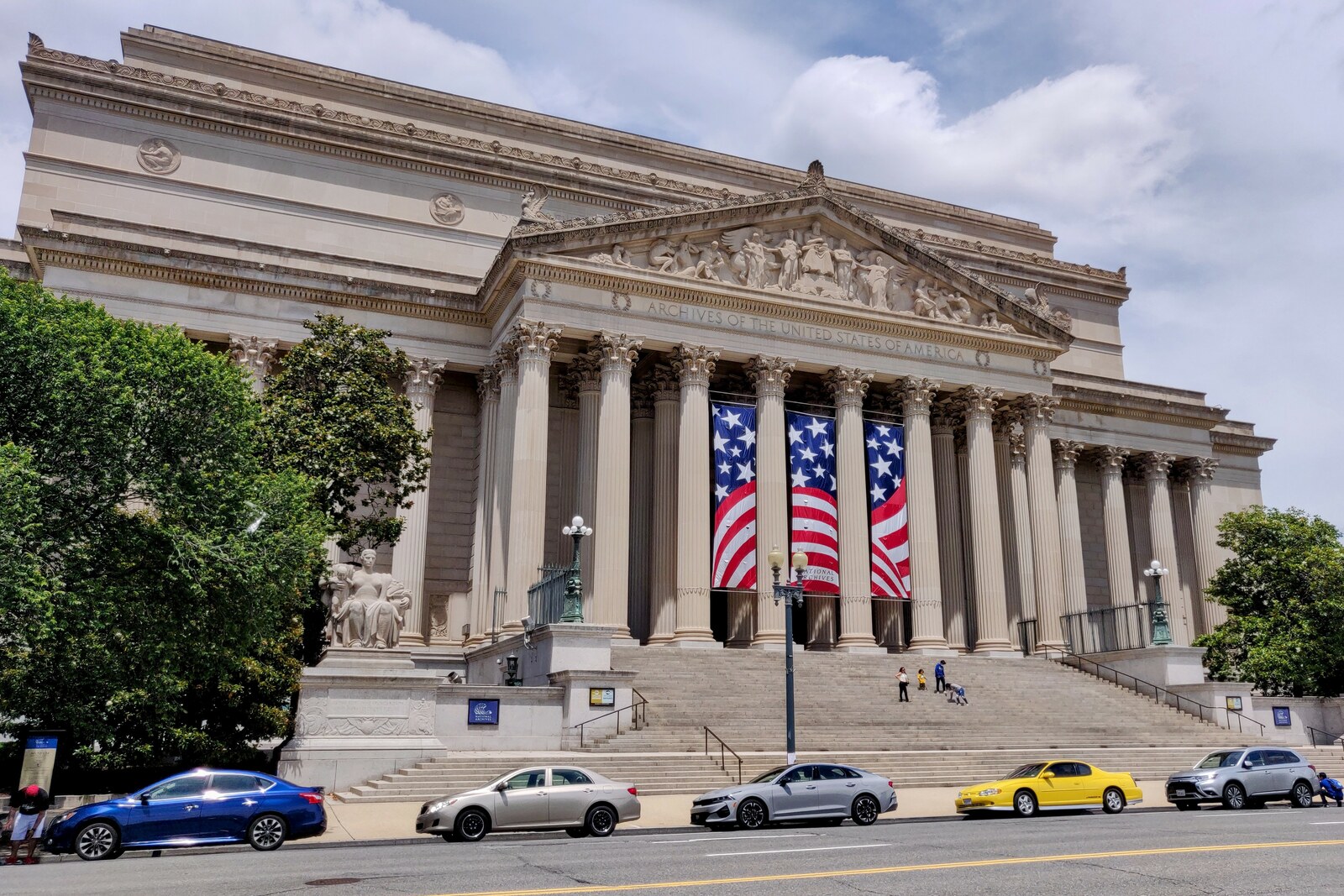
Look around first
What to notice
- South stairs
- Rotunda
- Airtight cases
- Declaration of Independence, Constitution of the United States, and Bill of Rights
The story of the place
The National Archives’ main documents arrived here fifteen years after the rotunda built for them was completed. In nineteen thirty-seven, two enormous paintings depicting the adoption of the Declaration of Independence and the Constitution of the United States already hung in its central hall. The originals for which this hall had been designed remained at the Library of Congress. Its directors had refused to give them up for years.
Wayne Grover knew how documents enter an archive from the lowest rung of service. In nineteen thirty-five, he came to the still-unfinished building as a receiving clerk: he processed the transfer of government papers and helped move them from institutions. Thirteen years later, President Harry S. Truman appointed him head of the National Archives. Grover now sought the transfer of the two originals without which the specially built rotunda remained a hall displaying images of absent documents.
An opportunity for negotiations arose in nineteen fifty-one. At a ceremony at the Library of Congress, Truman said that the first ten amendments to the Constitution of the United States should be kept beside its original. But the original Bill of Rights, which contains those amendments, had been here since nineteen thirty-eight, while the Constitution of the United States itself was at the Library. The president publicly linked documents divided between two institutions.
Grover began negotiations with Luther Evans, head of the Library of Congress and custodian of the Declaration of Independence and the Constitution of the United States. Evans agreed to the transfer, but both understood that the Library was losing its principal exhibits, and that an agreement between two officials alone would not be enough. They referred the decision to the United States Congress. On April thirtieth, nineteen fifty-two, it ordered the originals moved to the National Archives.
Here, the exhibition hall was rebuilt and a fifty-ton steel-and-concrete vault, designed to withstand fire and explosion, was installed. On the morning of December thirteenth, six parchment sheets—the Declaration of Independence, four pages of the Constitution of the United States, and a covering message—were taken from the Library of Congress in sealed cases. Twelve military police placed the wooden crates on mattresses inside a United States Marine Corps armored personnel carrier. A motorcade with military bands, two light tanks, and four soldiers carrying submachine guns proceeded along Pennsylvania Avenue and Constitution Avenue.
At eleven thirty-five, the crates were carried up the south stairs into the rotunda and handed over to Grover. Evans relinquished legal responsibility for the documents, and Grover assumed it on behalf of the National Archives. Until the opening ceremony, the cases spent the weekend in the new vault. On December fifteenth, the Declaration of Independence, the Constitution of the United States, and the Bill of Rights, already kept here, were displayed together for the first time.
The route of that motorcade ended at the stairs on the Constitution Avenue side. Behind this wall, the same Declaration of Independence and the same four pages of the Constitution of the United States still lie; only their airtight cases have become modern. Beside them is the Bill of Rights, transferred here fourteen years earlier.
Useful on site
As of 30.06.2026, extended daily hours of 10:00–22:00 are announced through 05.07.2026; after that, check current slots. Timed tickets are free or carry a service fee for booking and are strongly recommended.
Checked: June 30, 2026. Check the official source before visiting.To view the originals, you will need to undergo the required screening; it is best to confirm entry availability in advance. If you remain outside, focus on the contrast between the durable stone building and the vulnerable paper inside.