 Guide On Map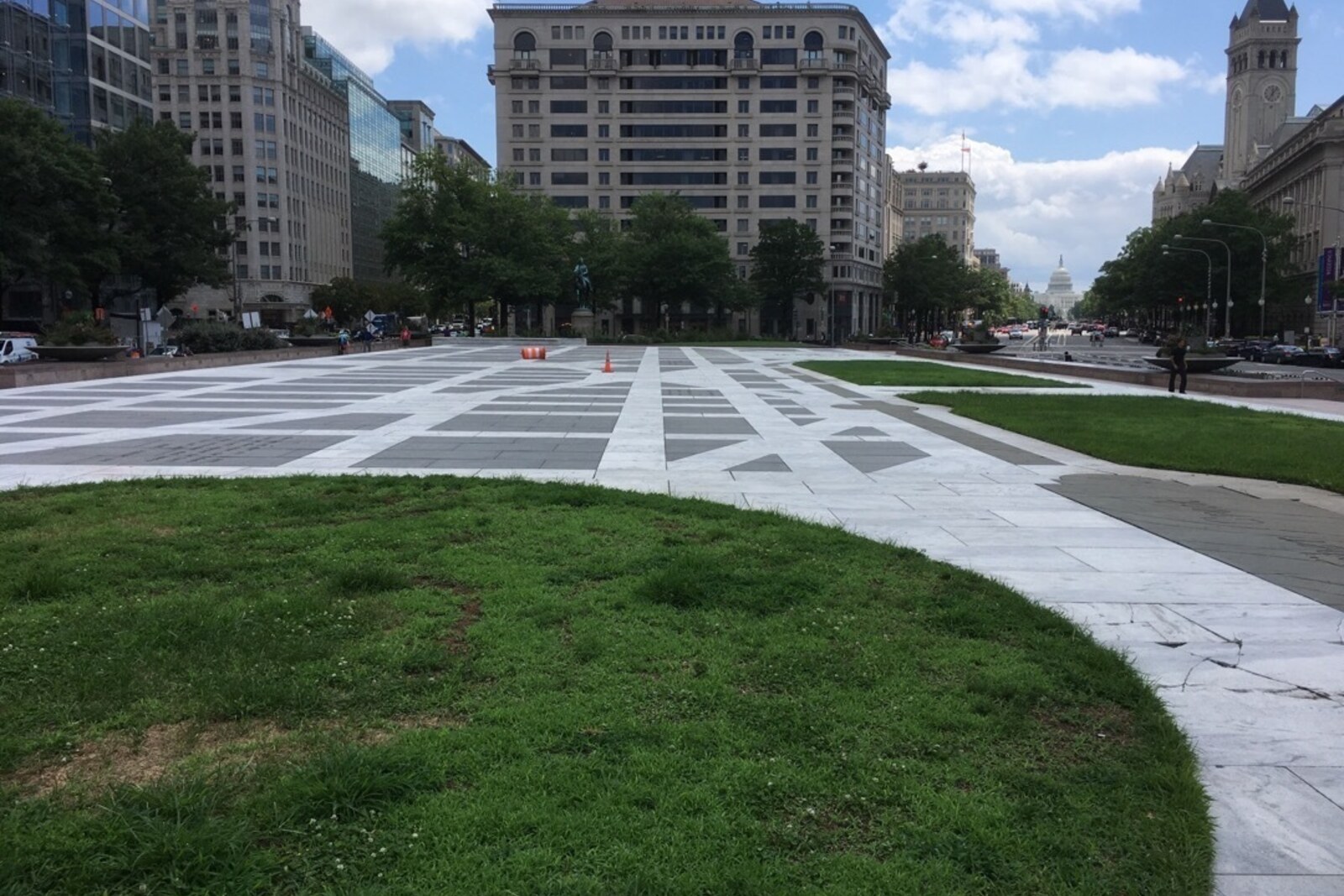
Look around first
What to notice
- Stone marker for the capsule
- Dark and light granite slabs
- Brass outlines of buildings
- Granite map of Washington
The story of the place
The light and dark granite slabs beneath your feet form a huge fragment of the city plan drawn by Pierre L'Enfant in seventeen ninety-one. Brass outlines of the White House and the United States Capitol run between them, and the entire design is set directly into the paving. The plaza's name is connected with the struggle for civil rights, and the Willard Hotel stands at its northwestern edge.
In January nineteen eighty-eight, this site was still called West Plaza. A crane was brought up to it, and an aluminum capsule weighing almost a quarter of a ton was lowered beneath the stone slabs. It was ordered to be opened a hundred years later. Coretta Scott King, the widow of the assassinated civil rights activist Martin Luther King Jr., watched the burial. Their son Dexter and King's sister, Christine, stood nearby.
King himself never spoke here: the present plaza did not exist during his lifetime. The reason this place was chosen stands at its northwestern corner—the Willard Hotel.
On the evening of August twenty-seventh, nineteen sixty-three, King gathered his advisers there. The thirty-four-year-old Baptist pastor and leader of the movement against racial segregation was to conclude the March on Washington for Jobs and Freedom the next day. A quarter million participants were expected before him; all three national television networks were preparing live broadcasts. The organizers were seeking a federal law that would ban segregation and discrimination.
The advisers proposed different speeches. Clarence Jones, a lawyer and speechwriter, brought a comparison with an unpaid check: rights had been promised by the Constitution of the United States, yet Black citizens still could not collect what was due to them on it. Wyatt Walker, King's chief of staff, urged him to drop the words about a dream—the pastor had already used them in earlier speeches, and Walker considered the device exhausted.
King left the hotel lobby for his room and worked until three thirty in the morning. The text printed for the press contained no refrain of “I have a dream.” The next day, at the Lincoln Memorial, King first followed the manuscript, then set it aside and returned to the images Walker had advised him to remove. It was this part of the speech that people remembered best.
The march was one of the events that intensified pressure for a new law. In July nineteen sixty-four, United States Congress passed the Civil Rights Act of 1964: segregation in public places and discrimination in hiring were declared illegal.
A quarter century later, a federal commission established to celebrate King's birthday decided to leave objects from his own life underground. The capsule contained a Bible, a pastoral robe from Ebenezer Baptist Church, a draft of his Nobel Peace Prize acceptance speech, and audio recordings of speeches. Before the burial, the capsule was taken through forty states and one hundred cities. Those who wished paid one dollar to have their names laser-engraved on a miniature Liberty Bell, which also went underground.
Three months later, on April twenty-second, nineteen eighty-eight, West Plaza was renamed Freedom Plaza in honor of Martin Luther King Jr.'s achievements. The capsule's location was marked by an inscription in stone. Around it, dark and light granite form a huge fragment of the plan of Washington drawn by Pierre L'Enfant in seventeen ninety-one; brass outlines mark the White House and the United States Capitol. Beneath this plan remain the Bible, the robe, and King's voice. The capsule is to be raised on January fifteenth, twenty eighty-eight.
Useful on site
Open plaza; access changes during rallies, festivals, work, and security closures.
Checked: June 30, 2026. Check the official source before visiting.To make out the map, step back from its edge and walk along the design, comparing its lines with the surrounding streets. The plaza is open, so it is more convenient to listen away from the steady flow of pedestrians.