 Guide On Map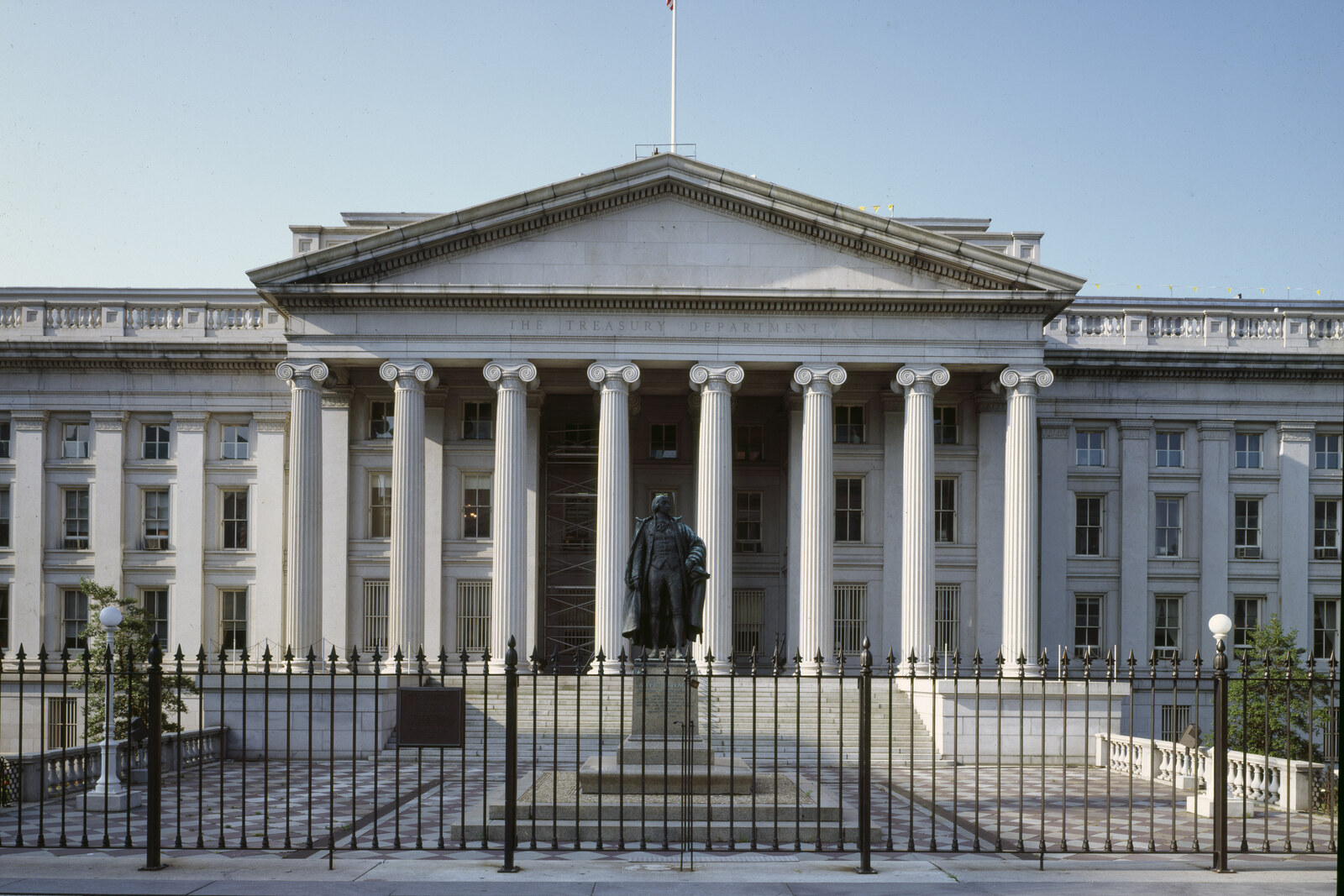
Look around first
What to notice
- Granite colonnade
- Main building
- Windows behind the colonnade
The story of the place
Behind a row of granite columns is the United States Department of the Treasury, where its employees keep public accounts, manage the federal debt, and prepare financial decisions. Before it, a low two-story brick building stood on this site; its rooms held financial ledgers, receipts, and signed sheets, and some clerks and guards stayed overnight. By decision of the United States Congress, the current granite complex was built as a fireproof replacement from eighteen thirty-six to eighteen sixty-nine.
On the evening of March thirtieth, eighteen thirty-three, brothers Richard and Henry White set out from Washington in a single two-wheeled carriage. The following morning, they reached Baltimore. The Treasury Building caught fire during the preceding night.
Richard was a clerk and lived on the wages he earned handling papers. Now the papers threatened him: according to the prosecution, pension records could expose the clerk's fraud involving payments to military personnel. Destroying the evidence was possible only here, because public accounts then existed primarily as ledgers, receipts, and signed sheets stored in government rooms.
The former Treasury Building stood on this site—a two-story brick building rebuilt after the British fire. Officials worked inside, financial documents were stored there, and some clerks and guards even stayed overnight. The fire destroyed nearly the entire building. Employees and volunteers carried out some of the papers; only a small fireproof storage room remained standing. The other documents burned, and the United States Department of the Treasury had to move into rented premises on Pennsylvania Avenue.
The investigation linked the arson to both brothers. At trial, the question was whether they could have returned to the building unnoticed after leaving; one witness claimed that Richard had confessed to the arson, but the court did not allow that confession to be repeated before the jury in Henry's trial. Deliberately destroying a government building carried a penalty of up to ten years' imprisonment at hard labor.
The indictment was brought on March thirtieth, eighteen thirty-six—exactly three years after the fire. At the time, federal law allowed two years for such a prosecution, provided the defendant was not evading justice. Richard's jury could not agree: one juror believed him guilty but refused to vote for a guilty verdict because the time limit had expired. Richard was left without a verdict.
Henry was tried separately. His jury decided that the flight from Washington had stopped the limitations clock, found Henry guilty, and the court sentenced him to seven years' imprisonment at hard labor. The brothers' one trip to Baltimore spared one of them a verdict and became evidence against the other.
After the fire, the United States Congress ordered a new, fireproof Treasury Building to be built on the same site. Work began in eighteen thirty-six; construction of the granite complex continued until eighteen sixty-nine. It is now the headquarters of the United States Department of the Treasury: its employees keep public accounts, manage the federal debt, and prepare financial decisions. Banknotes ceased to be printed in the main building in eighteen eighty.
No charred wall remains from the Whites' night. The former building disappeared along with part of its archives; a fireproof replacement stands on its site, behind whose granite colonnade federal accounts are still reconciled.
Useful on site
The façades are accessible from the street when sidewalks are open. Free tours inside usually take place on the first and third Saturday of the month at 9:00 and 10:30, only by advance request through a congressman's office and only for United States citizens and lawful permanent residents.
Checked: June 30, 2026. Check the official source before visiting.The story can be read from the exterior; a tour of the administrative building should be considered a separate visit. Do not linger at controlled entrances and driveways.