 Guide On Map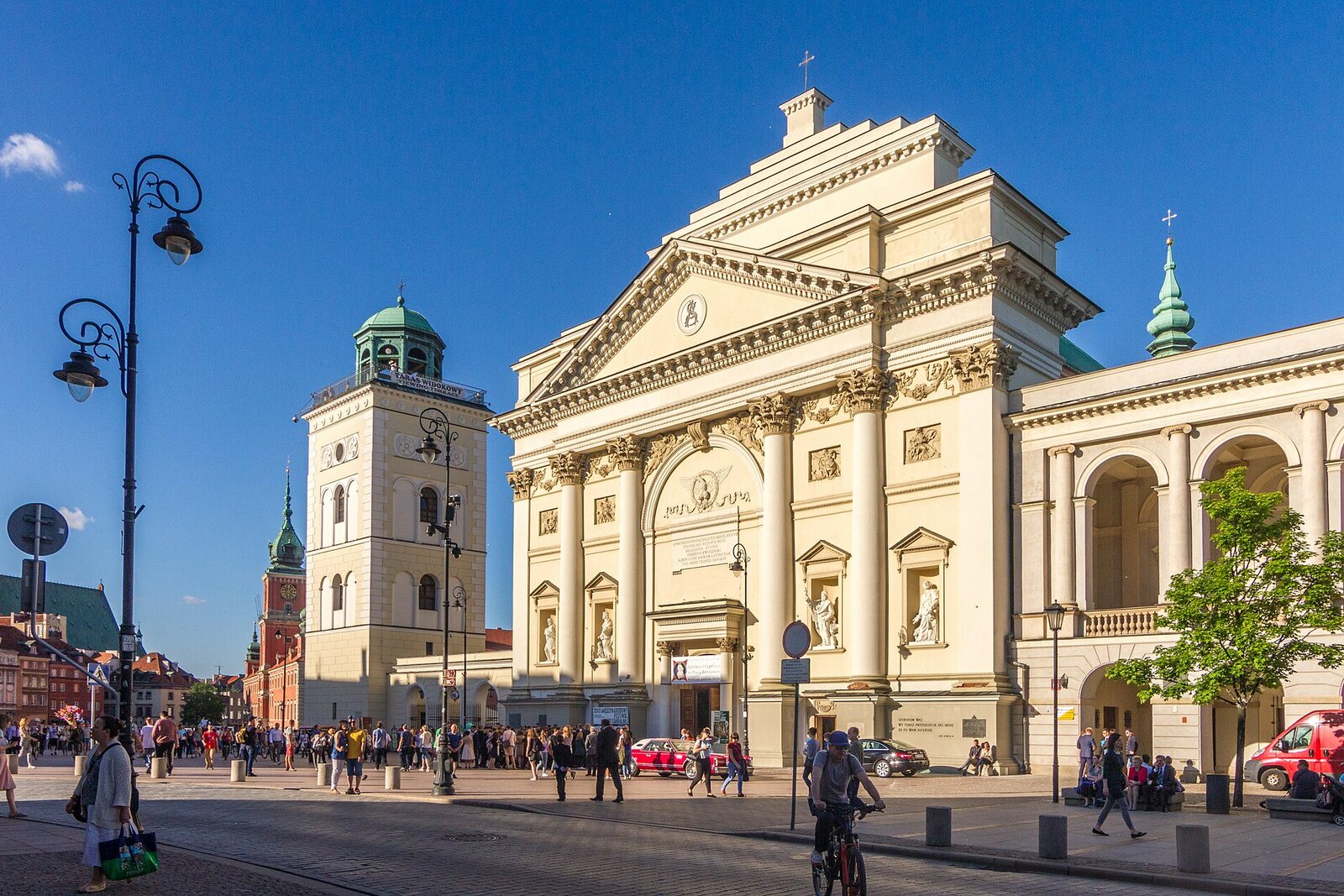
Look around first
What to notice
- The wooden group of St. Anne, Mary, and the infant Christ
- The altar section above the W-Z Route
- Surveying control markers
The story of the place
Krakowskie Przedmieście grew out of a road that began beyond the gates of Warsaw Old Town. At first, travelers took it to the ducal castle in Czersk; later, they continued farther south, to royal Kraków. This is where its present name comes from: it was the suburb by the Kraków road.
In fourteen fifty-four, Duchess Anna of Halshany, the widow of the Mazovian Duke Bolesław, invited strict-observance Franciscans here from Kraków. In Poland, they were called Bernardines. The duchess gave the monks a plot beyond the city wall and paid for the construction, even through her will. The first church was dedicated to St. Bernardino.
After the fire of fifteen fifteen, a new, more spacious church was financed by another Mazovian duchess, Anna—the regent Anna Radziwiłł. During her regency, the church received a second dedication, to St. Anne, whom Christian tradition calls the mother of the Virgin Mary. The saint's name gradually displaced the earlier one; a wooden group of Anne, Mary, and the infant Christ now stands in the vestibule to the right of the entrance.
The builders of the first church knew they had chosen a dangerous site. The altar section stands at the very edge of the high bank of the Vistula River. Beneath its walls, they laid three, and in places four, layers of large boulders so that the building would not slide downhill. These medieval foundations held for almost five centuries. In the spring of nineteen forty-nine, a new road nearly destroyed them.
In postwar Warsaw, the W-Z Route was being built to connect Wola with Praga. Near Warsaw Old Town, road workers removed an enormous mass of earth and ran the roadway beneath the square and streets. The slope by the church was left without sufficient support. Water saturated the sand lying above a sloping layer of clay, and the sandy mass began to slide toward the excavation.
Cracks ran through the walls and vaults all the way to the foundations. The altar section, the northeastern corner, and a side chapel were already moving downward. According to the commission's calculations, without urgent intervention, the collapse could have been only ten to fourteen days away. By then, the church had been restored after two fires during the war years and the fall of the gable during a hurricane. Now it could perish because of construction begun amid that restoration.
The rescue work was led by Wacław Żenczykowski, a professor at the Warsaw University of Technology and a structural engineer: he had to hold the centuries-old walls above an operating excavation. The hydraulic engineer Romuald Cebertowicz had to stop the water inside the slope. The surveyor Tadeusz Lazzarini was responsible for something else: using precise measurements, he determined whether the church was still moving while the others worked beneath it.
Żenczykowski ordered the foundations to be encased in a reinforced-concrete belt, the ground to be strengthened with reinforced-concrete columns, and concrete buttresses to be installed on the excavation side. Here, Cebertowicz used his electro-osmotic system for the first time in Poland. Metal electrodes were driven into the slope and connected to direct current. Water began moving through the ground toward drilled wells; at the same time, substances that bound its particles were introduced into the sand. Within a few days, the movement slowed, and in less than two months, the landslide was stopped.
The route opened, and the church continued to serve as an academic church—a status it had received as early as nineteen twenty-eight. Lazzarini's team did not finish its work along with the construction: his students and successors continued observing the building. Surveyors still measure the elevation of control markers, the position of the tower, and the width of cracks in the walls and vaults.
The W-Z Route runs beneath the slope. Above it stand the altar section of St. Anne's Church and the old walls, held by the reinforced-concrete belt, columns, and soil from which the engineers diverted the water.
Useful on site
Open urban space; choose a viewing point that does not obstruct pedestrian traffic.
Checked: date not specified. Check the official source before visiting.You can listen to the entire account from the street. If you enter the active church, turn off the sound and do not look around during a service; treat the climb up the bell tower as a separate visit.