 Guide On Map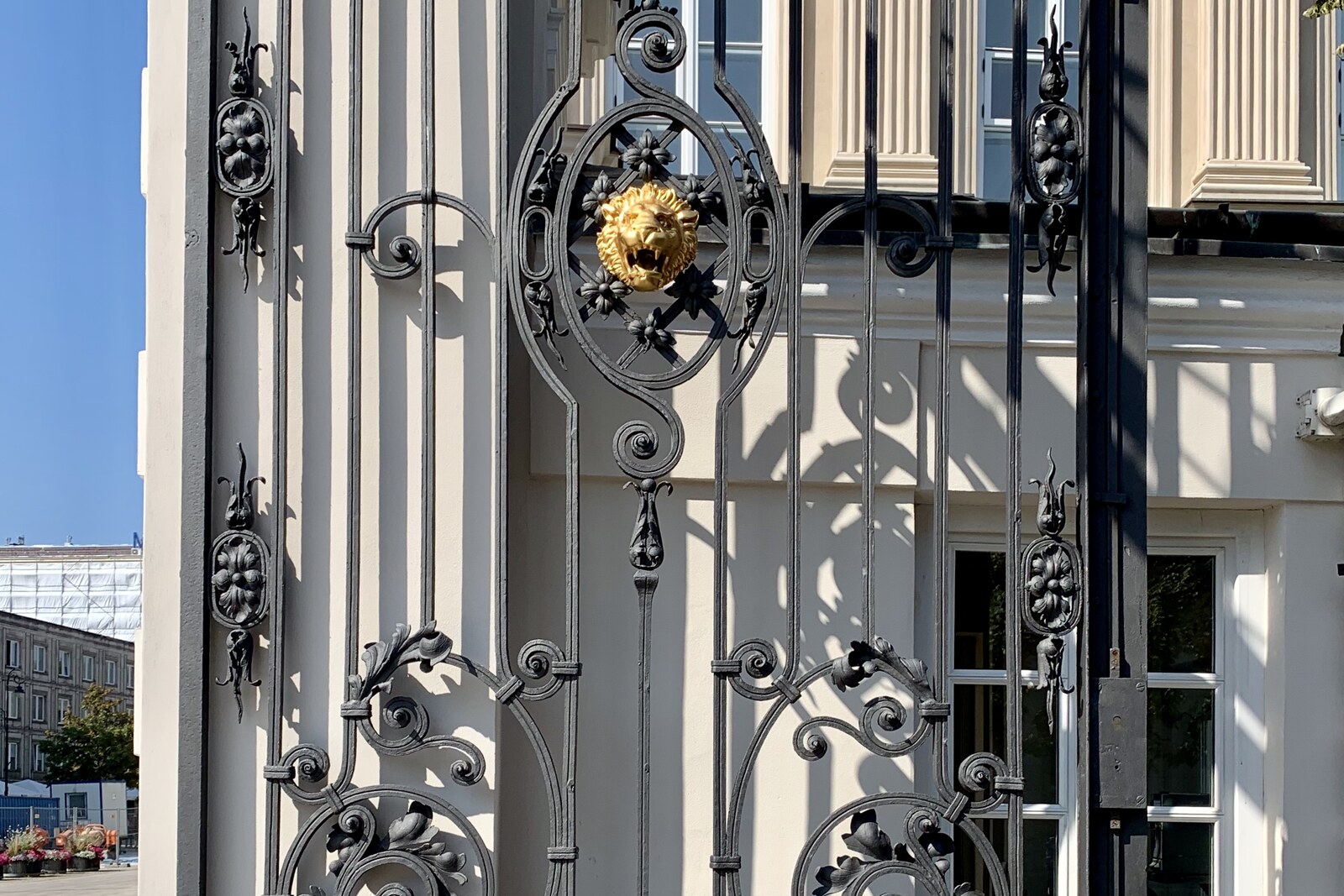
Look around first
What to notice
- The eagle with palm and laurel branches
- Five stars around the eagle
- The figures of Athena and Urania
- The Krybar Group plaque
The story of the place
The Main Gate of the University of Warsaw faces Krakowskie Przedmieście; behind the grille begins the campus on the high edge above Powiśle. Athena and Urania stand beside the entrance, reinstalled in the early nineteen eighties from an enlarged old photograph. Their prewar figures were shattered by bullets, which left them without arms and heads.
The three passageways between the stone pylons appeared here in nineteen ten to nineteen eleven. The university council ordered the former iron gates moved from deep inside the courtyard to Krakowskie Przedmieście, and commissioned the architect Stefan Szyller to create a new ceremonial entrance. The eagle above the grille holds palm and laurel branches, while the five stars around it represent the university's first five faculties.
In the summer of nineteen forty-four, this entrance was locked by a German garrison. The University of Warsaw stands on the upper edge of the Warsaw Escarpment; from here, soldiers could fire on Powiśle and control the streets near the city power station. They built a concrete bunker in front of the gate, surrounded the campus with double rows of barbed wire, and reinforced the garrison with about two hundred soldiers.
A Home Army combat group commanded by Captain Cyprian Odorkiewicz attempted to capture this position. Krybar was his underground pseudonym, formed from the names of his two daughters; the entire detachment came to be called the same. After the unsuccessful first assault, Odorkiewicz needed a vehicle capable of bringing fighters to the Main Gate of the University of Warsaw under fire.
It was assembled in thirteen days on the chassis of a Chevrolet truck. The work was led by Józef Fernik, known as Globus. Before the war, he earned his living as a master of the mechanical workshop at the State Aviation Works in Okęcie, so he knew how to fit a steel body onto a vehicle without ready-made plans or factory equipment. Shortly before this, his wife, the doctor Małgorzata Fernik, had tried to escape from a burning house in Mariensztat and died. Fernik named the armored vehicle Kubuś after her underground name. Assault fighters, who were to pass through these very gates, were meant to ride beneath its double sheets of steel.
At four in the morning on August twenty-third, Kubuś and the captured German armored personnel carrier Jaś reached the university. The armored group was commanded by officer cadet Adam Dewicz, known as Szary Wilk—Gray Wolf; he had to lead both vehicles into the courtyard while the infantry attacked the campus from the other side.
Sappers fixed charges to the grille. The explosion broke the bars, but the gate leaves did not swing open. They then fired at the upper hinge, and the infantrymen made their way inside, captured the bunker, and reached the area in front of the Old Library. The armored vehicles remained at the entrance. The delay gave the German soldiers time to take up positions in the university buildings and open crossfire.
A counterattack began forty minutes later. Dewicz and the gunner of his armored personnel carrier were killed, and most of the remaining crew members were wounded. During the retreat, Kubuś's engine stalled at the gate; about a minute later, the driver managed to start it again and drove the vehicle out onto Krakowskie Przedmieście. The garrison held the campus.
After returning, the insurgents renamed Jaś Szary Wilk, after the pseudonym of the fallen commander. On September second, both vehicles attacked the university again, but this assault also ended in retreat. Four days later, the fighters left Powiśle and disabled Kubuś so that the enemy could not use it. After the war, the armored vehicle was found and transferred to a museum.
The figures of Athena and Urania installed here before the war were shattered by bullets and lost their heads and arms. The present statues were restored in the early nineteen eighties from an enlarged old photograph. The concrete bunker in front of the gate is no longer there. Near the central passageway hangs a plaque bearing the name of the Krybar Group and the dates of the university's three assaults.
Useful on site
Open urban space; choose a viewing point that does not obstruct pedestrian traffic.
Checked: date not specified. Check the official source before visiting.This is an active campus entrance: do not block the gate or obstruct students. Even without access to the courtyard, the stop's key signs are visible from the street.