 Guide On Map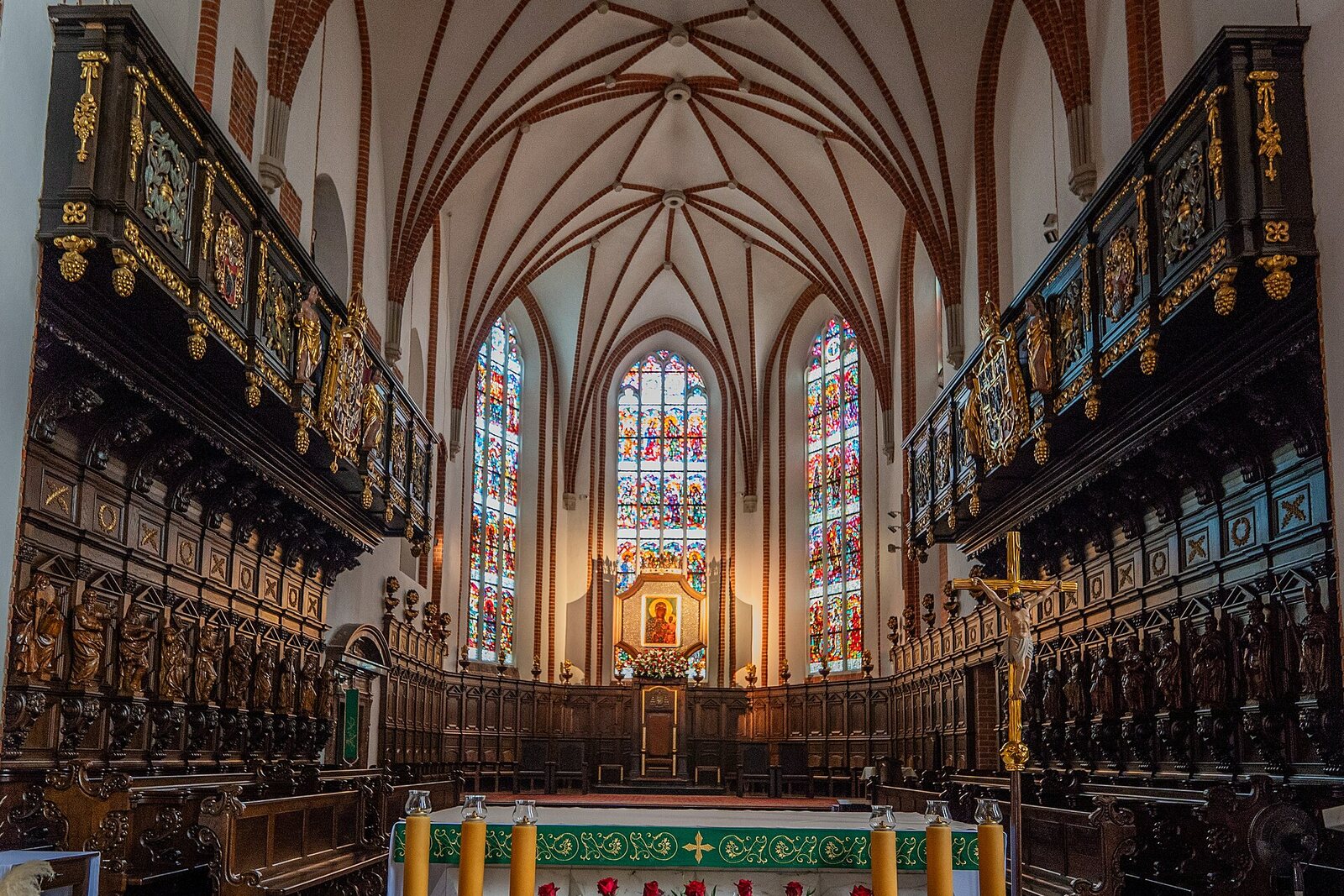
Look around first
What to notice
- Baryczka Crucifix
- Baryczka Chapel
The story of the place
Beside the residence of the Dukes of Masovia, and later next to the Royal Castle, stood the main parish church of medieval Warsaw. Royal services and state ceremonies were held here, and later the church became the principal one for the Archbishop of Warsaw. In the left side section hangs the late-Gothic Baryczka Crucifix, returned to its chapel after the war.
On August sixteenth, nineteen forty-four, twenty-one-year-old Barbara Piotrowska was on duty near the cathedral. Before the uprising, she had secretly studied architecture and earned money by giving lessons, drafting projects, and knitting for sale. Barbara now served as a medic with the Wigry Battalion of the Home Army: she dressed the wounded in the hospital and went out every other day to positions set up right inside the church.
During the morning shelling, the cathedral caught fire. In Baryczka Chapel, Barbara and the medic Teresa Potulicka saw the insurgent chaplain Wacław Karłowicz. The priest stood on the altar and tried to take down a large wooden crucifix. The young women received the heavy figure of Christ onto their outstretched arms and carried it out to Jesuit Street, which was under fire. In the nearest gateway, Karłowicz detached the outstretched arms from the torso: the sculpture was too difficult to carry whole across the barricades. Later, it was taken to the underground insurgent hospital at St. Hyacinth's Church.
The saved figure is called the Baryczka Crucifix. In fifteen twenty-five, Jerzy Baryczka, a wealthy Warsaw merchant and member of the city council, brought it from Nuremberg and gave it to the local church. According to an old tradition, Baryczka pulled the crucifix from a fire prepared by Protestants for Catholic images. Researchers consider this version a legend: church sculpture was not destroyed in this way in Nuremberg at the time, and the merchant most likely acquired it through ordinary means. The rescue of the crucifix in August nineteen forty-four, however, is confirmed by the accounts of the participants themselves.
By then, the figure had been venerated here for four centuries. That is why three people risked their lives for an object from a burning building: for parishioners, it was a revered sacred object, before which they left votive offerings and military decorations.
The church itself grew out of the parish church of medieval Warsaw, beside the residence of the Dukes of Masovia and later beside the Royal Castle. Royal services were later held here, along with state ceremonies. In eighteen seventeen, the church was granted the rank of archcathedral—the principal church of the Archbishop of Warsaw. That is why parish Masses and the principal services of the Archdiocese of Warsaw are still celebrated here today.
The church's full dedication is the Martyrdom of St. John the Baptist. John was a preacher who baptized Jesus; according to the Gospels, Herod Antipas, ruler of Galilee, ordered him beheaded after John condemned Herod's marriage to his brother's wife. As early as documents from thirteen thirty-nine, the local parish church was named after the Beheading of St. John the Baptist.
Barbara and Teresa survived the Warsaw Uprising, the camp in Pruszków, and forced labor; they escaped and returned to Warsaw. Barbara graduated from the architecture department and worked at the Bureau for the Reconstruction of the Capital. The destroyed archcathedral was rebuilt after the war, and the crucifix was returned to Baryczka Chapel in nineteen forty-eight. In twenty twenty, after another restoration of the figure, the almost ninety-eight-year-old Barbara again walked alongside it and supported the cross on the final stretch of its journey to the cathedral.
In the left side section of the archcathedral now hangs that same late-Gothic figure, which three people carried out of here with its arms detached.
Useful on site
Open urban space; choose a viewing spot that does not obstruct pedestrian flow.
Checked: date not specified. Check the official source before visiting.From outside, you can see the postwar choice in favor of Masovian Gothic. When entering, keep services in mind, remain quiet, and do not expect unrestricted viewing of every part of the church.