 Guide On Map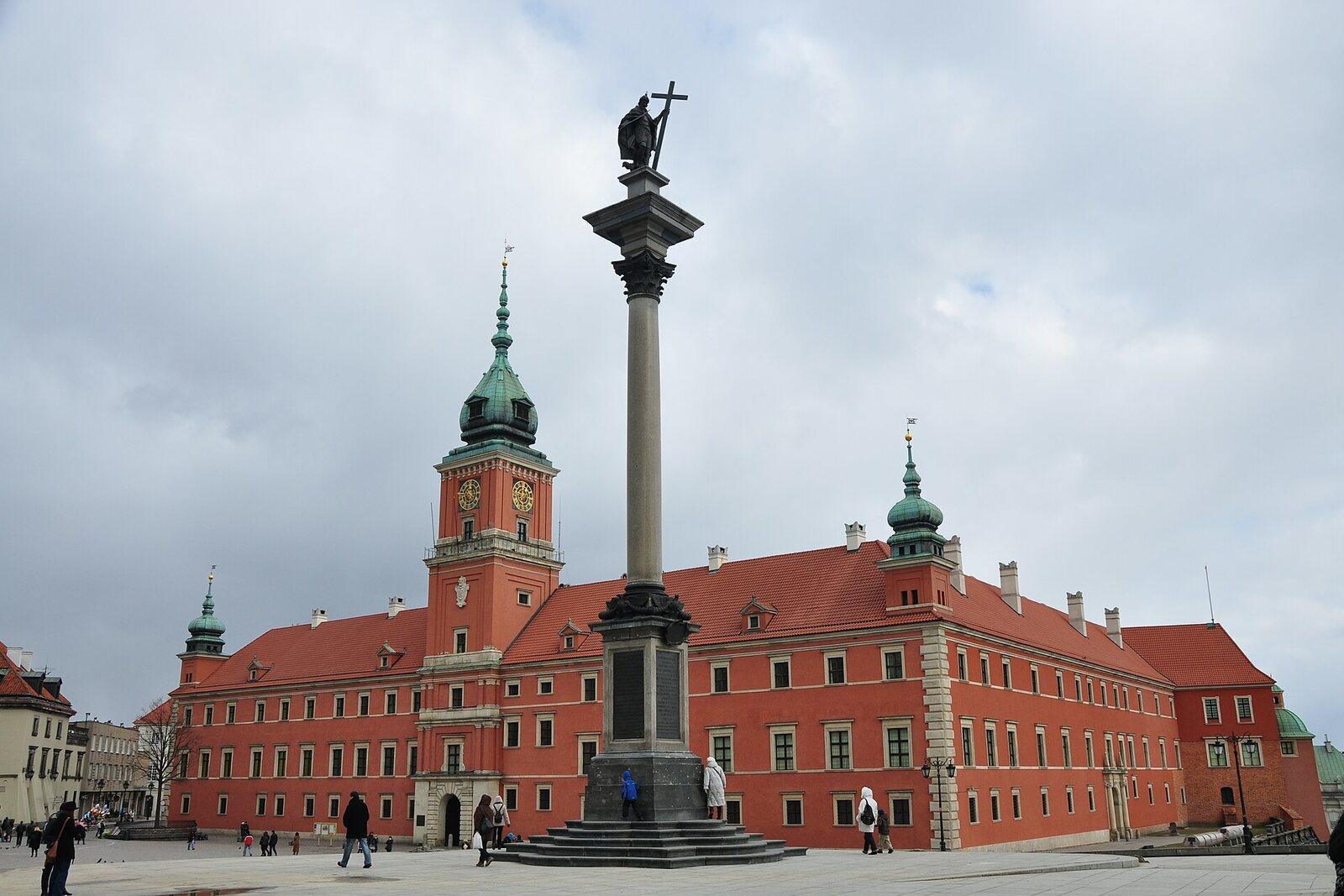
Look around first
What to notice
- Two strips of red brick in the paving
- A sandstone plaque on John House
- The square’s open triangle
The story of the place
The red brick strips set into the paving repeat the lines of the vanished city walls and Kraków Gate. Until the beginning of the nineteenth century, the route to the Royal Castle in Warsaw was hemmed in by residential houses, a pharmacy, a stable, and a carriage shed. The tsarist administration ordered these buildings removed so that a broad ceremonial approach could appear before the residence; this is how the open triangle of today’s Castle Square took shape.
On April eighth, eighteen sixty-one, seventeen-year-old Michał Landy came here with a procession of Poles and Jews. The son of a Warsaw timber merchant, he attended both a Realschule and the Warsaw Rabbinical School at the same time. The participants demanded an end to tsarist repression and the return of the townspeople’s ability to maintain order in Warsaw themselves.
Six weeks earlier, soldiers had already fired on demonstrators here and killed five people. Afterward, merchants, doctors, priests, and representatives of other urban estates formed the City Delegation. Fourteen delegates secured the withdrawal of troops from the streets, released some prisoners, and appointed their own constables. For a time, the townspeople managed without the tsarist police. The administration then dissolved the delegation and the Agricultural Society, a major legal Polish organization.
On the night of April seventh to eighth, the head of the civil administration, Aleksander Wielopolski, hoping to end street gatherings, presented a new law to the viceroy, Mikhail Gorchakov. It allowed weapons to be used against civilian crowds. That morning, Warsaw residents were burying a former Siberian exile. After the funeral, part of the procession headed to the viceroy’s residence in the Royal Castle in Warsaw, with more people joining it along the way.
The layout of the square proved decisive for just such a confrontation. Until the beginning of the nineteenth century, there was no open triangle in front of the castle here. Between the residence and the city stood Kraków Gate, walls, residential houses, a pharmacy, a stable, and a carriage shed. Between eighteen eighteen and eighteen twenty-one, the architect Jakub Kubicki demolished these buildings by order of the tsarist administration. This created a ceremonial approach to the castle, from which the square received its present name. Two strips of red brick in the paving mark the lines of the vanished gate and wall.
When the procession filled the cleared space in front of the viceroy’s residence, the soldiers opened fire. Dozens of people were killed. Landy walked at the front carrying a cross. According to the best-known account, he picked it up after soldiers wounded a Catholic monk. The Museum of Warsaw cautions that the accounts differ: other eyewitnesses named Karol Nowakowski, a participant in the procession, as the previous bearer of the cross.
Landy received a fatal wound. He was carried into a pharmacy, and then his father took his son to St. Roch Hospital. The young man died the next day. He was buried at night from April tenth to eleventh in the Jewish cemetery; police ensured that only close relatives were allowed to the grave and that the funeral did not turn into another procession. The shooting of the peaceful demonstration became one of the events after which the Polish underground began preparing the armed January Uprising against the Russian Empire.
In two thousand eighteen, a sandstone plaque was installed on the facade of the corner John House, where the square opens onto Krakowskie Przedmieście. It names Michał Landy, both his schools, and April eighth, eighteen sixty-one. The plaque hangs near the edge of the square where the schoolboy was carried out from under fire.
Useful on site
Open urban space; choose a viewing point that does not obstruct pedestrian traffic.
Checked: date not specified. Check the official source before visiting.All the main details are visible from the square without a ticket. Step back to the edge of the space to take in the column, its old fragments, and the castle facade at the same time.