 Guide On Map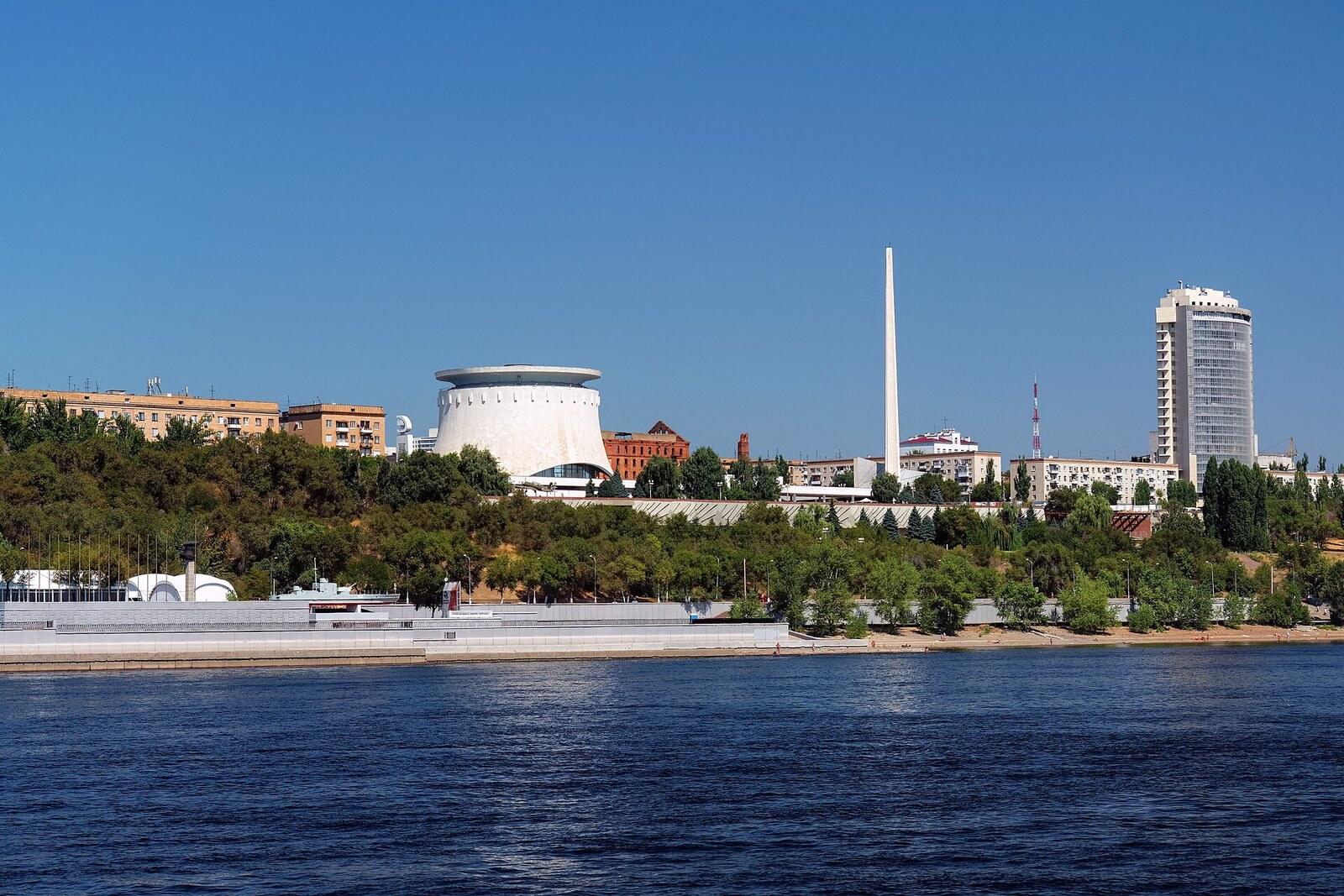
Look around first
What to notice
- The white rotunda
- The panorama's circular canvas
- Water tanks on the canvas
- The viewing platform
The story of the place
Inside the white rotunda by the Volga is a circular panorama of the Battle of Stalingrad. From the viewing platform, the visitor is surrounded by a linen canvas sixteen meters high and one hundred twenty meters long; the viewpoint has been moved to Mamayev Kurgan, although the museum stands on the riverbank. On the canvas, water tanks, a command post, snipers among the ruins, and a column of prisoners stand side by side: the artists deliberately brought together in one circle episodes from different days and parts of the city.
The white rotunda stands where trams turned around after the war. The panorama was initially planned for Mamayev Kurgan, but in nineteen sixty-four the Council of Ministers of the Russian SFSR ordered it built here—beside the mill and Pavlov's House, on the site where Alexander Rodimtsev's division landed in September of nineteen forty-two. After the ferry crossing described on the embankment, the soldiers came up into this very part of the city. The museum was placed among the points of the bridgehead they created.
In the summer of nineteen eighty, the rotunda was still unfinished when a linen canvas weighing more than a ton was brought inside. It had to be lifted onto a circular frame and stretched without wrinkles: one hundred twenty meters of fabric were to close into a ring sixteen meters high. Georgy Marchenko—a front-line veteran, battle painter, and one of the authors of the future panorama—was responsible for the work.
During the war, Marchenko volunteered for antitank artillery. When he learned the outcome of the Battle of Stalingrad, he made himself a promise: if he returned, he would devote a major work to it. He began sketching the panorama as early as nineteen forty-eight. Thirty-two years later, the artist was seriously ill and constantly taking medication, but he came to Volgograd to supervise the installation of the canvas.
Fifty servicemen raised the canvas by hand with ropes. Several times, Marchenko made them lower the entire load and start over: he was not satisfied with the tension. When the fabric finally lay correctly on the frame, he wept. The artists then divided the surface into forty-eight sections, projected the prepared drawing onto them, and transferred the outlines to the canvas.
Marchenko painted the summit of Mamayev Kurgan: shattered water tanks, the observation post of a division commander, snipers among the ruins, and German soldiers marching into captivity. On February twentieth, nineteen eighty-one, he was waiting beside his painting at the Volgograd Museum of Fine Arts for workers to whom he was to speak about the panorama. The artist turned pale, fell, and died of a massive heart attack. Almost a year and a half remained before the opening.
The team completed the canvas in the spring of nineteen eighty-two. In the opening brochure, Marchenko's surname was printed in a black mourning border, and the section he painted was left in the overall ring.
From the platform inside the rotunda, you can see the battle of January twenty-sixth, nineteen forty-three, when the 21st Army and the 62nd Army met on the slope of Mamayev Kurgan, cutting the encircled German force in two. At the same time, the artists deliberately combined on one canvas episodes that took place on different days and in different parts of Stalingrad. The panorama does not present itself as a snapshot of a single minute: it is an account of the entire battle assembled by its authors.
The museum itself stands by the Volga, while the notional viewpoint inside has been moved to Mamayev Kurgan. Among the painted water tanks, observation post, and prisoners, a fragment by Georgy Marchenko remains—on the very canvas he made the soldiers lift again and again.
Useful on site
Summer schedule 2026: Mon–Thu and Sun 10:00–18:00, Fri–Sat 10:00–20:00; the ticket office closes 30 minutes earlier. After August 31, check the regular schedule.
Checked: June 24, 2026. Check the official source before visiting.Allow separate time for the indoor exhibition; if you do not go inside, focus on the building and the outdoor objects.