 Guide On Map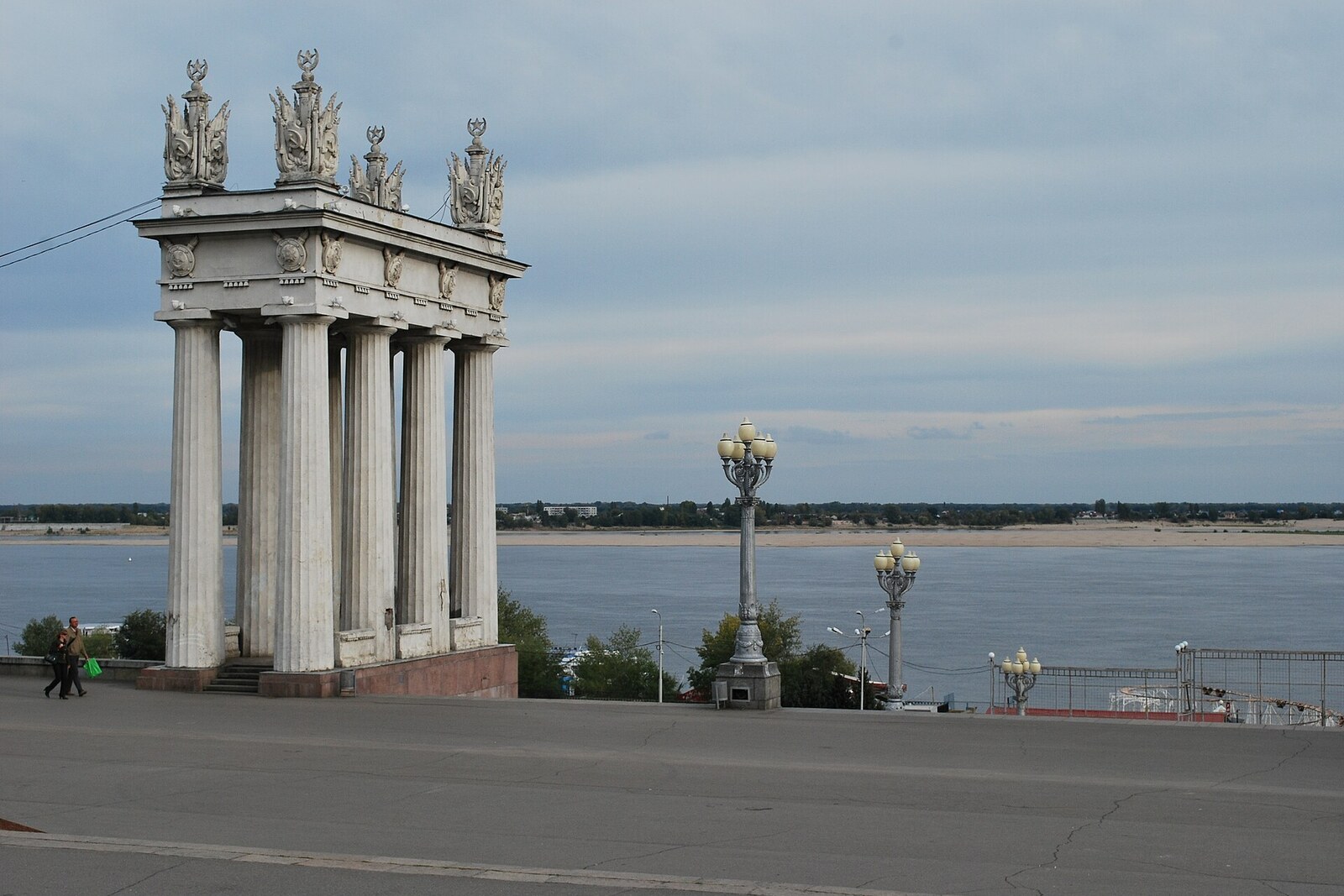
Look around first
What to notice
- Eight-column propylaea
- Granite staircase
- Shield panels with orders and crossed torches
- Volga
The story of the place
A broad granite staircase leads down to the Volga here, and its descent is marked by two white pavilions, each with eight columns. The shore acquired this appearance after the war, when an embankment was laid out above the former Central Ferry Crossing. Vessels once came in here, and a brewery operated nearby; neither the landing piers nor the brewery has survived. The embankment's name preserves the memory of the 62nd Army, whose units depended on the Volga crossings.
On September fourteenth, nineteen forty-two, Ivan Petrakov held a patch of shoreline by the Volga on which the Central Ferry Crossing depended. Petrakov headed a department of the regional directorate of the People's Commissariat for Internal Affairs, an agency for state security and internal affairs. He now commanded a composite detachment of directorate personnel, police officers, and firefighters. His task came down to a few hours: to prevent German assault groups from taking the landing piers before dark.
Across the Volga lay the rear area of Vasily Chuikov's 62nd Army, which was defending Stalingrad. Men, ammunition, and food were brought from there, and the wounded were evacuated there. There was no bridge. When German units occupied the railway station, the State Bank, and other buildings above the shore, they came to within about one hundred fifty meters of the crossing. Observers on the upper floors directed fire at the vessels. If Petrakov's detachment had been pushed back to the water, there would have been nowhere for reinforcements to land.
Petrakov led his men in a counterattack near the brewery. According to researchers, his detachment recaptured two Soviet guns previously seized by the enemy, turned them around, and opened fire on positions in the shoreline buildings. The shore remained in the defenders' hands.
Later, Petrakov recalled a conversation with a German captain who commanded an assault battalion that day. The captain intended to occupy the strip along the shore in the morning. He believed that the guns positioned near the brewery and the shelling of the Volga had already made a landing impossible. The counterattack by the small composite detachment upset that calculation. The time bought by the delay until morning was exactly enough for the purpose for which Petrakov held the shore.
On the eastern bank of the Volga, General Alexander Rodimtsev, commander of the fresh 13th Guards Rifle Division, was preparing to ferry his regiments across. The division had just been assigned to the 62nd Army; Rodimtsev was ordered to return the city center to Soviet forces and preserve the Central Ferry Crossing. First, he sent a rifle battalion and a company of submachine gunners in armored gunboats. They were to clear the landing site and cover the vessels that followed.
The crossing took two nights. Gunboats and barges that were spotted came under fire from the shore. On the morning of September fifteenth, a direct hit sank a gunboat carrying submachine gunners: sixty-six men died, and only a few managed to swim back. On another gunboat, Rodimtsev's headquarters crossed under mortar fire; the division engineer was wounded. The advance detachment that landed moved from the piers to the railway station and occupied it by the end of the day. The remaining units gained a stretch of shore where they could disembark. The German breakthrough to the Volga in the center was halted, and Rodimtsev's division held a strip here, in places only one hundred to five hundred meters deep, until the end of the battle.
The embankment bears the number of the formation in which these men fought. Chuikov's 62nd Army united the divisions and brigades defending the city and dependent on the Volga crossings. In nineteen seventy-five, the city council officially gave the Central Embankment the name of the 62nd Army.
The military landing piers and the brewery are no longer here. After the war, two white eight-column pavilions and a broad granite staircase were built above the site of the Central Ferry Crossing. Between them, the road again descends directly to the Volga—to the shore that Petrakov's detachment held until Rodimtsev's gunboats arrived.
Useful on site
Open around the clock as a city embankment; individual sections may be closed for work or events.
Checked: June 24, 2026. Check the official source before visiting.Descend as far as you are comfortable, then look across the river and imagine the route of the nighttime vessels.