 Guide On Map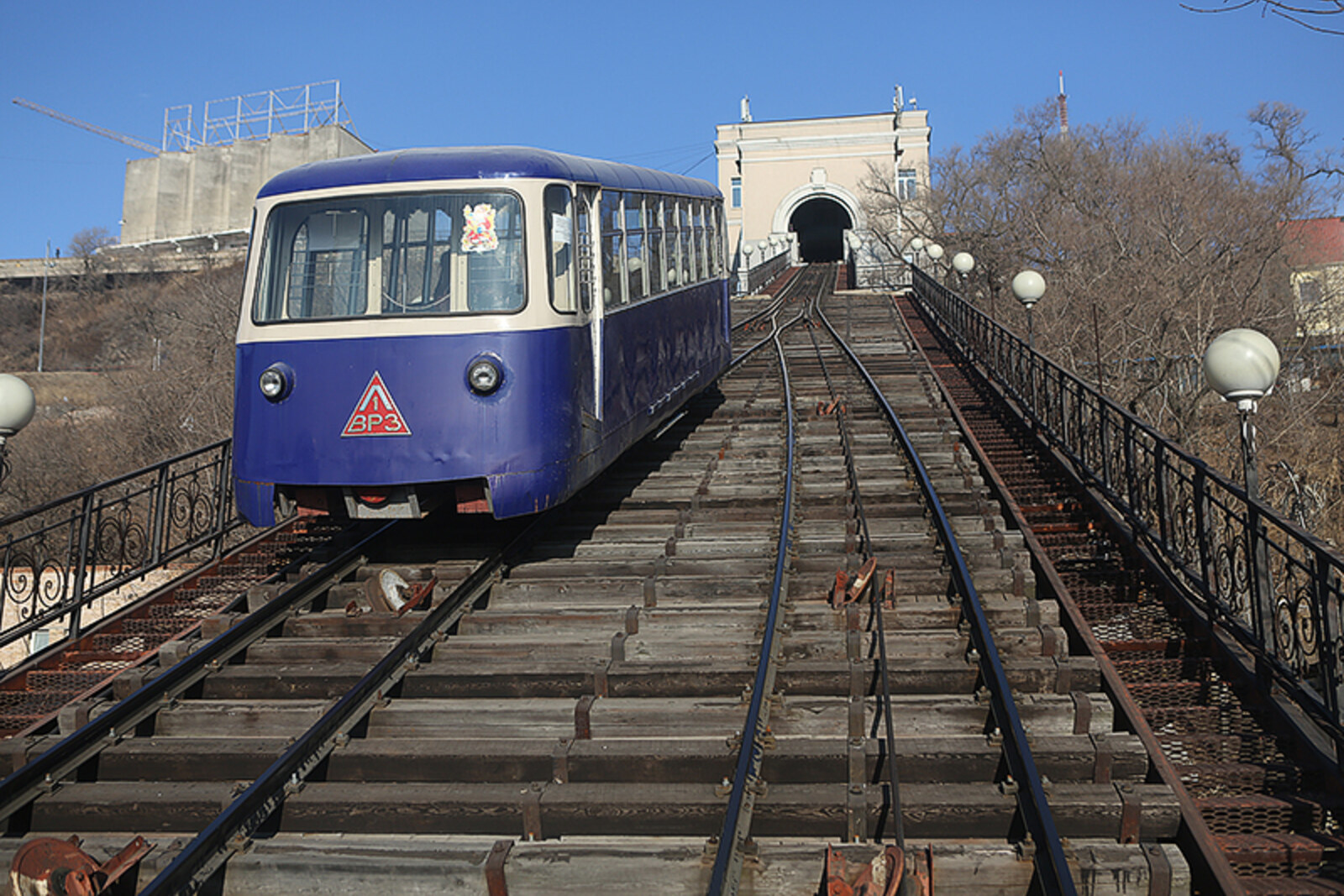
Look around first
What to notice
- Lower platform
- Car at the boarding area
- Cable and rail track
- Two-track passing section
The story of the place
At the site of the lower station, there was an excavation in nineteen fifty-nine, filling with groundwater and rain. Heavy machinery could not reach it because of the steep slope. Youth brigades laid the foundation and built the walls by hand—with shovels and picks, sometimes waist-deep in water and mud.
The route was being built between the buildings of the Far Eastern Polytechnic Institute. The main building stood below, on Pushkinskaya Street, while the other academic buildings were higher up the slope of Eagle's Nest. Students had to negotiate this difference in elevation by stairs. After visiting Vladivostok in nineteen fifty-four, Nikita Khrushchev, First Secretary of the Central Committee of the Communist Party, proposed building several funiculars in the city. City leaders chose two lines; this one was to be the first—a daily route to the institute.
The opening was promised for Vladivostok's centennial, in the summer of nineteen sixty. But Moscow designers delayed the working drawings, concrete and crushed stone were in short supply, and a cable crane made for the construction site stood without cables. Students completed practical training here. After their shifts, workers from the Metallist Plant and employees of the Far Eastern Shipping Company came here. Yet during one period, only ten to twenty builders remained on the site: they prepared the formwork for the lower station and waited two months for a truck crane. The anniversary deadline passed, while the excavation was still a construction site.
The first passengers were not admitted until May fifth, nineteen sixty-two. By three in the afternoon, hundreds of city residents had filled Pushkinskaya Street. Before departure, the mechanic Yuri Patrikey checked the brakes once again. The conductors Lyubov Sozinova and Galina Strizhak were responsible for boarding people into the cars for the first time. The operators Antonina Udodova and Klavdiya Nikitenko controlled the lifting mechanism from the upper station. When both conductors confirmed that they were ready, the operators released the brake and switched on the motor. One car set off uphill from Pushkinskaya Street, while the other simultaneously moved downhill from Sukhanova Street. They passed one another at the two-track passing section in the middle of the route. Two minutes later, the first run was over.
That is how this short route still operates today. At the lower platform, the conductor makes sure passengers have finished boarding and that no one is on the tracks, then gives clearance to the operator above. Bells and colored lamps once served this purpose: two signals from one car, three from the other. Later, workers switched to radio communication. The operator remains by the motor at the upper station; the operator cannot be seen from here. The two cars are connected by a cable and move only together—while one climbs, the other descends.
Beneath the floor of the lower station is the foundation that youth brigades and students dug by hand. Above it, boarding ends with the same action that began the first run: the conductor tells the upper station that the car at Pushkinskaya Street is ready to depart.
Useful on site
The mapped route passes the lower station and continues on foot; a ride in the car is not part of this line. Stay off the funicular tracks.