 Guide On Map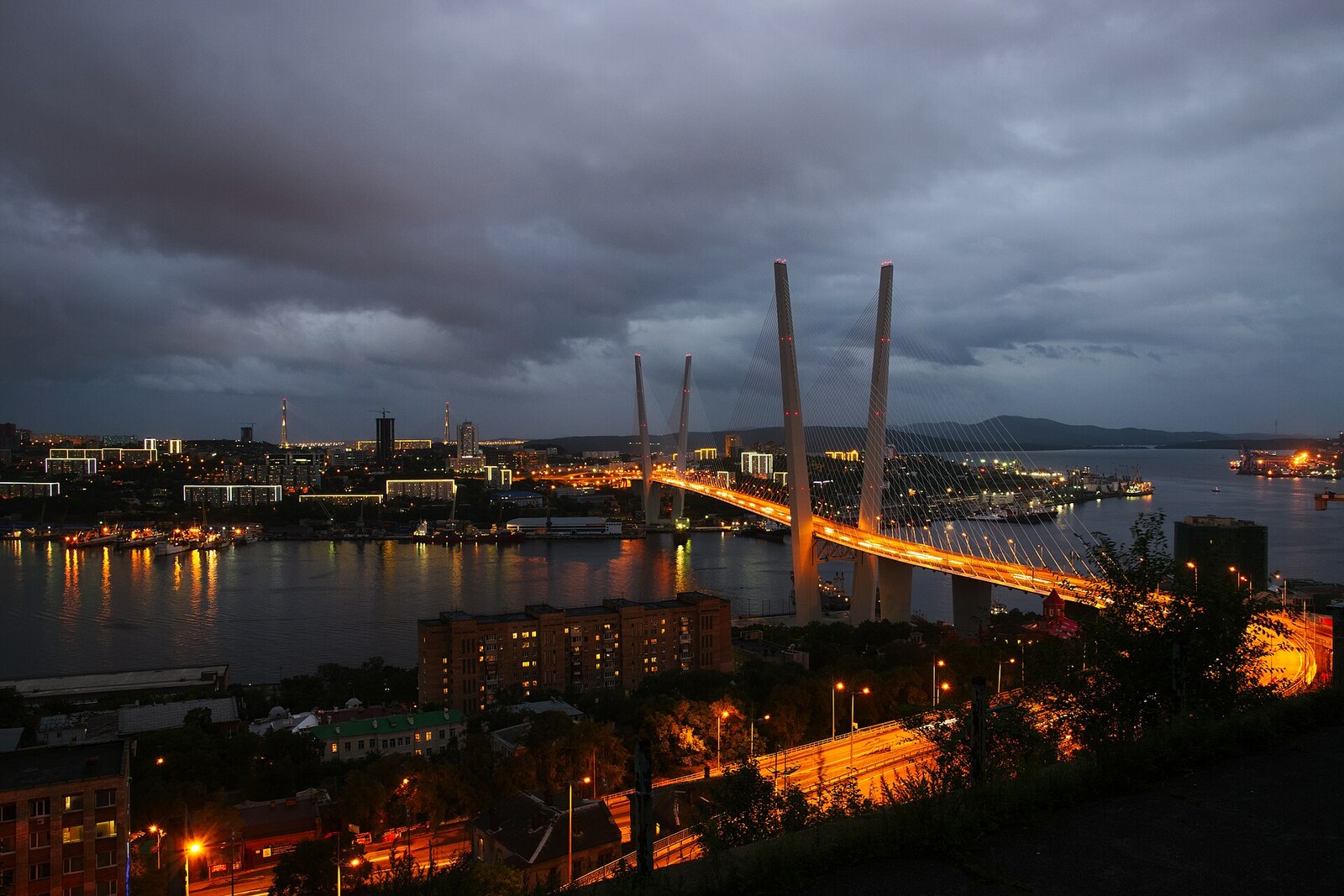
Look around first
What to notice
- Golden Horn Bay
- Port piers
- City hills
The story of the place
Eagle's Nest rises nearly two hundred meters above historic Vladivostok and looks directly onto Golden Horn Bay, the port piers, and the ridges of neighboring hills. Before the viewpoint appeared, this was an open summit, convenient for observing everything happening on the water and in the city. It received its name in memory of a rock at Shipka Pass, where Russian soldiers and Bulgarian volunteers held the road through the Balkans in eighteen seventy-seven. In Vladivostok, the name took hold for the height from which the bay lies in full view.
On March sixth, 1904, Frederick “Ted” Prey grabbed field binoculars and ran to the top of this hill. He worked at the family American Store and wanted to understand what was happening to the city where his home and livelihood were. Ted and his wife Eleanor at first took the artillery salvos for exercises. Then they were told that a person had been killed at the other end of Vladivostok.
Eleanor Prey wrote to her family about city life almost every day, and that same day she recorded what her husband had seen. From the summit, Ted made out the departing Japanese cruisers, the places where shells fell, and the Russian squadron that was finally leaving Golden Horn Bay. The next day, a rumor spread through the city that the enemy had returned. Ted climbed up here again. According to him, the hill was black with people. He saw Japanese ships heading south and came back with the news that there would be no new bombardment.
The townspeople chose this very summit for its height—one hundred ninety-nine meters above sea level, higher than the other hills of the historic center. The Vladivostok newspaper wrote that ships and their maneuvers could be made out from here through binoculars and spyglasses at a distance of eighteen versts. The viewpoint appeared later; that day, the summit became a civilian observation post.
The Japanese detachment was commanded by Vice Admiral Kamimura Hikonojō. His seven cruisers were sent to Vladivostok as a demonstration and to intimidate: the Russian ships based here could attack Japanese transports. Kamimura's five armored cruisers stayed no closer than fifteen versts from the shore, beyond the reach of the fortress guns, and fired more than two hundred shells at the city and its fortifications.
The Russian batteries could not respond. The cruisers in Golden Horn Bay had to raise steam, and their departure was delayed by ice and minefields. By the time they reached Ussuri Bay, Kamimura's ships were already disappearing out at sea. Most of the shells caused no serious damage, but one pierced a wooden house and killed the pregnant wife of Master Kondakov, the mother of four children. Another wounded five sailors. That is why people filled the hill again the next day: they were checking whether the enemy had really left.
The name Eagle's Nest already existed then. It was brought here in memory of a rocky outcrop at Shipka Pass in Bulgaria. In eighteen seventy-seven, Russian soldiers and Bulgarian volunteers held the road through the Balkans there and did not allow the significantly superior Ottoman Army to join the forces at besieged Plevna. The Vladivostok height was named in honor of the defenders of that Eagle's Nest.
Golden Horn Bay is still below. On March sixth, Ted Prey saw from here how the Russian cruisers anchored in it weighed anchor as the Japanese detachment was already turning back out to sea.
Useful on site
Free entry; an open city viewpoint. Temporary restrictions are possible because of construction work or events.
Checked: June 24, 2026. Check the official source before visiting.The viewpoint and its approaches may change because of construction work—observe the barriers. In windy weather, do not go near the edge; it is forbidden to step onto the bridge roadway.