 Guide On Map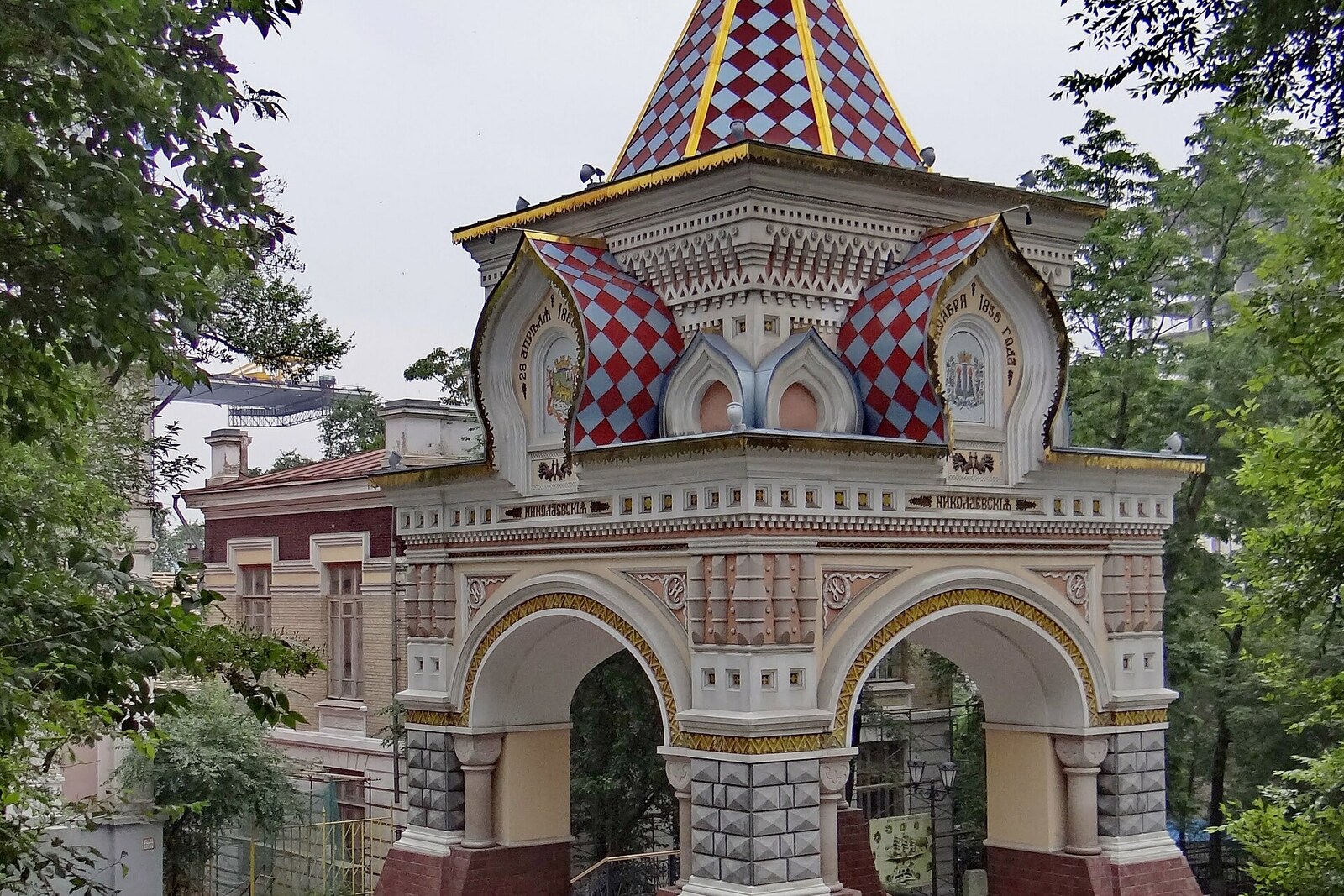
Look around first
What to notice
- Four stone pillars
- An arched opening
- A tented roof with a double-headed eagle
- The icon and date on the seaward side
The story of the place
Four stone pillars support an arched passage beneath a tall tented roof with a double-headed eagle. There has never been a fortress wall nearby: the gate was set across Prudovaya Street, on the route from Admiralteiskaya Pier to the city's uphill approach. On the seaward side, it bears an icon of Saint Nikolai and a commemorative date. The former arch was dismantled, and the present one was reconstructed from old photographs and descriptions.
Under the cap of Nikolai Aleksandrovich, the twenty-three-year-old heir to the Russian throne, there was a small black bandage that day. Less than two weeks earlier, in the Japanese city of Ōtsu, a police officer from the security cordon had rushed at him and struck him on the head with a saber. The wound proved shallow. Emperor Aleksandr III, Nikolai's father, ended the Japanese part of the journey and ordered his son to return. In Vladivostok, duties awaited the heir: here he was to inaugurate the Great Siberian Railway—the future Trans-Siberian Railway—and then travel home across the whole country.
Construction of the arch had begun before the attack. On January twelfth, eighteen ninety-one, the Vladivostok City Duma decided to welcome the first representative of the Romanov dynasty with stone gates. The site was chosen on Prudovaya Street, now Peter the Great Street. The city architect Nikolai Konovalov prepared the design, the merchant Mikhail Suvorov headed the construction committee, and the Chinese contractor Shu Jie-lin supplied workers for two shifts. The city treasury provided five thousand rubles, and Vladivostok merchants raised another four thousand. On May first, Aleksandr III authorized the name Nikolaev Triumphal Gate. Ten days remained before the ship's arrival.
On May eleventh, the frigate Pamyat Azova entered Golden Horn Bay. Nikolai went ashore the following morning. Before landing, his head was bandaged again; in his diary, he noted that the black bandage was small enough for him to put his cap on freely over it. After seven months at sea, the heir set foot on Russian soil for the first time.
Prudovaya Street rose directly from Admiralteiskaya Pier into the city. The gate was set across it: four stone supports, an arched vault, and a tall tented roof with a double-headed eagle. There was no fortress wall here. The arch marked the route from the sea pier to the city street, and Nikolai entered Vladivostok through its opening. Ivan Makovsky, the city head—in today's terms, the mayor—met him at the entrance and asked him to forgive “the disorder of our city.” After the ceremony, the heir carried out his father's instruction: he took part in laying the foundations of the railway, the station, and the dry dock.
The gate's name recalled Nikolai Aleksandrovich himself. On the seaward side stood an icon of his heavenly patron, Nikolai the Wonderworker, whom sailors also revered. Below the icon was the date of arrival—May eleventh, eighteen ninety-one. It is also on the present arch: the ship arrived on the eleventh, although Nikolai went ashore on the twelfth.
The bronze eagle, the icon, and the masonry itself have not survived to the present day. In nineteen twenty-seven, the district committee ordered the arch dismantled: by then Prudovaya Street was called Pervogo Maya Street, traffic to the commercial port ran along it, and the gate was declared an obstacle to traffic with no artistic value. The eagle, the zinc icon, and the bronze frame were first transferred to the city museum. The museum staff then judged them to be of no museum value and sent them for scrap. Under the act of December fourteenth, nineteen twenty-nine, the metal parts were destroyed; in early nineteen thirty, the stone supports were dismantled as well.
In nineteen ninety-eight, the Vladivostok entrepreneur Aleksandr Ermolaev decided to fund the reconstruction of the gate. The design drawings no longer existed, so the architects restored its proportions from photographs and old descriptions. The new arch opened on May sixteenth, two thousand three. It had to be placed slightly to the left of the former line. One of the four present-day pillars stands above stones from the old foundation; the opening through which Nikolai entered the city with a black bandage under his cap was slightly to the right.
Useful on site
Open space, accessible year-round.
Checked: June 24, 2026. Check the official source before visiting.It is convenient to walk around the arch from both sides: the seaward and city-facing facades tell different parts of the design. Remember that this is a reconstruction, not a surviving 19th-century structure.