 Guide On Map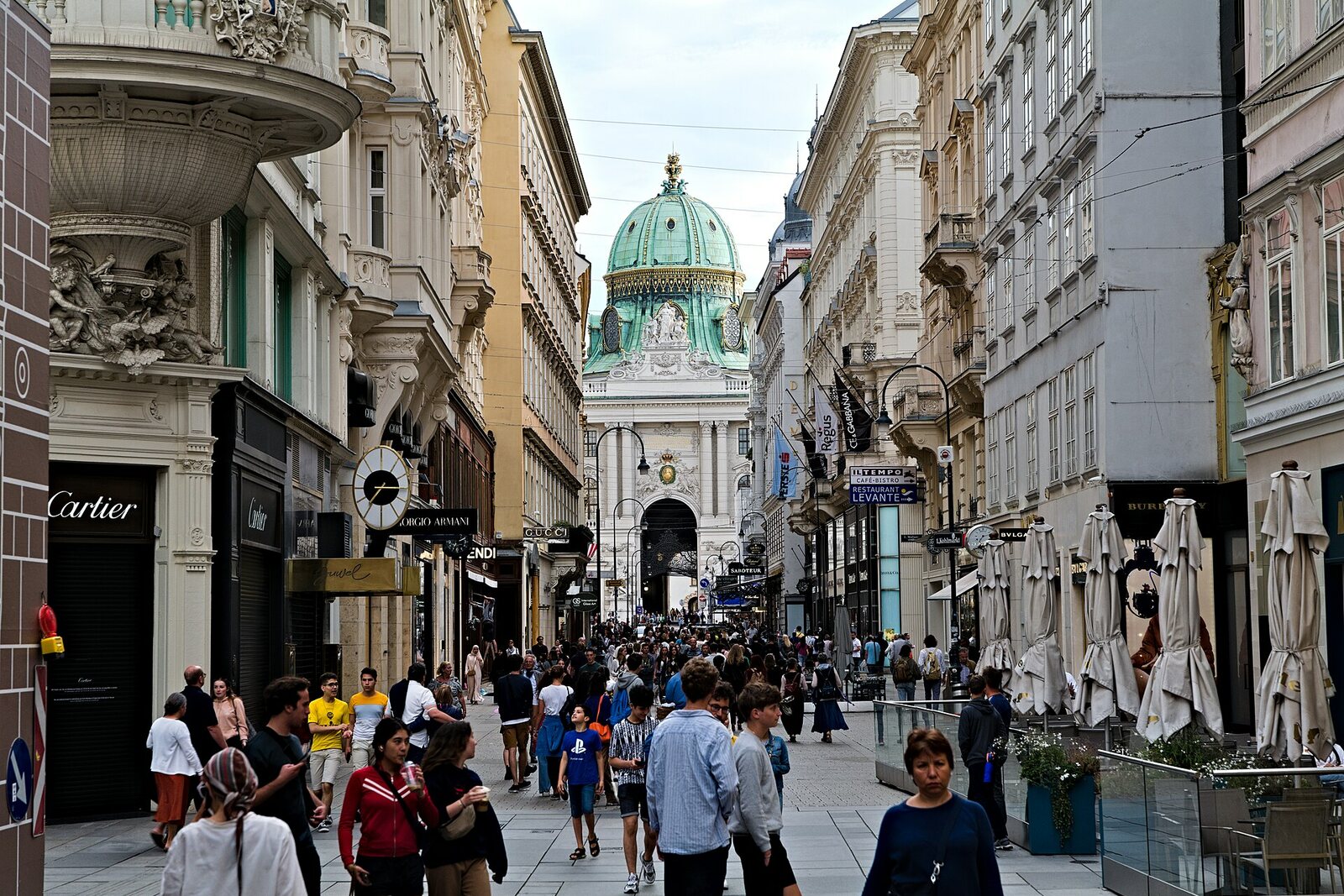
Look around first
What to notice
- Façade of building No. 14
- Demel sign
- Inscription about the court confectioner
- Confectionery display windows
The story of the place
At first, firewood was sold on this shopping street, then charcoal; the medieval name Kohlmarkt comes from them. It lies on the route between Graben and the Hofburg used by people going to court. When the imperial court was nearby, jewelry, books, and tobacco for the palace and wealthy homes began to be bought here instead of fuel. Behind today’s display windows, expensive goods still stand—the goods that came here in the court’s wake.
The façade of number fourteen still bears the title “imperial and royal court confectioner.” It belongs to Demel. A court supplier was a firm authorized to supply the imperial court and to state this on its signs and packaging. This title helps explain why Kohlmarkt is occupied by expensive shops.
The street’s medieval name referred to a very different commodity. At first, firewood was sold here, then charcoal, and at the beginning of the fourteenth century documents recorded Kohlmarkt—the Charcoal Market. Merchants were drawn here by the route between Graben and the Hofburg. When the imperial court settled nearby, objects ordered for the palace and wealthy homes followed everyday fuel: jewelry, books, tobacco, and confectionery.
In eighteen eighty-eight, Josef Demel and Karl Demel, the owners of the court confectionery, lost their former premises on Michaelerplatz when the old court theater was demolished. They needed to remain near the Hofburg and their customers. The brothers moved the business to Kohlmarkt, to the present-day number fourteen. Here, a dispute unfolded in which the price of one word proved comparable to the value of a family business.
The confectioner Eduard Sacher had once trained at Demel and made there a chocolate cake from the recipe of his father, Franz Sacher. Later, Eduard opened Hotel Sacher, where the same cake became its signature dish. Two establishments therefore had grounds to lay claim to it: the Sacher family gave the cake its name, while Demel had taken part in its early history and had sold it for many years.
After the death of Anna Sacher, Eduard’s widow and the owner of the hotel, the business went bankrupt. In nineteen thirty-four, new owners bought the hotel. Anna’s son, also Eduard Sacher, allowed them to keep the hotel’s name, but secured for himself the right to use his own surname in another business and to make cakes. He could no longer open another Hotel Sacher in Vienna. On July twenty-four of the same year, Eduard granted Demel the exclusive right to produce and sell the Eduard Sacher Torte. The hotel no longer belonged to him; he could now earn money from the family name through the confectionery on Kohlmarkt.
The hotel’s new owners began selling their version under the name Original Sacher-Torte. Demel used the same word, “original,” and placed a triangular chocolate seal bearing Eduard’s name on its cakes. The dispute reached the Vienna Commercial Court and the Supreme Court. In nineteen fifty-six, the judges determined that Demel’s triangular seal could not be confused with the hotel’s round seal. The parties reached a final agreement in nineteen sixty-three: the word “original” remained with the hotel, while the confectionery retained the right to its own cake and triangular mark.
Today, the product at number fourteen is called Demel's Sachertorte. Its chocolate icing still bears the triangular seal—the shape that the court distinguished from the hotel’s round seal.
Useful on site
The pedestrian shopping street is accessible as an outdoor route; hours depend on individual shops, cafés, and seasonal demand.
Checked: June 28, 2026. Check the official source before visiting.It is enough to walk along the street, comparing its old name with its present appearance. Visiting Demel is a separate gastronomic stop; there is no need to queue to go inside in order to continue the story.