 Guide On Map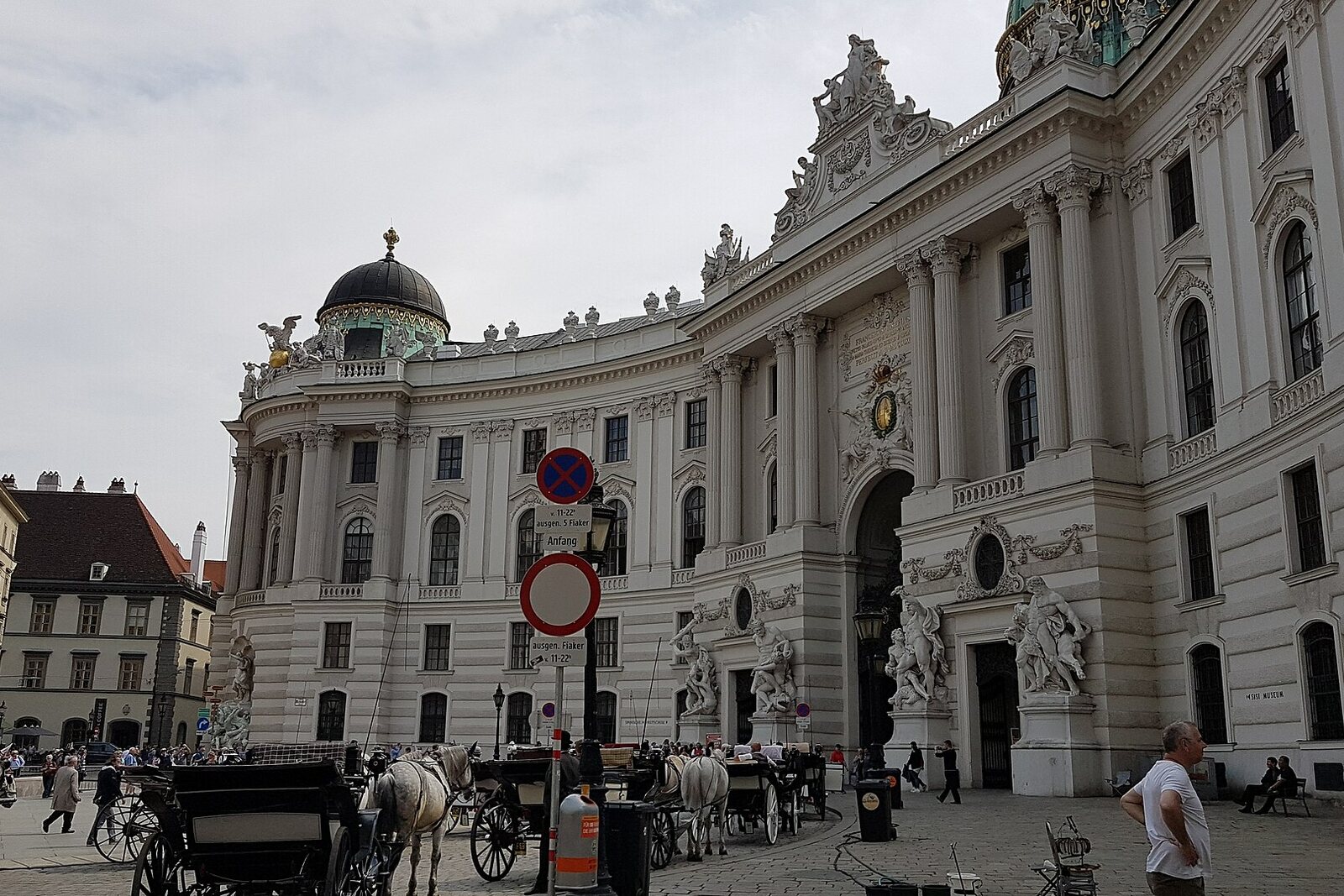
Look around first
What to notice
- Semicircular façade of the Hofburg
- Dome of the Michaeler Wing
- Sculpture of Archangel Michael
- Two plaques about the Old Burgtheater
The story of the place
The name Michaelerplatz came from St. Michael's Church opposite—the church of Archangel Michael. Above its entrance, Michael casts down the rebellious angels. The semicircular, domed façade of the Hofburg, which the square faces, appeared much later than the name itself.
In the eighteenth century, a court theater stood on this site. An old ball-game hall beside the palace was adapted for it; separate corridors led from the imperial apartments to the boxes. In seventeen seventy-six, Emperor Joseph II took responsibility for maintaining the theater at court expense, named it the German National Theatre, and enrolled the actors as court employees. Joseph regarded the public stage as a school of morals: the audience was to be educated, and plays capable of making an undesirable impression were to be stopped.
It was just such a play that the composer Wolfgang Amadeus Mozart and the court poet Lorenzo Da Ponte chose. In Beaumarchais's comedy “The Marriage of Figaro,” a count tries to seduce his servant's bride. The servants set a trap for their master, and Figaro delivers a long speech against advantages obtained by birth. Joseph banned public performances of this comedy in Vienna.
Mozart then lived without a permanent post at court: he earned money from concerts, lessons, and individual commissions. Da Ponte received his salary specifically from Joseph's theater. Without the emperor's consent, their months of work could not reach the stage. Da Ponte reduced five acts to four, removed Figaro's sharpest speeches, and presented the emperor with an Italian opera libretto now without the banned passages. Joseph authorized the production.
On May first, seventeen eighty-six, “The Marriage of Figaro” was performed here for the first time, at the Old Burgtheater. Mozart himself conducted the first performances. At the third performance, the audience demanded so many encores that the next day Joseph ordered that numbers sung by several performers were no longer to be repeated: otherwise, the performance ran too long.
In Vienna, the opera remained in the repertoire without any particular triumph. A few months later, the theater director Pasquale Bondini staged it in Prague. Its success there was such that Bondini invited Mozart to conduct “Figaro” and commissioned a new opera from him. Mozart worked with Da Ponte again; the result was “Don Giovanni.”
In eighteen eighty-eight, the troupe moved to a new building on the Ringstrasse. The old theater was demolished to complete the Michaeler Wing of the Hofburg and create the current palace entrance in front of it. Nothing of the auditorium remains above ground. On the wall beneath the dome, two small plaques mark the site of the theater and its former entrance; one of them names “The Marriage of Figaro” among the premieres held here.
Useful on site
The square and the visible excavations can be viewed from the street; St. Michael's Church, Sisi Museum, Imperial Apartments, Spanish Riding School, and other entrances operate separately.
Checked: June 28, 2026. Check the official source before visiting.First, look at the square from a diagonal angle, then approach the excavations along the accessible edge. Do not go down beyond the barrier; the Roman walls are intended to be viewed from above.