 Guide On Map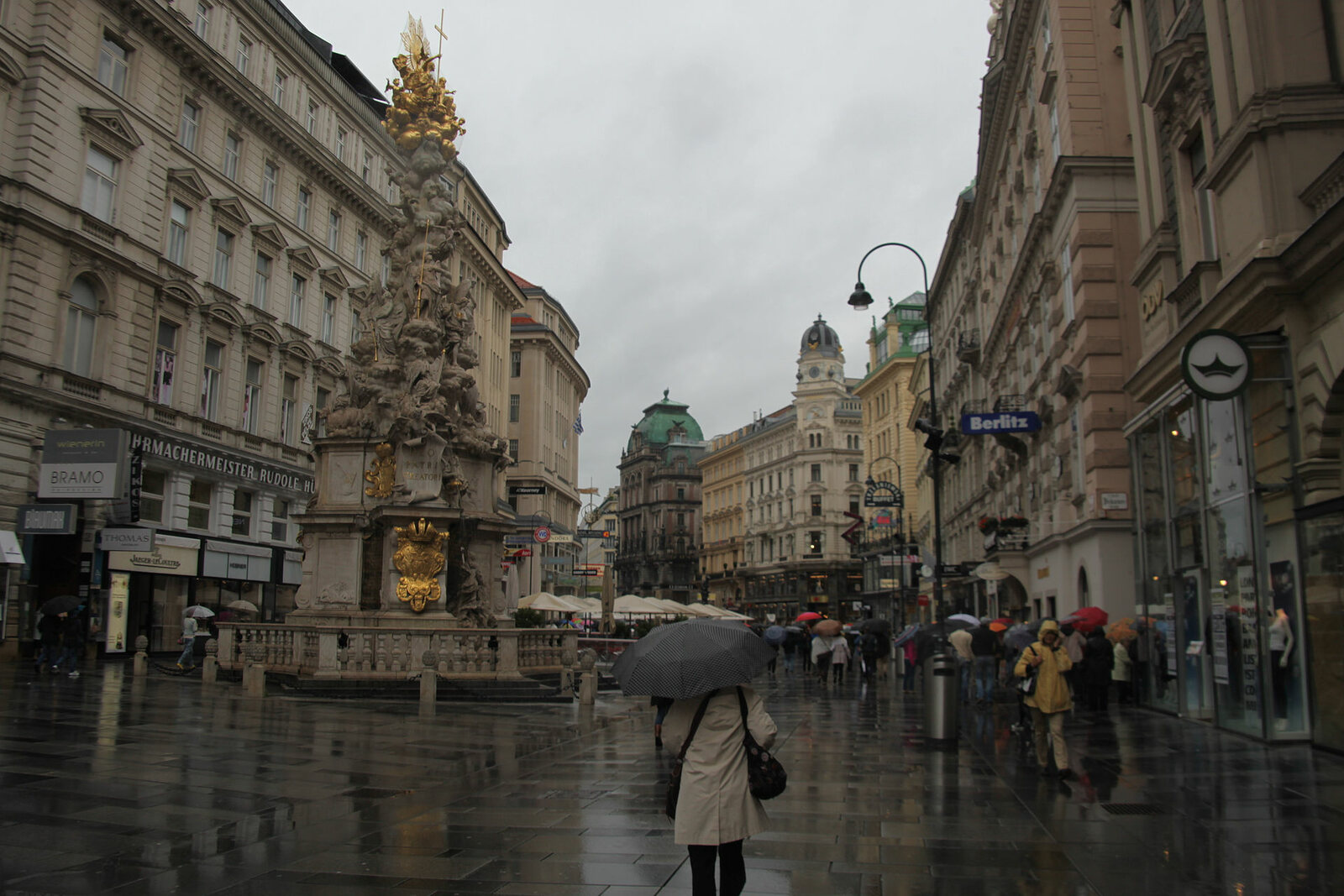
Look around first
What to notice
- Figures of the Trinity above the clouds
- A kneeling figure in armor
- A female figure beneath a cross
- Two public fountains
The story of the place
A defensive ditch once ran beyond Graben's stone pavement, separating the city from the outside world. When Vienna was expanded, the ditch was filled in, and the street found itself within the new walls. Between two fountains rises a dense marble group: the Trinity is visible above the clouds, below is a kneeling man in armor, and beside the cross stands a female figure. Viennese residents call this column the Plague Column.
In January sixteen seventy-nine, Paul de Sorbait, a physician and rector of the University of Vienna, published rules for an outbreak of plague. He pressed for the sick to be isolated, the streets cleared of refuse, and city officials to stop concealing the first deaths. The physician served at court and taught medicine; now he had to persuade his own employers to acknowledge the epidemic. His instructions were poorly followed. Even as the death toll rose, Vienna continued to stage ceremonial entries by embassies, with crowds of spectators.
By July, denying the plague had become impossible. Sorbait advised Emperor Leopold I to leave the city with only a few attendants: a small retinue reduced the danger of carrying the infection farther. Leopold departed with his family and almost all of his large court. The procession first headed on pilgrimage to Mariazell, then to Prague and Linz. New outbreaks of plague soon appeared in the places it passed through. The emperor survived and remained in Linz until the epidemic ended.
Thousands of people died in Vienna during that time. The surviving records list seven thousand one hundred ninety-six victims; historians believe there were between twelve and fifteen thousand. The last of the dead were still being buried in the spring of the following year.
While the emperor was away from the city, Viennese residents and the Brotherhood of the Holy Trinity decided to create a place for shared prayers for the plague to end. At first, they intended to place the column in the cemetery by St. Peter's Church, but they chose Graben, a busy open space between two public wells. The sculptor Johann Frühwirth received an urgent commission for a wooden column: no one wanted to wait for marble to be worked during an epidemic.
On October twenty-seventh, sixteen seventy-nine, men in penitential robes, their faces beneath tall hoods, dragged the figures made by Frühwirth from the town hall to Graben. The column was consecrated two days later. Sermons and litanies were read beside it. On June seventeenth of the following year, when mass mortality had already ended, a thanksgiving ceremony was held here.
Leopold had vowed, while still away, to replace the wooden column with a marble one. Construction stretched on for years, and the former simple pillar with nine angels gradually became an entire sculptural scene. The present column was consecrated in sixteen ninety-three. Its official name is the Holy Trinity Column, but Viennese residents call it the Plague Column.
On the front of the pedestal, Leopold I is depicted kneeling in ceremonial armor. Beneath him, Faith, with a cross, casts down an emaciated woman embodying the plague. Above the emperor rise angels and clouds, crowned by the Trinity. The inscription thanks God for delivering Vienna and Austria from the epidemic. In this version of events, Leopold's prayer saves his lands; Sorbait's advice about a small retinue and the infected trail left by the imperial court are not shown in stone.
The very name Graben preserves a different human story. A defensive ditch ran here in front of the wall first of the Roman military camp, then of medieval Vienna. At the end of the twelfth century, Duke Leopold V planned to expand the city, but he obtained the necessary money thanks to a prisoner.
The English king Richard the Lionheart was returning from the Third Crusade. During the campaign, he quarreled with Leopold over precedence and the division of booty after the capture of Acre. Richard tried to cross the duke's lands in disguise, but shortly before Christmas eleven ninety-two, Leopold's men seized him near Vienna. The Crusader was under the protection of the Church, so the pope excommunicated the duke. Richard spent more than a year in captivity; after the first payment of an enormous ransom, he was released and returned to his lands.
Leopold directed his share of the silver toward building a new Vienna city wall. The old wall was dismantled, the ditch filled in and leveled, and the area of the city more than doubled. St. Stephen's Church, which had previously stood outside the fortifications, found itself within them. There has long been no open ditch beneath the present pavement, but its name remains. The wooden column that the townspeople dragged here in the middle of the epidemic has also disappeared; in its place stands a marble Leopold I, kneeling above the defeated Plague.
Useful on site
Pedestrian street and outdoor monument; access is open, but events, crowds, and holiday decorations may change the most convenient viewing points.
Checked: June 28, 2026. Check the official source before visiting.Walk around the column: its story cannot be read from one side. Graben has a dense flow of people, so for the audio it is better to stand slightly to one side of the walkway.