 Guide On Map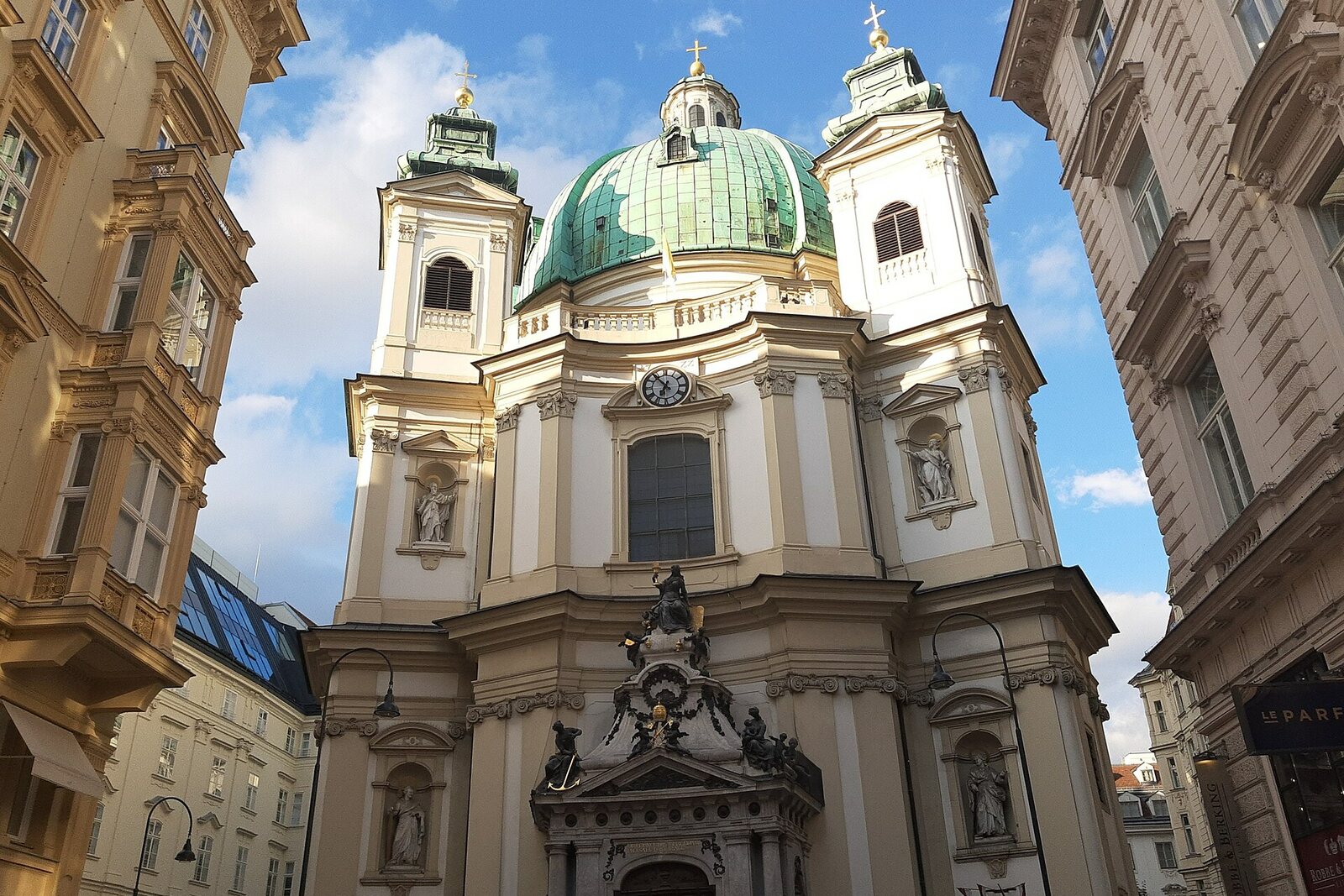
Look around first
What to notice
- Oval façade
- Inscription above the entrance
- Gray marble portal
- Dome fresco
The story of the place
The gray marble portal opens into a Baroque church with an oval space beneath a dome: the fresco and pulpit are dedicated to the Holy Trinity, and above the main altar Peter is shown with John at the gate of the Temple in Jerusalem. Its name and dedication to Peter came from the old parish church, which a document from eleven thirty-seven already calls St. Peter's Church. That church is gone: its cemetery was demolished with it, while the present church retained both Peter and the memory of the Trinity. Dozens of commissioned masses were once celebrated here in a single day.
During that very epidemic mentioned at the Holy Trinity Column, the leaders of the Brotherhood of the Holy Trinity submitted a petition to Emperor Leopold I. The Brotherhood was an association of laypeople: its members prayed together, organized processions, and commissioned services for the living and the dead. They sought the rebuilding of the old St. Peter's Church, which they had managed since sixteen seventy-six. After a fire, the church stood with damage temporarily patched up and gradually fell into disrepair.
Leopold promised a new church but provided no money. The imperial treasury was paying for the war, while Viennese residents were donating ever less willingly: the epidemic had ended, and its vow no longer seemed urgent. Meanwhile, the Brotherhood was growing. Wealthy townspeople, courtiers, and nobles joined it, including Leopold himself. These people wanted to ensure prayerful commemoration for themselves after death, and they invested money in the community while still alive.
Such contributions resembled a will, insurance, and a bank deposit all at once. The town widow Margareta Ziegler transferred five hundred gulden to the Brotherhood and received five percent annually from that sum for the rest of her life. Others left capital on the condition that masses be said for them regularly. Money of this kind paid for priests, musicians, and the church's upkeep.
Only in seventeen oh one did the Brotherhood receive permission to build the church—well appointed inside, but without excessive expense. The old church was demolished along with the cemetery surrounding it. Saving money did not work out. In a late Brotherhood chronicle, the final sum came to four hundred seventy-five thousand gulden; it is now impossible to verify this calculation. But the result is before our eyes: an oval hall beneath a dome, imperial boxes, and images of the Holy Trinity in the dome fresco and on the pulpit. The present church was consecrated at the same time in honor of the Trinity and Saint Peter.
Peter here is the apostle, one of Christ's closest disciples and, in Catholic tradition, the first head of the Roman Church. His name passed to the Baroque building from the earlier church: a document from eleven thirty-seven already calls St. Peter's Church a parish church. Why the earliest sanctuary was dedicated specifically to Peter is not known for certain. A marble relief on the eastern wall shows Charlemagne supposedly founding a church here in the eighth century. It was installed only in nineteen oh six, and it depicts a tradition rather than a proven event. Above the main altar, Peter is shown in an episode that the church considers a fact of his earthly life: together with Saint John the Apostle, he heals a lame man at the gate of the Temple in Jerusalem.
The Brotherhood filled St. Peter's Church with regular services. By seventeen seventy-seven, its lists contained more than forty-three thousand people, and its treasurers managed three thousand six hundred deposits and testamentary funds. Toward the end of the Brotherhood's existence, an average of sixty commissioned masses a day were celebrated here.
Money also left tangible traces. Joachim Georg Schwandtner, a court and ministerial councilor, made his career in imperial service and then headed the Brotherhood. He paid for the organ gallery and the gray marble portal through which people enter the church. Schwandtner died in seventeen fifty-two, before the work was completed. Under his will, a college of six priests was established here: they were to hear confessions, preach, and minister to the Brotherhood's members. Schwandtner's own grave is to the left of the altar area.
In seventeen eighty-three, Emperor Joseph II dissolved the Viennese brotherhoods and confiscated their property. St. Peter's Church was made an ordinary parish church; later it became a rectorial church, meaning a church without its own parish district. The Brotherhood of the Holy Trinity no longer exists. Above the entrance, the inscription about Leopold's vow remains; beneath it is the portal paid for by Schwandtner, and inside is his grave.
Useful on site
Official website of St. Peter's Church: Mon–Fri 08:00–19:00, Sat–Sun 09:00–19:00; masses, confessions, group visits, and concerts may affect access.
Opening hours by day
The full architectural design can be seen from the small square. If the church is open, enter quietly: services and concerts may restrict viewing, and visiting the interior is not required for the route.