 Guide On Map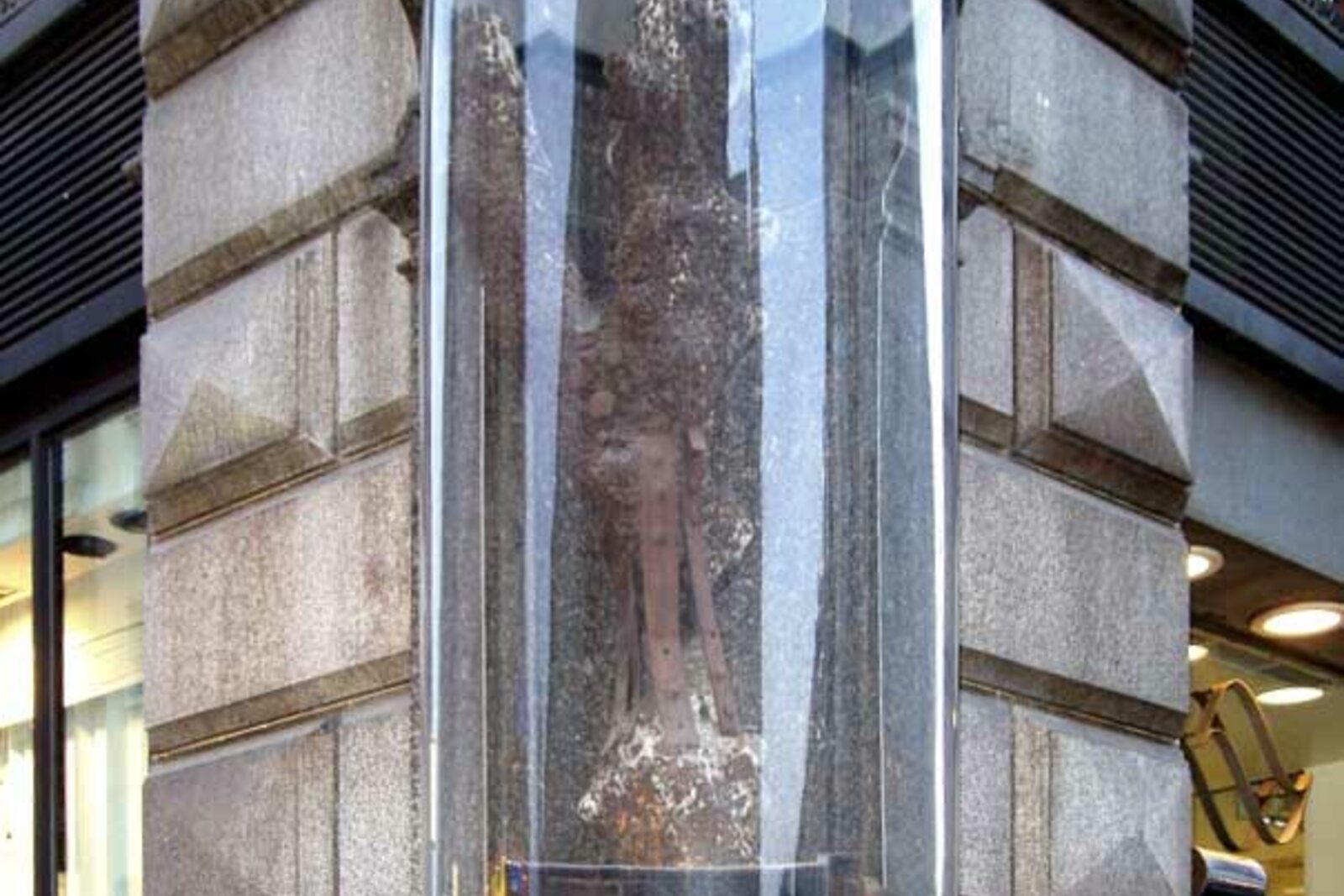
Look around first
What to notice
- Spruce trunk behind glass
- Nail heads
- Iron band
- Padlock
The story of the place
An authentic fragment of a medieval spruce is preserved in the display case on the corner of Palais Equitable. The first nails were driven into it while the tree was still growing: the wood had time to grow around several heads. Who left them is unknown; researchers suggest requests for protection or gratitude for healing. Later, journeymen came here and added their own nails, while also donating money to the guild.
In a glass niche on the corner of Palais Equitable stands a medieval spruce trunk, almost concealed beneath nail heads. This is Stock im Eisen—“the trunk in iron.” The Viennese had already given the square this name in the seventeenth century. The name itself appeared earlier: a document from fifteen thirty-three calls the tree “a trunk enclosed in iron.” This refers to a wide band with a padlock. The lock was never locked—it is a dummy. The band still bears the year it was replaced and the initials of the building’s owner at the time, Hans Buttinger.
In the same document, the trunk was already lying beside a well right here. Fifteen years later, it was fastened to the wall of a house. When the Equitable Life Assurance Society demolished the old buildings and erected Palais Equitable at the end of the nineteenth century, those who commissioned it ordered a corner niche to be made for the tree. A bronze relief by the entrance depicts a popular legend: traveling journeymen supposedly drove in one nail before setting out on a further journey, while the ingenious lock was made by a blacksmith who had made a deal with the devil.
This is a legend, not the established origin of the trunk. Research showed that the spruce grew around fourteen hundred and was felled around fourteen forty. The wood had time to grow over several nails: they were driven in while the tree was still standing and alive. Who did this is unknown. Most likely, people left a nail, expensive at the time, as a request for protection or in thanks for healing. The custom of traveling craftsmen is documented here only from seventeen fifteen. The journeymen really did drive in their own nails and donate money to the guild, but they came to the tree several centuries after the first unknown participants in the ritual.
On January twenty-ninth, nineteen forty-four, a car pulled up to Palais Equitable. Several men in party uniforms demanded that the caretaker, Leopold Koci, be summoned. They presented an order: Stock im Eisen was to be removed and sent to a museum in Germany.
Koci earned his living serving this building and depended on the people who controlled its property. But he refused to hand over the trunk. The men who had arrived backed down, and the caretaker understood that they might return without any discussion. That night, he removed the tree from the façade and hid it in the palace cellar. The following month, the building was badly damaged in an air raid; by then, Stock im Eisen was downstairs.
After the war, even the monument protection agency did not know about the hiding place. The trunk was found in the cellar only in August nineteen forty-six. Nearly five more years went into repairs and preparing its former location. On June sixth, nineteen fifty-one, the tree was fastened once again to the corner of the palace, Leopold Koci was publicly called its savior, and a representative of the Equitable Life Assurance Society placed the relic in the city’s care.
Behind the glass is the very original that the caretaker removed from this wall and carried down to the cellar. It has not been replaced here by a museum copy.
Useful on site
A street object behind glass on the corner of Palais Equitable; view it from the sidewalk without blocking the flow at Graben and Kärntner Straße.
Checked: June 28, 2026. Check the official source before visiting.The trunk is clearly visible from the street; there is no need to enter the building. The corner is narrow and busy, so examine the niche without blocking the way.