 Guide On Map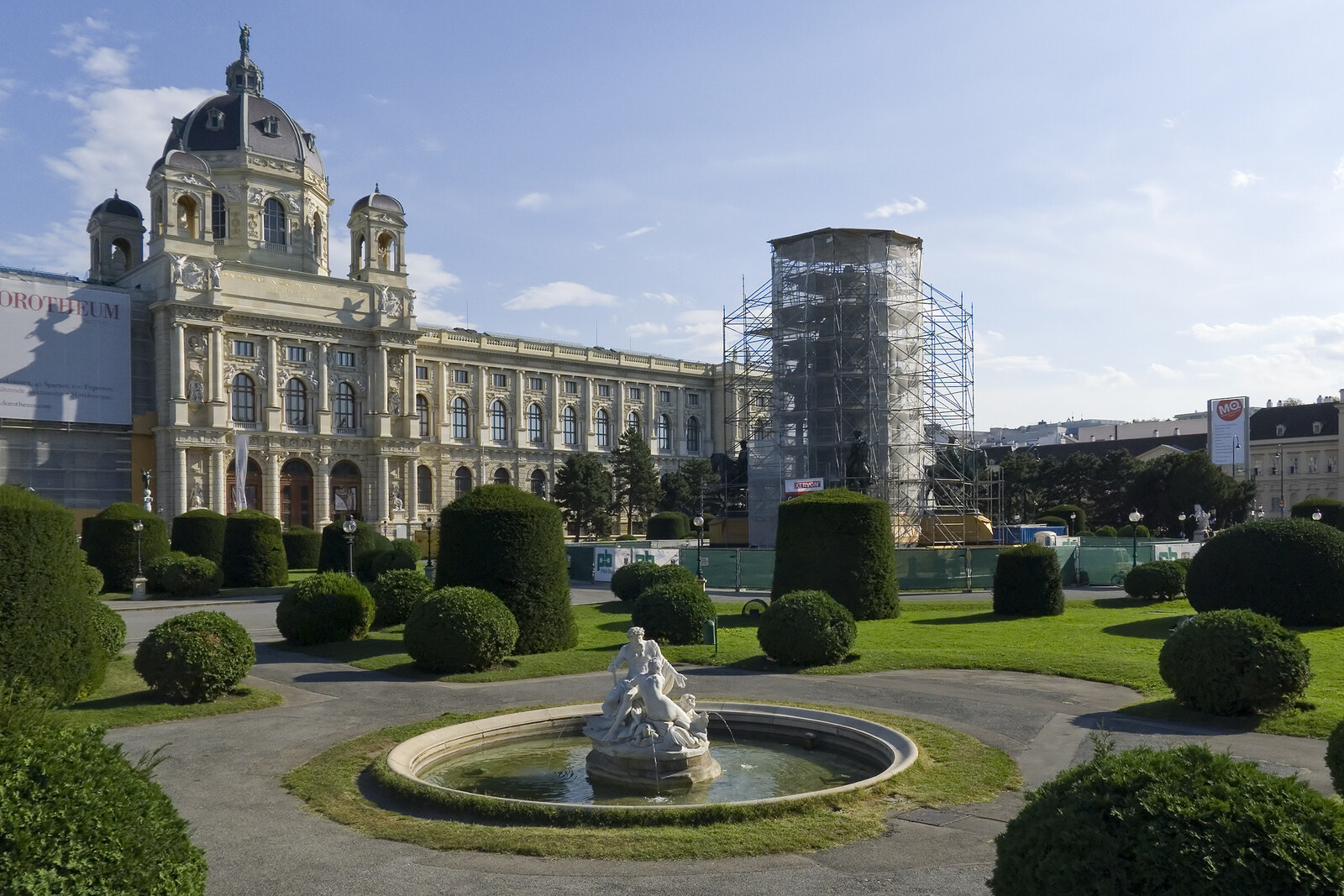
Look around first
What to notice
- Monument to Maria Theresa
- The scroll in her left hand
- Figures on the pedestal
- Two identical museum domes
The story of the place
Maria Theresa sits between two identical domes—the ruler of the Habsburg hereditary lands in the eighteenth century. She was called Empress as the wife of Franz Stephen, the Holy Roman Emperor. The square was given her name on the day this monument was unveiled.
Franz Joseph, the reigning emperor, commissioned it because he needed a convincing image of the dynasty's former success. By eighteen seventy-three, his monarchy had lost Lombardy and Venice, yielded Prussia the leading role in German affairs, and been forced to renegotiate with Hungary over the structure of the state. At such a moment, Franz Joseph announced the creation of a monument to Maria Theresa.
Her own reign began with a similar threat. In seventeen forty, her father, Karl VI, died. He had no son, and his twenty-three-year-old daughter inherited disordered finances and an army in need of reorganization. Europe's rulers refused to recognize her as his heir. Prussian King Friedrich II invaded Silesia, while Bavaria, Saxony, and France expected to divide the Habsburg possessions.
For eight years, Maria Theresa fought to have her right to the throne recognized, sought allies, and continued the war. She kept most of her inheritance, although nearly all of Silesia remained with Prussia. That is why the bronze ruler holds the Pragmatic Sanction in her left hand—her father's decree on the indivisibility of the Habsburg lands and the possibility of passing them to his daughter. It looks like a scroll; in her life, it was a document that had to be defended with weapons.
Franz Joseph invited three sculptors and chose the design of his favorite, Caspar von Zumbusch, a professor at the Academy of Fine Arts Vienna. The imperial commission even determined the circle of people on the pedestal: Maria Theresa was to appear above her military commanders, advisers, officials, scholars, and musicians. Zumbusch worked on the bronze figures with his student Anton Brenek for thirteen years.
On May thirteenth, eighteen eighty-eight, Franz Joseph and Elisabeth unveiled the monument before ten thousand invited guests. Natural History Museum Vienna was still waiting for visitors until the following year, and the Kunsthistorisches Museum for another three years. Franz Joseph lived to open both buildings personally, and court collections that had previously been scattered through different rooms received two public museums facing each other.
These buildings were conceived as a pair at the emperor's own request: one housed nature, the other art and antiquities. Together with the square, they formed the completed part of the enormous Imperial Forum, which was intended to extend from Hofburg Palace across the Ring to the court stables, today's MuseumsQuartier. The rest of the plan was never completed. What remains of it is this very section: two museum entrances facing each other, Maria Theresa with a disputed document in her hand, and Hofburg Palace on the other side of the boulevard.
Useful on site
Check the KHM and NHM schedules separately; the square remains an outdoor stop
Checked: date not specified. Check the official source before visiting.For this stop, the square and an exterior view of both museums are enough. The Venus of Willendorf and Saliera are in different collections, so plan museum visits separately.