 Guide On Map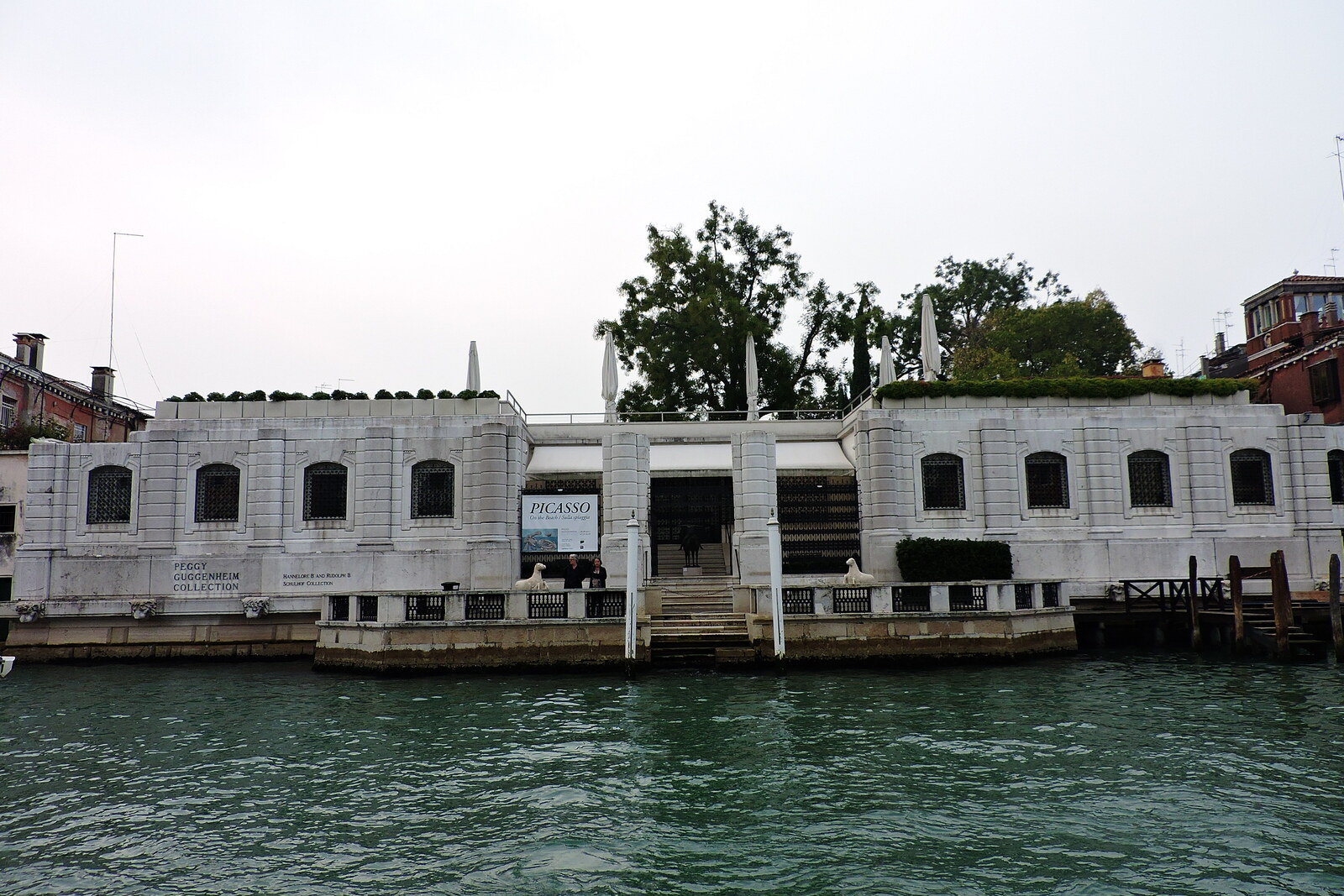
Look around first
What to notice
- Low stone façade
- Lion heads at the base
- Sculptures in the garden
- Low exhibition pavilion
The story of the place
The name above the entrance does not belong to an artist. Peggy Guggenheim was an American heiress, gallery owner, and patron of artists. Her father's family made its fortune in mining and smelting metals. Peggy spent her share of the inheritance on modern art: she bought paintings, organized exhibitions, and paid artists stipends. These purchases were what she lived by—not as a source of income, but as the work she had chosen.
In nineteen forty-seven, Guggenheim closed her New York gallery, Art of This Century, and returned to Europe. A year later, the Venice Biennale exhibited her collection. For many European viewers, this was their first encounter with Jackson Pollock, Mark Rothko, and Arshile Gorky. After the exhibition, the paintings needed a permanent home, and Peggy herself needed a place where she could live beside them.
In July nineteen forty-nine, she bought Palazzo Venier dei Leoni. The Venier family had commissioned it as early as seventeen forty-nine: the architects planned five stories, but built only the first. The old project left behind a broad stone façade by the water. The word “Leoni” in the name most likely comes from the lion heads of Istrian stone at the base of the façade; the story of a live lion in the garden is considered a legend.
Guggenheim moved into the unfinished palace and hung the paintings in its living rooms. She immediately arranged an exhibition of modern sculpture in the garden. Beginning in nineteen fifty-one, the owner admitted the public to her own home free of charge three times a week, from Easter until November. Visitors passed among Cubist, abstract, and Surrealist works while Peggy continued to live here and add to the collection. This arrangement lasted for almost thirty years.
Soon there was not enough space. Peggy commissioned architects to expand the palazzo, but rejected their design and later added a low exhibition pavilion along the garden boundary. The five stories envisioned by the Veniers never appeared: the additional galleries were placed beside the house, not above it.
In nineteen seventy, Guggenheim gave the palace to the Solomon R. Guggenheim Foundation, founded by her uncle Solomon R. Guggenheim. In nineteen seventy-six, she gave the collection to the foundation as well. After her death in nineteen seventy-nine, the former home opened as a permanent museum bearing her name.
Peggy Guggenheim’s ashes are here too, in a corner of the garden among the sculptures. She is buried on the very plot where, thirty years before her death, she first admitted visitors to view modern art.
Useful on site
Outside, it is accessible like a city street; the museum usually follows daytime hours and is closed on Tuesdays—check the official website.
Checked: date not specified. Check the official source before visiting.From the street, the building’s unusual scale is easy to understand, but the collection, garden, and Peggy’s grave are inside the museum. Plan your visit separately and check the official information.