 Guide On Map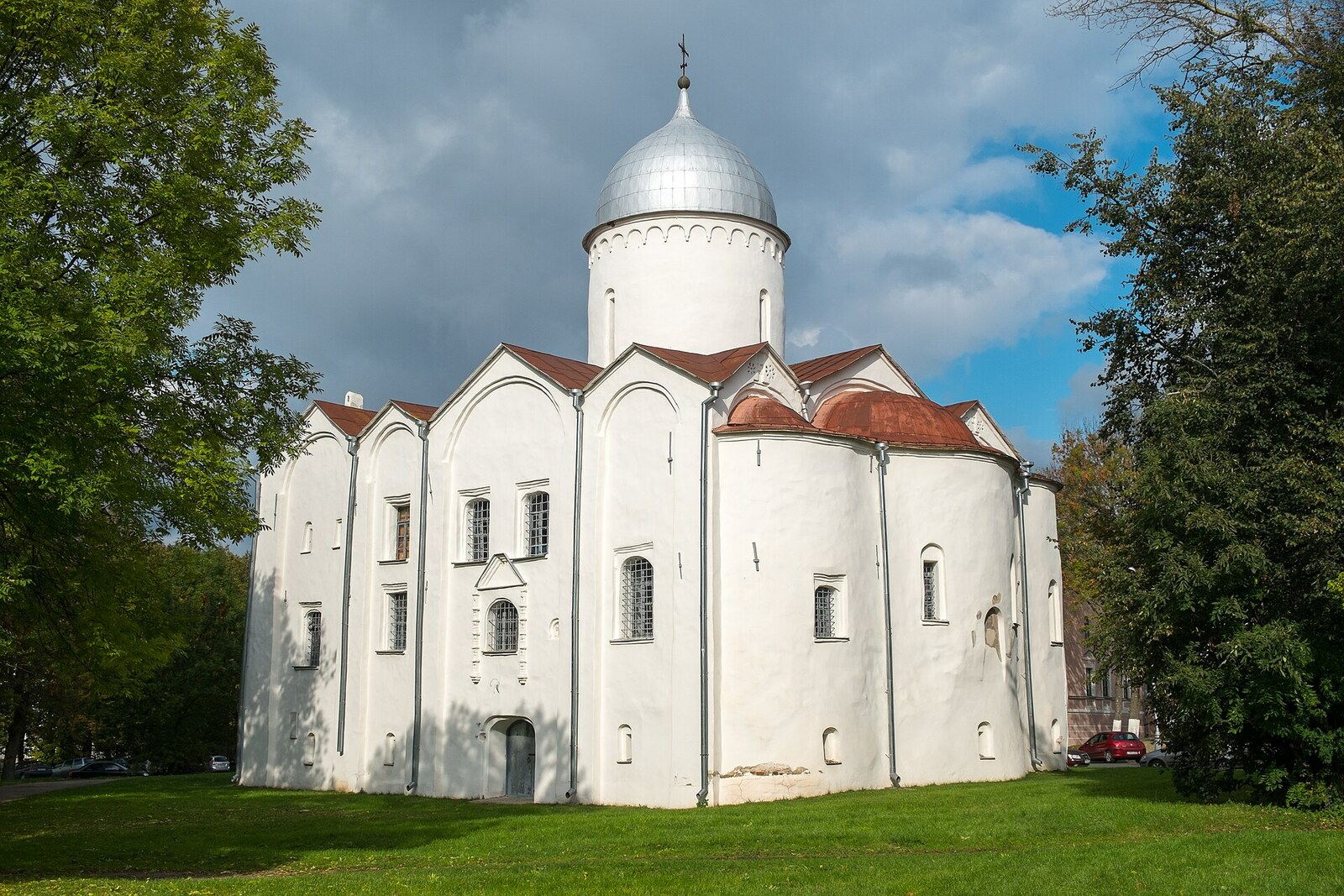
Look around first
What to notice
- Church facade
- Stone masonry
The story of the place
The stone church on the Torg was built in fourteen fifty-three, using the foundation of the earlier church. Its upper part has disappeared, and only the foundation and the outline of the plan survive in the ground. The church passed to wealthy wax merchants; a closed fellowship formed around it, with membership inherited. The facade and stone masonry stand on the same site where merchants gathered for several more centuries.
In eleven twenty-seven, Vsevolod Mstislavich, prince of Veliky Novgorod, laid the foundations of a stone church at Petryatin Court. The chronicler recorded his intention succinctly: the church was being built “in the name of his son.” The young prince was named Ioann, so the church was dedicated to his heavenly patron, John the Baptist.
The son did not live to see the work completed. In April eleven twenty-eight, the chronicle reported his death, and the builders finished the church two years later. Thus Ioann’s name became established here both as a dedication to the saint and as a memorial to the prince’s child.
After construction was completed, Vsevolod gave the church to the wealthiest merchants trading in wax. On the Torg, they needed a place where a large consignment of goods could be checked and a dispute settled in a way that both sides would recognize. The church therefore kept shared standards: scales for wax, a pood for honey, a grivenka for silver, and Ivan’s ell for cloth.
Ivan’s Hundred, an association of merchants named after the church, formed around it. Here, “hundred” meant a fellowship, not an exact number of members. Only a very wealthy trader could join it. A surviving later version of the charter names an entrance payment of fifty silver grivnas—about ten kilograms. Membership was inherited and gave the right to take part in weighing wax, collect the duties connected with it, and elect merchant elders.
Together with the tysyatsky, the city official responsible for trade, these elders judged disputes between merchants from Veliky Novgorod and those from elsewhere. The charter forbade the posadnik and the boyars from intervening in the decisions of Ivan’s Hundred. An error in a measure here changed the price of an entire consignment of wax or cloth, so the testing ell and the weights were both trading tools and legal evidence. The fees for weighing supported the priests, the deacon, the scribe, and the church watchmen.
Vsevolod himself soon lost his princedom of Veliky Novgorod and was expelled. For several more centuries, until the seventeenth century, merchants continued to judge trade cases and keep the measures at the Church of St John the Baptist at Opoki.
Nothing of the church that Vsevolod built in memory of his son and gave to the merchants remains above ground: only the foundation and the plan have survived. The main masonry of the present church dates from fourteen fifty-three, when it was rebuilt on the old foundation. Neither the wax scales nor Ivan’s ell are here any longer, but the building still occupies the same site on the Torg where merchants checked goods and passed decisions in the name of Ivan’s Hundred.
Useful on site
The church is closed to visitors; exterior viewing is available.
Checked: date not specified. Check the official source before visiting.The interior is not necessary to complete the route. Stay outside and relate the church to the square where cloth, wax, and silver were traded.