 Guide On Map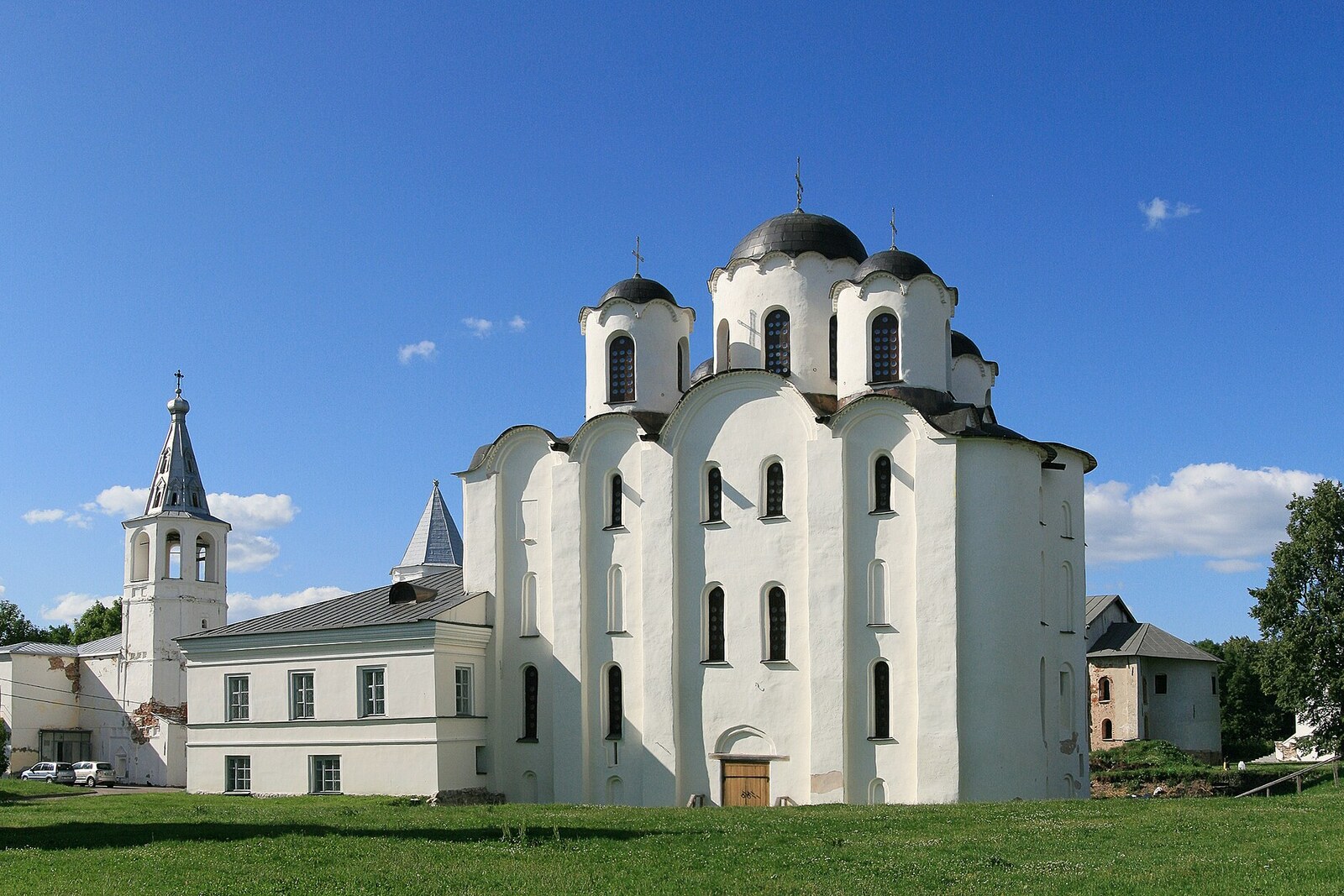
Look around first
What to notice
- Facade of St Nicholas Cathedral
- Museum exhibitions
The story of the place
Museum display cases now stand in a church built for the princely court. Work began at the command of Mstislav Vladimirovich in eleven thirteen; the court also had its own priests. The cathedral's name brings together St Nicholas of Myra, revered as a miracle worker, and the court that the church served. Its facade survives amid the space where the residential and service buildings of the princely estate once stood.
At the end of eleven thirty-six, Prince Sviatoslav Olgovich came here to be married. The people of Veliky Novgorod had invited him only a few months earlier, after expelling the previous prince. Sviatoslav knew how precarious his position was, but he had no intention of giving up the wedding.
Nifont became the obstacle—the bishop of Novgorod, who had to permit the marriage under church rules. He refused to marry Sviatoslav and forbade Novgorod's priests and monks even to attend the wedding. The chronicler recorded his words: the prince “is not permitted to take her.” The exact reason is not given. Modern researchers suggest an impediment connected with a previous marriage of Sviatoslav or the bride; it cannot be said with confidence that it was kinship or any other specific reason.
The prince still had his own court priests. They had come with him, were maintained at his court, and did not answer to Nifont. Sviatoslav brought them into this church, and the wedding took place without the bishop and all the city's clergy.
The cathedral was suited to such an act because of its origins. Prince Mstislav Vladimirovich laid its foundation in eleven thirteen at the princely court. This is where the word “Dvorishchensky” comes from: the church belonged to the court, not to Nifont's see. “Nikolo” refers to St Nicholas of Myra—the bishop of the ancient city of Myra, revered as a miracle worker. A later legend explained the dedication through Mstislav's illness: St Nicholas supposedly appeared to the prince, after which a round icon brought to him healed him. This is a church tradition; the chronicle contemporary with the events reports only that Mstislav laid the foundation of the Church of St Nicholas.
Nifont's refusal did not lead to Sviatoslav's expulsion and did not deprive him of his marriage. The bishop did not excommunicate the prince. As early as the following year, they sealed an agreement on the revenues of the see: instead of a share of judicial fines, Nifont received a fixed one hundred grivnas, and any shortfall was to be paid from the princely treasury. Sviatoslav kept his wife and his princedom; Nifont kept the right not to recognize the disputed wedding through his own participation, along with assured support for his see.
Museum exhibitions are now housed in the cathedral. The residential and service buildings of the medieval princely court nearby are no longer there. The word “Dvorishchensky” preserves their location: in eleven thirty-six, it meant something quite literal—the prince had his own church and his own priests here.
Useful on site
The cathedral is closed to visitors for the period of restoration work; exterior viewing is available.
Checked: date not specified. Check the official source before visiting.The account works for exterior viewing; do not assume interior access is guaranteed, and check separately.