 Guide On Map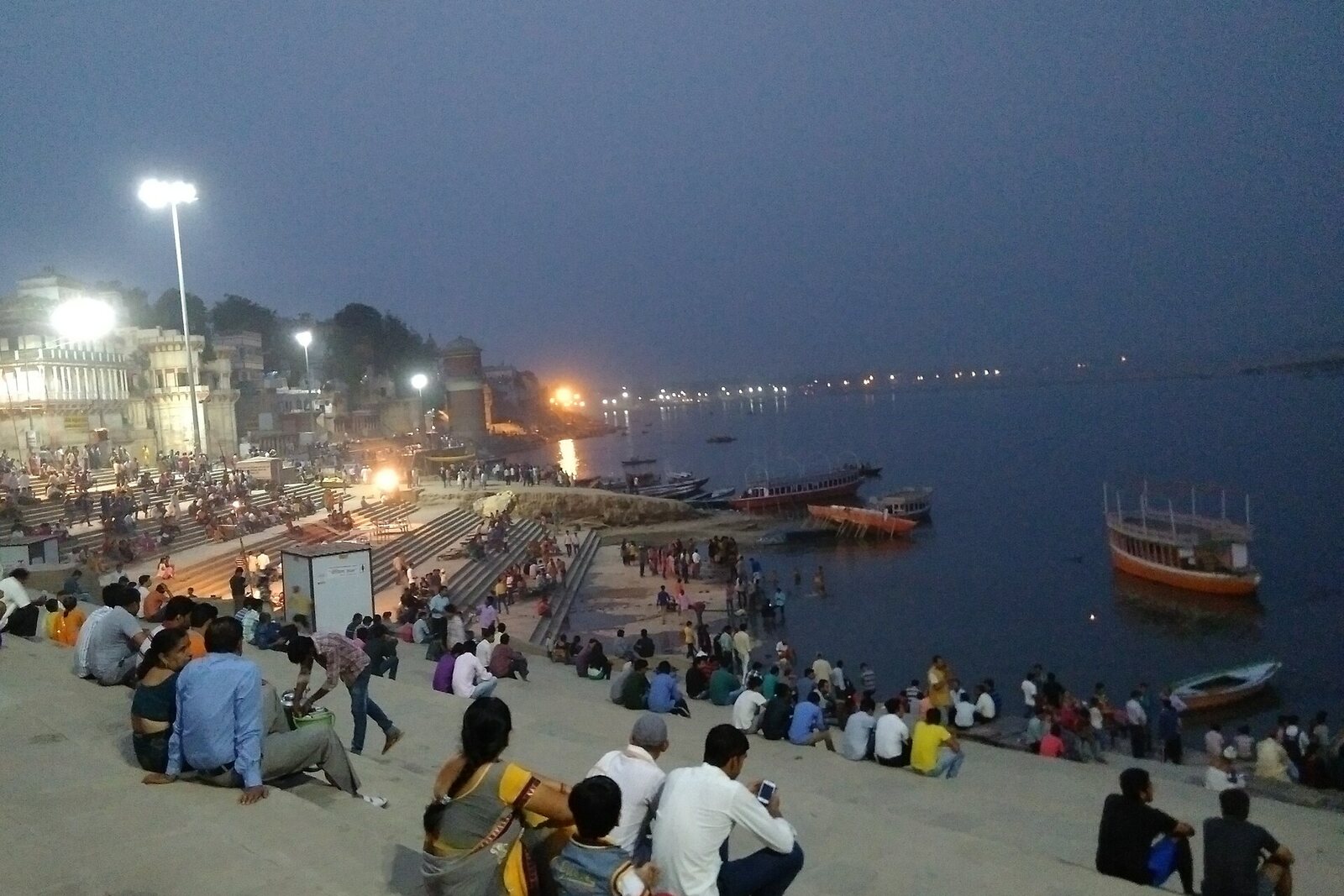
Look around first
What to notice
- Wide steps
- Peepal tree
- Shiva lingam beneath the tree
- Assi Sangameshwar Temple
The story of the place
On the steps of Assi Ghat, a riverside embankment, people were taught more than just prayer. In nineteen fifty-three, sixteen-year-old Kashinath Singh came from a village to Varanasi to continue his education. His father sat his sons down with books because he no longer placed his hopes in the family farm: without an education, he repeated, they would have to beg for alms. The younger son was looked after by his brother Ramji Singh. Ramji himself ran the family affairs, prepared by correspondence for bachelor’s degree examinations, and believed that what Kashinath needed above all was conversational English.
One evening, Ramji brought his brother to Assi Ghat, seated him on a step near a peepal tree, and demonstrated an exercise. Moving about fourteen meters away from the tree, he asked in English what his interlocutor’s name was. Then he ran up to the peepal tree and answered himself: “Sir, my name is Ramji Singh.” He moved away again, asked a question about the father, returned, and answered it. He switched roles and ran between the step and the tree until he was drenched in sweat.
Kashinath later admitted that he never did learn to speak English then. But he completed his studies, became a professor, and then headed the Hindi department at the nearby Banaras Hindu University. Assi remained his regular address beyond the classroom.
A broad street leads into the city from the ghat’s upper platform—a rarity among the waterfronts of old Varanasi, where access is usually through narrow lanes. Students and teachers came down this road to the river. They lingered in tea shops and argued about books and city affairs. Singh recalled that someone would still buy a cup for a visitor without money. Conversation required neither a ticket nor an academic department.
For years, Singh listened to the regulars at Pappu’s tea shop. When he began writing Kashi Ka Assi, he gave the characters their real names and their sharp colloquial speech. He changed only individual details, fearing lawsuits. People recognized themselves anyway: some were indignant, while others threatened fights and court cases. The magazine Hans first printed five texts, and in two thousand four they were published as a book. The novel was repeatedly republished, adapted for the stage, and made into films. Visitors to a small tea shop became characters through whom readers recognized Assi.
The same accessibility determines how the ghat is used today. The wide steps serve as a place for bathing, a boat landing, and an open-air auditorium. In the mornings, Subah-e-Banaras is held here: Vedic hymns are recited, classical music is performed, yoga is practiced, and a fire offering is made to the Ganges. In the evening, aarti takes place—a fire offering to the Ganges. The university remains nearby, so there are many students and teachers here among the pilgrims and visitors.
The ghat’s name arose from the Assi River. Its former mouth marked the southern boundary of sacred Varanasi. According to legend, after her victory over the demons Shumbha and Nishumbha, the goddess Durga threw down her sword; where the blade split the earth, the Assi stream arose. This is a religious legend, not an account of the river’s origin established by historians.
The original mouth itself is no longer by today’s steps. The channel was diverted to the Ganges about seven hundred seventy meters upstream, beyond the Ravidas Ghat park; the former channel at Assi Ghat is blocked and receives household wastewater. People still worship a Shiva lingam beneath the peepal tree here, and nearby stands the small Assi Sangameshwar Temple of Shiva, revered as the patron of the confluence of rivers. It cannot be determined whether the present peepal tree is the one by which Ramji acted out his English lesson. By the steps remain the tree, the Shiva lingam, and the name Assi; the water that gave them this place now enters the Ganges at another point.
Useful on site
Public ghat, usually accessible around the clock; the lower steps and access to the water may change with the water season, cleaning, and festival arrangements.
Checked: June 17, 2026. Check the official source before visiting.Do not block access to the water or interfere with bathing, prayers, or morning activities. During ceremonies, watch from the edge of the shared space.