 Guide On Map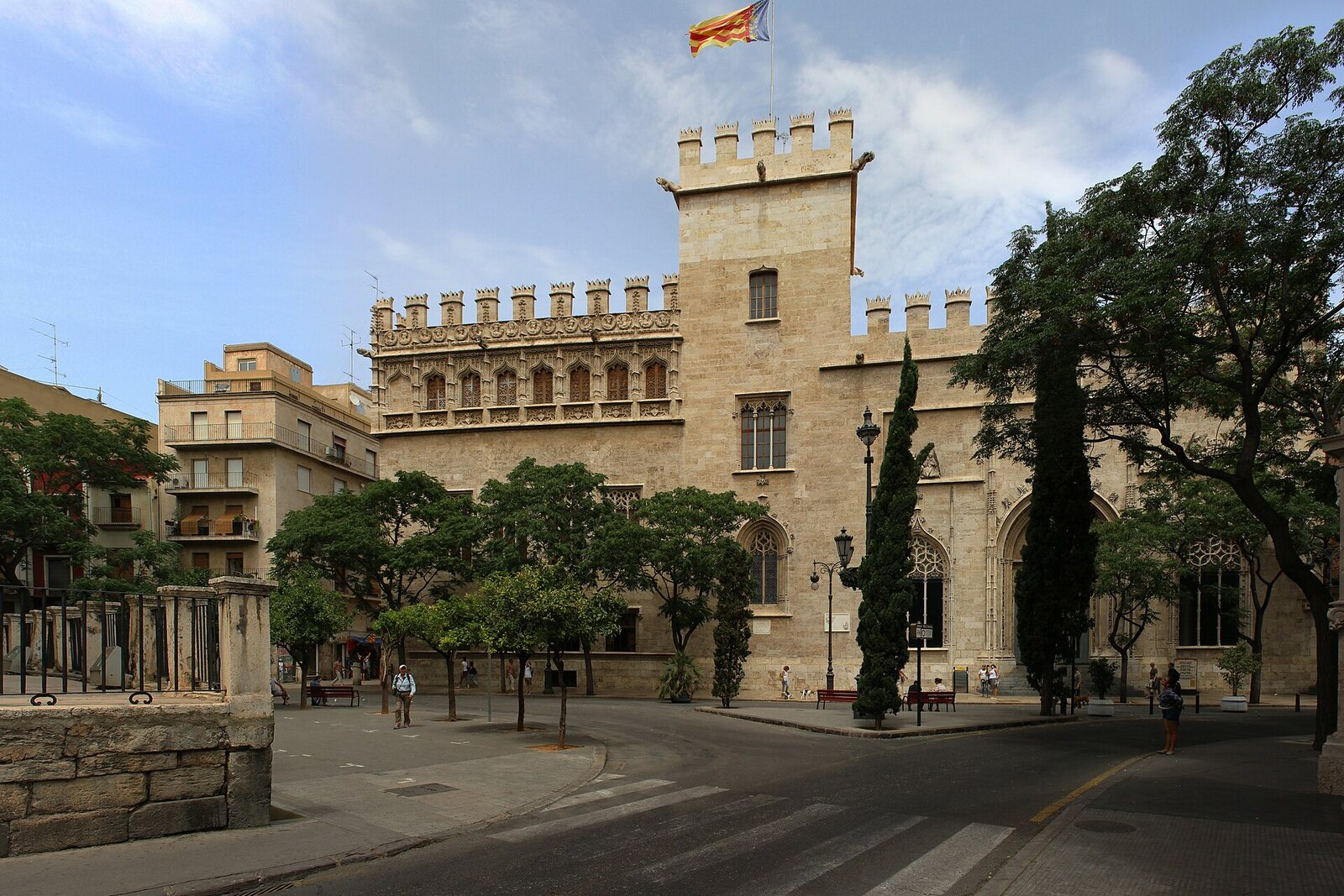
Look around first
What to notice
- Twisted columns
- Latin inscription on the walls
- Stone tower
- Gothic windows
The story of the place
Twisted columns rise in the hall that served Valencian merchants as a place for commercial deals. Goods arrived by sea at the port, while they were sold in the city center and partners for business were found there. Alongside textiles, grain, oil, wool, and spices circulated here. Silk gradually came to the fore and became established in the name of the Silk Exchange, although trade was never confined to silk alone.
The columned hall of the Silk Exchange housed a bank that looked like a piece of furniture. Behind the wooden taula—a table—coins were exchanged, deposits accepted, commercial credit issued, and money transferred from one merchant’s account to another’s. The institution took its name from this table: Taula de Canvis, the “exchange table.”
The city council had already created such a bank in fourteen oh eight, in the old Silk Exchange nearby. The councilors wanted to reduce the city’s debts and safeguard deposits, but instead of using the Taula as a full-fledged bank, they used it chiefly as a municipal treasury. Eight years later, it had to be liquidated because of poor management.
In fifteen nineteen, the councilors decided on a second attempt and set up the New Taula de Canvis in this very hall. They chose the place because this was where the deals themselves came together. Goods arrived at the port by sea, but they were sold in central Valencia; at the Silk Exchange, merchants found partners, made contracts, and settled their obligations. The city guaranteed deposits with all municipal property. The main treasury was managed by three administrators elected for two years; when taking office, they provided their own security. They were assisted by a merchant familiar with trading practice and a notary responsible for the records.
For a merchant, this was substantial protection. His funds could remain tied up for a long time in cargo sent by sea, while the loss of a ship or a debtor’s refusal to pay still left obligations to other people. The Taula made it possible to keep money under the city’s guarantee, pay for deals without carrying the entire sum in coins, and obtain credit for the next round of trade. The New Taula de Canvis lasted until sixteen forty-nine, when it was closed after another financial failure. Nine years later, the councilors opened a third institution, the Newest Taula de Canvis; it was finally liquidated in seventeen nineteen.
The merchant’s risk was built into the structure of the building. Between the trading hall and the chamber of the Consulate of the Sea—a court that heard disputes among participants in maritime trade—stands a tower. Its two upper floors were intended for merchants declared insolvent. On the lower level, contracts were made and payments carried out; nearby, disputes were tried; above, those who could not pay were held. A Latin inscription runs along the walls of the hall: it requires merchants not to lie in trade, not to cheat their neighbor, and not to lend money at interest; it promises wealth and eternal life to the honest merchant.
The name “Silk Exchange” became established later. Grain, oil, wool, spices, and other goods were traded here, but silk gradually displaced them in the city’s economy. Even before the hall opened, fifty-six master silk weavers, including twelve Genoese, drew up the rules of their craft. The city council and King Ferdinand recognized their association; the Genoese passed on to Valencians the techniques for making velvet, satin, damask, and brocade. By fourteen eighty-seven, Valencia had two hundred ninety-three master silk weavers. By the end of the seventeenth century, their product had given the Silk Exchange the name that remained with the building, although deals here were never limited to silk.
The wooden Taula in the columned hall is no longer there. The table behind which the city guaranteed merchants’ deposits was moved to Cervelló Palace; at the Silk Exchange, only the inscription above the place of the deals and the two prison floors in the tower remain.
Useful on site
Exterior viewing is unrestricted; the official tourism page gives daytime hours for the Silk Exchange, with a reduced schedule on Sundays/holidays and last entry before closing.
Checked: June 27, 2026. Check the official source before visiting.The façade is worth taking in slowly and from different points around the square. The trading hall is accessible only with separate admission; even without it, the stop remains meaningful.