 Guide On Map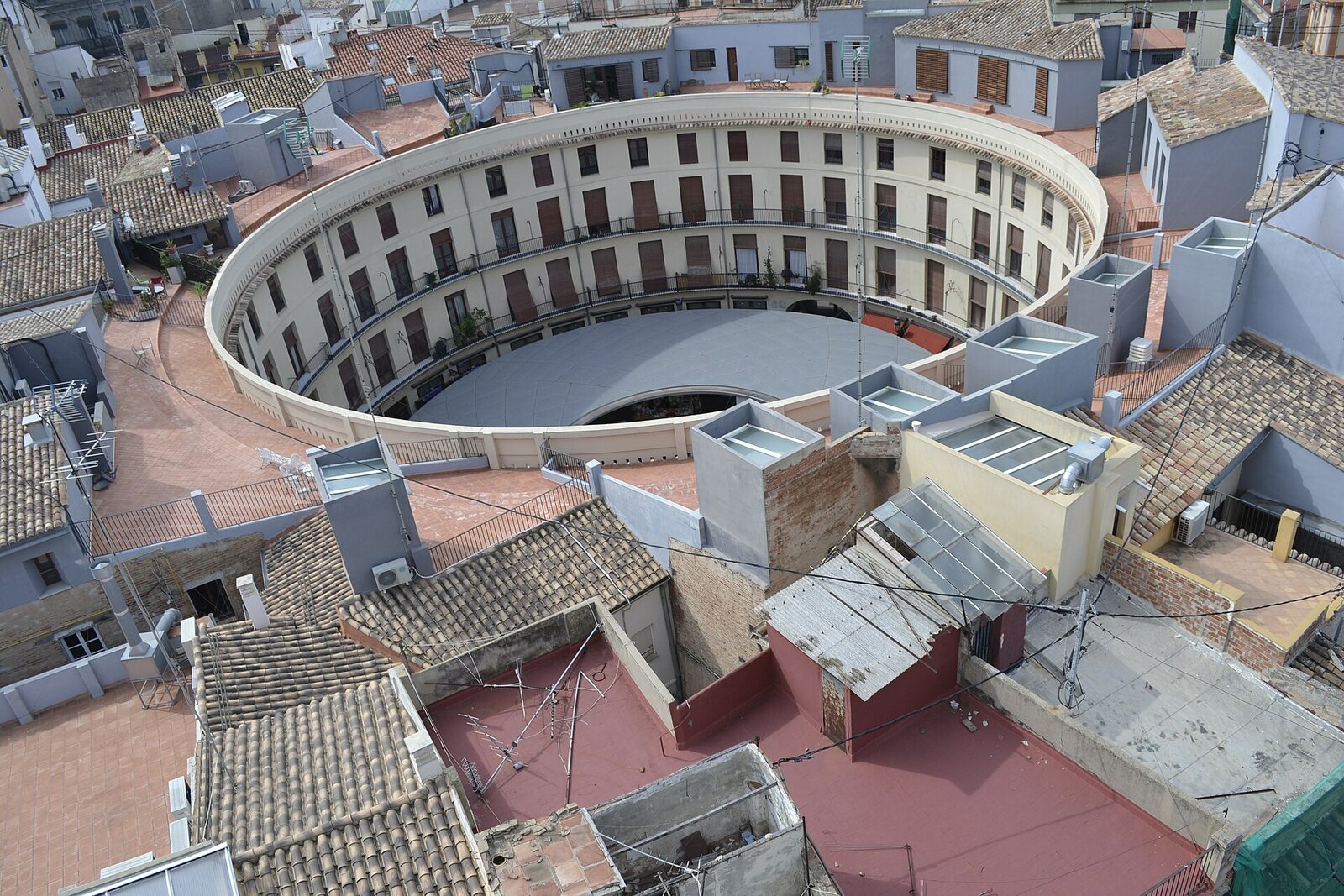
Look around first
What to notice
- Ring of houses with balconies
- Central fountain
- Inner market stalls
- Four passages
The story of the place
In sixteen sixty-five, sellers of partridges, rabbits, and other game were forbidden to trade anywhere in Valencia except El Clot—the “Pit,” which occupied the site of today’s Plaza Redonda. Birds here were sold mainly by women. They stood holding their goods or moved among the buyers; the chance to choose a busy spot determined their daily earnings. After the order, only one address remained permitted.
The order was issued by the mustasaf, a city judge who inspected markets, scales, and the quality of foodstuffs. He sought to ensure that perishable goods were inspected in one place. The game warden subordinate to him checked whether the game was fit for sale. If a buyer asked for a bird to be plucked, another municipal official collected the feathers left behind. The women traders lost the opportunity to look for buyers throughout the city, but for several centuries El Clot became Valencia’s market for birds, rabbits, and game.
The circular courtyard did not yet exist. There were meat stalls, a slaughterhouse, and a fish market here. Later, the mustasaf’s duties passed to Tribunal del Repeso—an institution where purchases were reweighed and complaints about traders were heard.
In eighteen thirty-nine, Manuel Tió, commissioner of the repeso, proposed rebuilding the old stalls that his department was to supervise. The architect Salvador Escrig placed thirty-four houses around the market, forming a closed ring thirty-seven meters in diameter. Spaces on the ground floor were set aside for traders, with apartments above them. Thus, the sellers remained in the same place, but instead of a slaughterhouse and scattered counters, they received a ring of shops with four passages.
At first, the center of the square was empty. A fountain was installed in eighteen fifty, and the inner ring of wooden stalls was added only in nineteen sixteen. The present-day counters and canopy appeared after the reconstruction of twenty twelve.
Now the permanent stalls sell fabrics, haberdashery, handicrafts, and souvenirs. The Sunday market is set aside for old books, stamps, coins, card albums, engravings, paintings, and bird supplies. One of the passages leads to Carrer de Pescateria—Fish Street. The square’s official name describes the circle designed by Escrig. Valencians also continue to use the old name, El Clot: that was the name of the market-“pit” where the order gathered the women game sellers.
Useful on site
An open city square; shops, stalls, cafés, and Sunday trading operate on individual schedules.
Checked: June 27, 2026. Check the official source before visiting.The square is compact: let shoppers pass and do not linger in the narrow entrances. The stalls’ activity varies, but the shape of the space and the fountain are visible regardless of trading.