 Guide On Map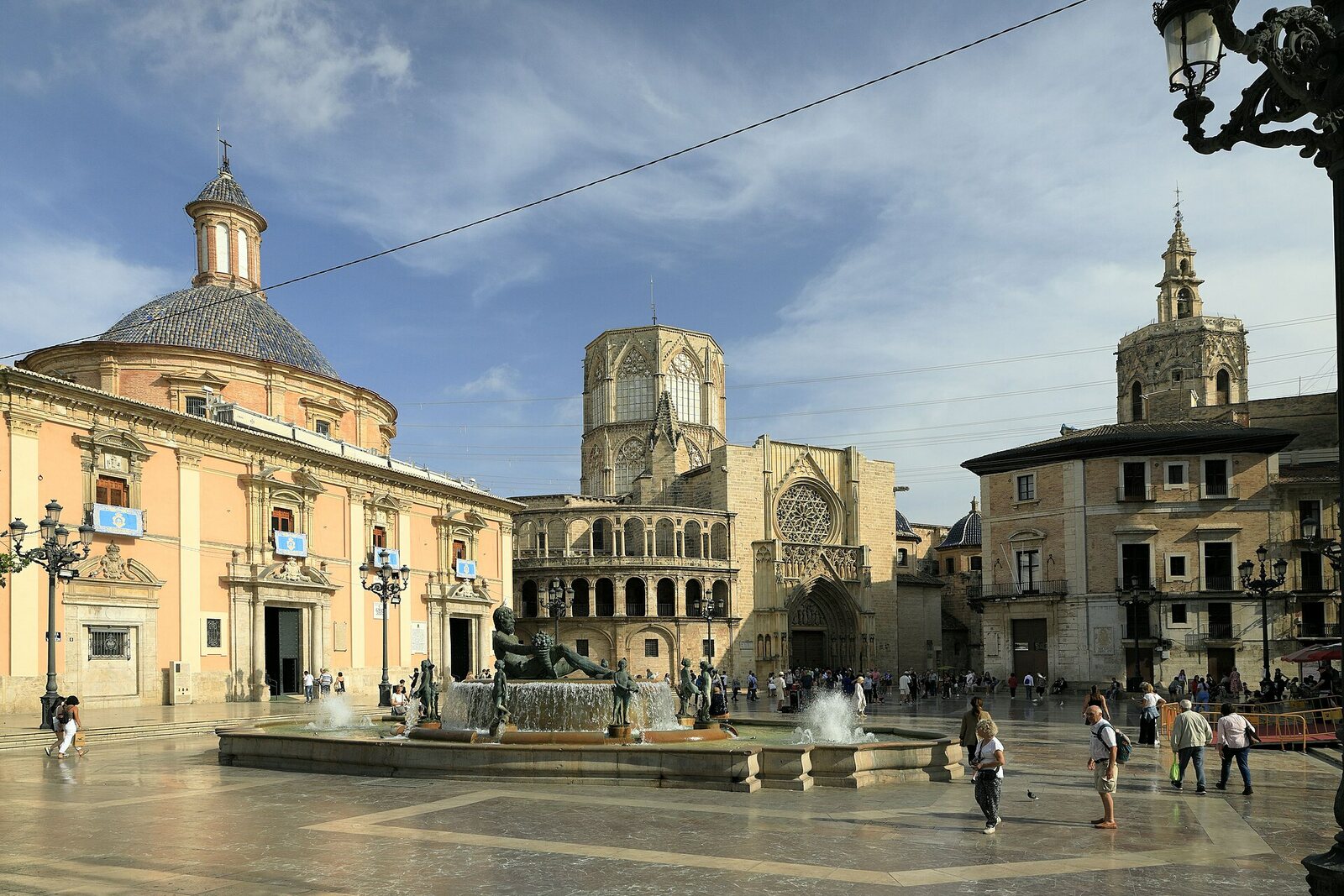
Look around first
What to notice
- Apostles' Gate
- Fountain with a reclining figure of the Turia River
- Eight figures with jugs
- Ceramic plaque of Casa Vestuario
The story of the place
At the cathedral, traces of two different cities meet: Valencia's main mosque once stood here, while Casa Vestuario, where the syndics meet, survives opposite the portal. A bronze figure of the Turia River lies in the middle of the paved square; eight women with jugs stand around it in a circle. On the facade of Casa Vestuario, a ceramic plaque gives the square the name of Our Lady, and the basilica answers it from across the square.
Every Thursday at exactly noon, eight elected syndics appear at the Apostles' Gate—farmers whom the irrigation-channel communities have entrusted with judging water disputes. They take their seats directly in front of the cathedral, and the court bailiff begins calling the defendants by the names of the canals. The order of summons follows the water's course from the Turia River: from those who received it earlier to those farther downstream.
Outside the city, this water determined whether a family would have a harvest. The fields were irrigated in turn, so a farmer who raised a barrier at someone else's allotted time could save his own plantings and leave a neighbor without irrigation. Cases came before the court for unauthorized withdrawal of water, damage to a canal wall, a blockage that kept the flow from reaching farther on, and releasing excess water onto a neighboring field. The last offense was serious too: a harvest can be destroyed by flooding as well as by drought.
The canal guard summons the defendant for the following Thursday and states the complaint here as well. The defendant answers personally. There are no lawyers, and written documents are usually unnecessary; a witness may be brought in, or an inspection of the plot may be requested. The syndic of the canal to which the parties in the dispute belong takes no part in the discussion. If the defendant uses a canal on the Turia River's right bank, the representatives of the left bank propose the decision, and vice versa.
The verdict is delivered immediately. There is no appeal: if a person is found guilty, that person's community collects the set fine, costs, and compensation for damage. This speed arose from economic necessity. A court case can wait for months; the irrigation schedule and damaged plants cannot. The judges themselves derive their income from their farms and receive no pay for hearings.
The court's origins are dated to the time of al-Andalus, between the ninth and thirteenth centuries, but documents have not preserved the exact year of its founding. Thursday, which precedes the Muslim Friday day of rest, and the site by the former main mosque are cited as evidence of this connection, not as conclusive proof. A cathedral later appeared here in place of the mosque, and the farmers continued to gather at the same public threshold. The hearing remained open: every verdict is delivered before the parties and passersby.
Opposite the gate stands Casa Vestuario—the syndics' meeting place. Before the court, the syndics prepare there; afterward, they discuss the distribution of water and the state of the canals. And the bronze giant lying in the middle of the square represents the Turia River. Around him stand eight female figures with jugs—the eight historic canals of the Valencian Huerta, the irrigated rural district. The fountain shows the workings of the very system for which defendants are summoned at the cathedral gate.
On the facade of Casa Vestuario is a ceramic plaque with another explanation of the square. It bears the Valencian words for “Our Lady Square” and depicts Our Lady of the Forsaken, the patroness of Valencia.
Her name grew out of an act by the Mercedarian friar Juan Gilabert Jofré. In fourteen hundred nine, he was on his way to preach at Valencia Cathedral when he saw several young men beating a person with mental illness. Jofré intervened and then, during his sermon, urged the congregation to create a refuge for people abandoned by their families and beaten in the streets. The townspeople raised money, formed a committee, and built a hospital.
Five years later, they founded a brotherhood to support the sick, help foundlings and prisoners, and bury the executed and unidentified dead. These were the people called forsaken—those left without family, protection, and burial. During funeral processions, the brotherhood laid the statue of Our Lady on their coffins. That is why it had a flat back, while its head rested on a small pillow and was slightly inclined.
In sixteen sixty-seven, the statue was moved to a new chapel on this square, now the Basilica of Our Lady of the Forsaken. From it, the former Cathedral Square received the name of the Virgin. On the ceramic plaque of the water judges' building, Our Lady is still shown in the old iconography; in the basilica opposite, the tilt of her head still reveals the statue that was once carried lying on the coffins of people who had no family to bury them.
Useful on site
Open city square; the Water Tribunal normally convenes on Thursdays at 12:00 by the Apostles' Gate, with changes on holidays and during city events.
Checked: June 27, 2026. Check the official source before visiting.During a Water Tribunal hearing, stand aside and remain quiet. Entry to the basilica depends on the building's religious life and is not needed to understand the square.