 Guide On Map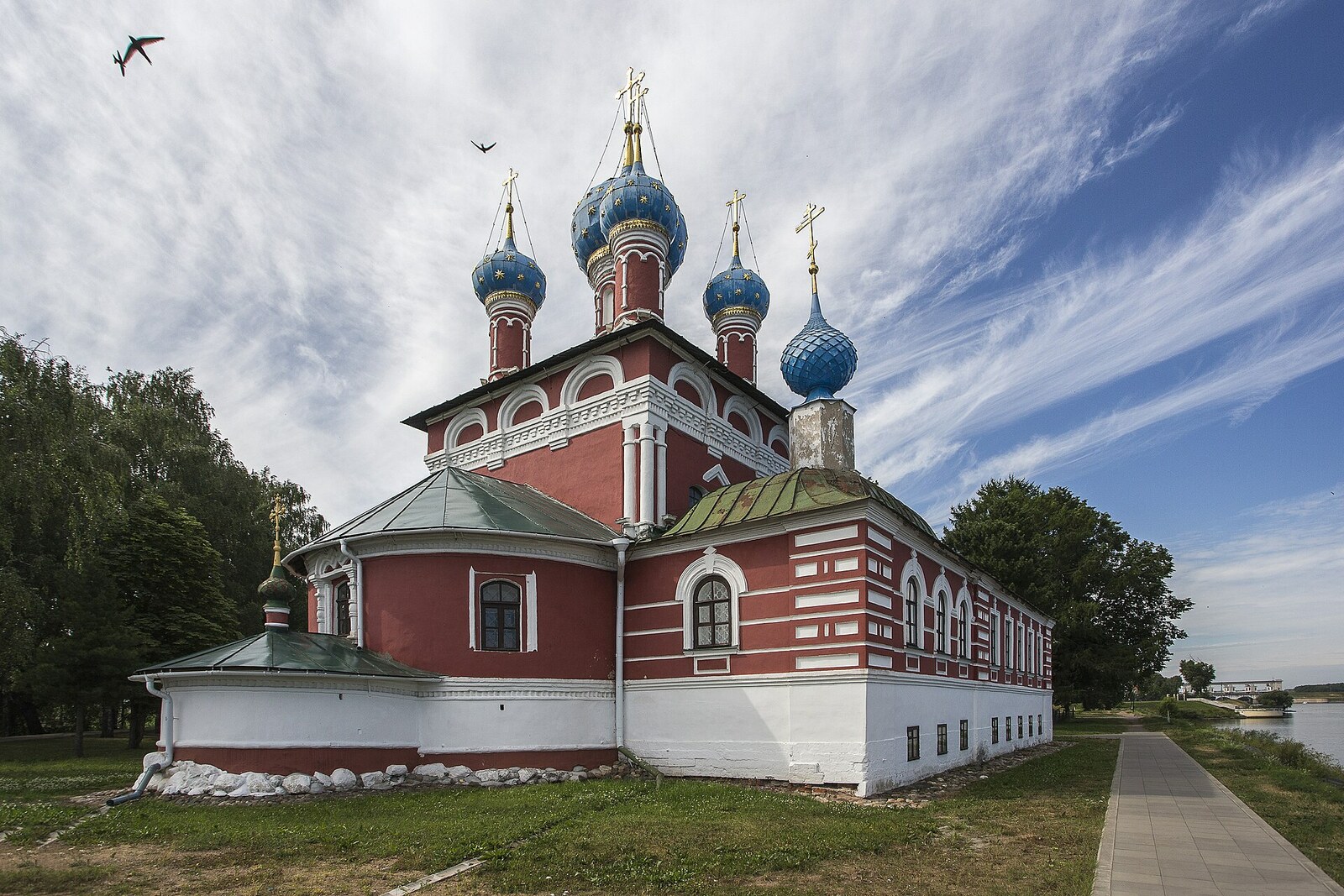
Look around first
What to notice
- Painting on the western wall
- Photocopy of the investigation file
- Images of the tsarevich and townspeople
The story of the place
The western wall inside the church is occupied by a painting of the tsarevich and the townspeople, and beside it a photocopy of an old investigation file is displayed. The stone church of the late seventeenth century replaced the chapel and wooden church that had stood here before. It received its name, “on the Blood,” later, when the tsarevich began to be venerated as a saint.
On May fifteenth, fifteen ninety-one, eight-year-old Dmitry, the younger son of Ivan the Terrible and brother of Tsar Fyodor Ioannovich, went out to play in the yard of his Uglich palace. After his father’s death, the boy and his mother, Maria Nagaya, were sent here from Moscow. Uglich became his appanage—the city maintained a separate princely court. Dmitry’s uncles lived with their nephew and, thanks to him, retained their status and income. With his death, the family stood to lose everything at once.
For several days, Dmitry had repeated attacks of the falling sickness, as epilepsy was called then. That day, he held a knife used in a children’s game. The nanny, wet nurse, bedchamber attendant, and the boy’s companions later testified that during an attack Dmitry was thrown to the ground and wounded his own throat.
His mother ran into the yard and decided that her son had been murdered. She named as murderers the nanny’s son, as well as the son and nephew of Mikhail Bityagovsky, a Moscow court clerk who managed palace affairs and kept watch over the Nagoys. The family had long been quarrelling with him over money and obligations. That very morning, the tsarina’s brother, Mikhail Nagoy, demanded money from the treasury beyond the amount set, and the clerk refused.
The alarm bell was rung. The townspeople who gathered began their reprisal. Bityagovsky arrived at the yard and tried to stop the people, then hid in one of the palace huts. The crowd broke down the door, dragged him outside, and killed him. His son, nephew, the nanny’s son, and several servants also died. One of those accused was brought to Maria Nagaya and killed in front of her.
Three days later, Mikhail Nagoy tried to support the accusation with physical evidence. According to the testimony of his brother and the town clerk, he ordered two knives bought, an iron club obtained, a chicken slaughtered, and the weapons smeared with its blood. The objects were then laid out beside the dead men, as though they had belonged to those involved in the attempt on the tsarevich.
The following day, the boyar Vasily Shuysky arrived in Uglich, sent to determine how Dmitry had died and who had begun the reprisal. The commission questioned more than a hundred people and found that the boy’s death had been an accident during an attack. That conclusion did not remove every doubt: the investigators had been sent by the Moscow court, against which the accusation had been made. But the planted weapons did not prove murder either.
Maria Nagaya sent the metropolitan a plea for mercy for her relatives and called the reprisal a sinful, culpable act. She was forcibly tonsured as a nun under the name Marfa and sent to a monastery. Her brothers were exiled, while Uglich residents implicated in the killings were executed or expelled.
Fifteen years later, the same Vasily Shuysky became tsar. He faced a new task: to prove that the man who had managed to take the throne under the name of the surviving Dmitry was an impostor. Shuysky ordered the boy’s remains moved to Moscow, and Dmitry began to be venerated as an innocently murdered saint. Thus the former investigator rejected the conclusion of his own commission.
After the canonization, a chapel was erected at the place of death, followed by a wooden church. The present stone church was completed in sixteen ninety-two. Its words “on the Blood” established the version of murder. On the inner western wall, villains strike Dmitry, townspeople punish them, and the tsarevich’s remains are carried away to Moscow. The same church displays a photocopy of the investigation file, with testimony about the knife in the boy’s hand and the weapons that adults had smeared with chicken blood.
Useful on site
The museum site opens at 09:00; check the exact summer closing time on the day of your visit.
Checked: June 24, 2026. Check the official source before visiting.The interior is part of the museum exhibition. View the frescoes as a later interpretation of events, not as an eyewitness account.