 Guide On Map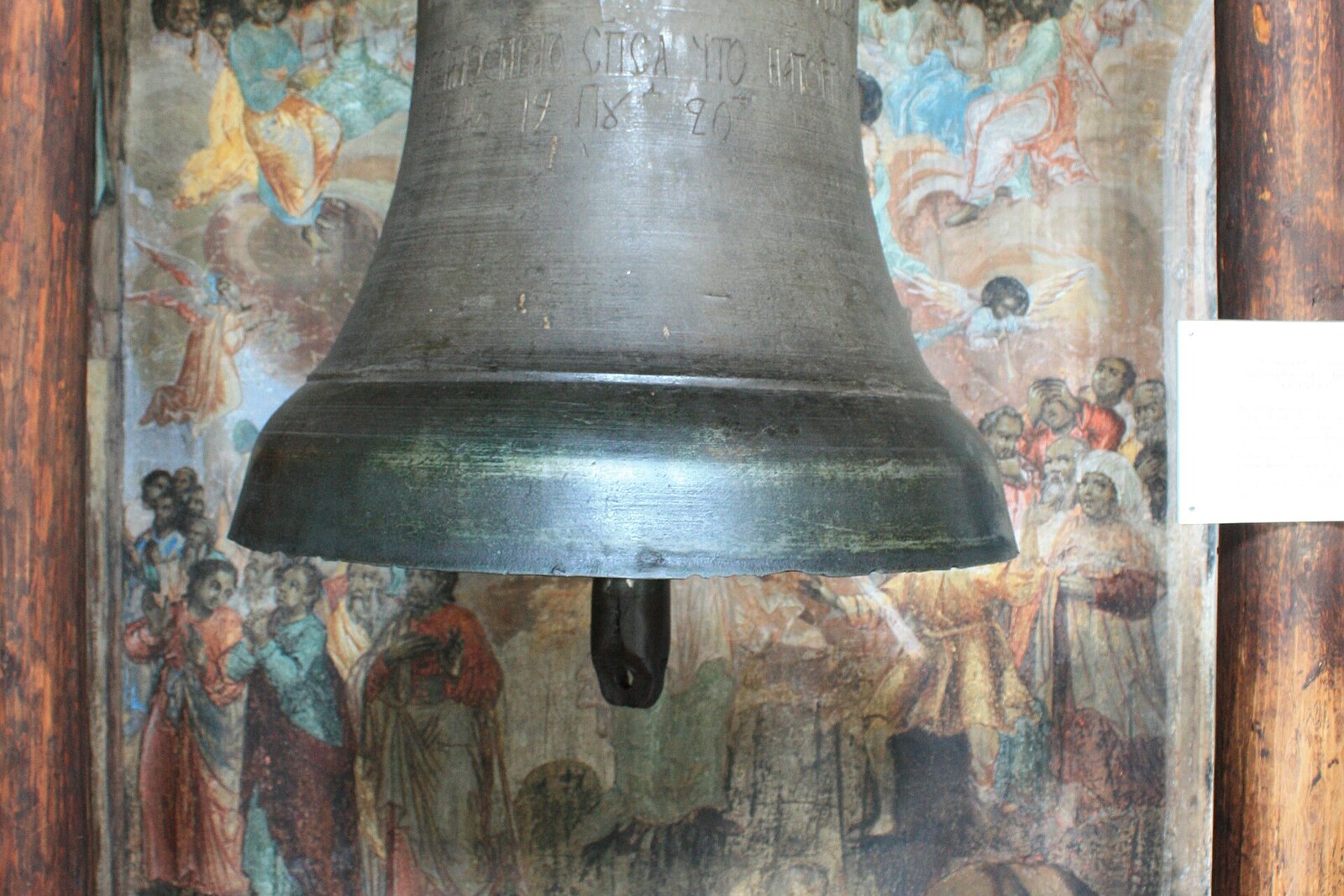
Look around first
What to notice
- Bronze bell
- Tobolsk inscription
- Bell ear
- Bell tongue
The story of the place
The Church of Tsarevich Dmitry on the Blood holds a bronze bell that became a museum object after its return to Uglich. An inscription from Tobolsk, made much later than the events it describes, can be read on its body. Beside it, the tongue and ear are visible—the latter is the name for the suspension loop; before entering the display case, the bell had again served on bell towers and struck the hours.
On May fifteenth, fifteen ninety-one, the widowed priest Fedot Afanasyev, nicknamed Cucumber, and the watchman Maksim Kuznetsov climbed not this church, but the bell tower of the Transfiguration Cathedral. Maria Nagaya ordered the townspeople to be summoned to the princely court. That was what the alarm bell was for: its ringing announced an extraordinary event and gathered people. The stone Church of Tsarevich Dmitry on the Blood did not yet exist.
The crowd that came in response to the alarm dealt with those who had been called the tsarevich’s murderers. After an inquiry led by Prince Vasily Shuysky, both the participants in the lynching and the object from which it had all begun were punished. The bell was thrown down from the belfry, stripped of the sign of the cross, had its tongue torn out, and had one of its ears chopped off—the name given to the loops by which a bell is hung—was given twelve strokes of the whip, and sent to Siberia. Sixty Uglich families were exiled there for permanent settlement.
According to a later legend, the exiles dragged the heavy bell to Tobolsk themselves for almost a year. There is no documentary confirmation of this detail. What is reliably known is that in fifteen ninety-three, the bell arrived in Tobolsk together with the people of Uglich. The local voivode first ordered the unusual prisoner to be kept in the government office, then church servants raised it to the bell tower of the Church of the Savior. Later, at Sophia Courtyard, it struck the hours. Exile did not silence the bell: it was given a new tongue and again used for its intended purpose.
Almost three centuries later, Leonid Solovyov took on the task of returning it. A native of Uglich, he had been sent to Saint Petersburg as a boy to work as a servant. He became an independent trader and then a merchant of the second guild. Solovyov supported the Uglich museum and public library, and in the late eighteen eighties he gathered fellow countrymen living in the capital, offered money for the journey, and began seeking the bell’s return through city institutions, ministries, and the Holy Synod. He put his own funds and merchant connections into the matter, although an earlier petition from the people of Uglich had already been rejected.
Tobolsk Museum did not want to part with the exhibit. An entry was found in an old Siberian chronicle: during a fire in sixteen seventy-seven, the exiled bell melted away completely. That meant that the bell displayed in Tobolsk could have been a later replacement. The people of Tobolsk used precisely this to argue that Uglich had no right to demand the object back, while at the same time asking to keep it for themselves: for more than two centuries, residents and visitors had considered it that very exiled bell.
Emperor Alexander III authorized its return. In the spring of eighteen ninety-two, a delegation from Uglich paid Tobolsk Museum six hundred rubles—the amount needed for a new bell for the bishop’s church—and took their purchase home. In May, the bell was delivered to Uglich, and soon it became one of the first exhibits of the city’s Museum of Antiquities.
The museum now displays it here, in the Church of Tsarevich Dmitry on the Blood. An inscription from Tobolsk, about the alarm, the exile, and service on the Sophia Bell Tower, is carved into the bronze, but the inscription itself appeared much later than the Uglich events. The bell’s authenticity remains disputed. It has been established with certainty that this is the object which the Uglich delegation took from Tobolsk Museum for six hundred rubles and brought to Uglich in May eighteen ninety-two.
Useful on site
Accessible only inside the Church of Tsarevich Dmitry on the Blood and follows its museum schedule.
Checked: June 24, 2026. Check the official source before visiting.The bell is in the museum space. If the exhibition is unavailable, do not replace viewing it with a retelling of the legend.