 Guide On Map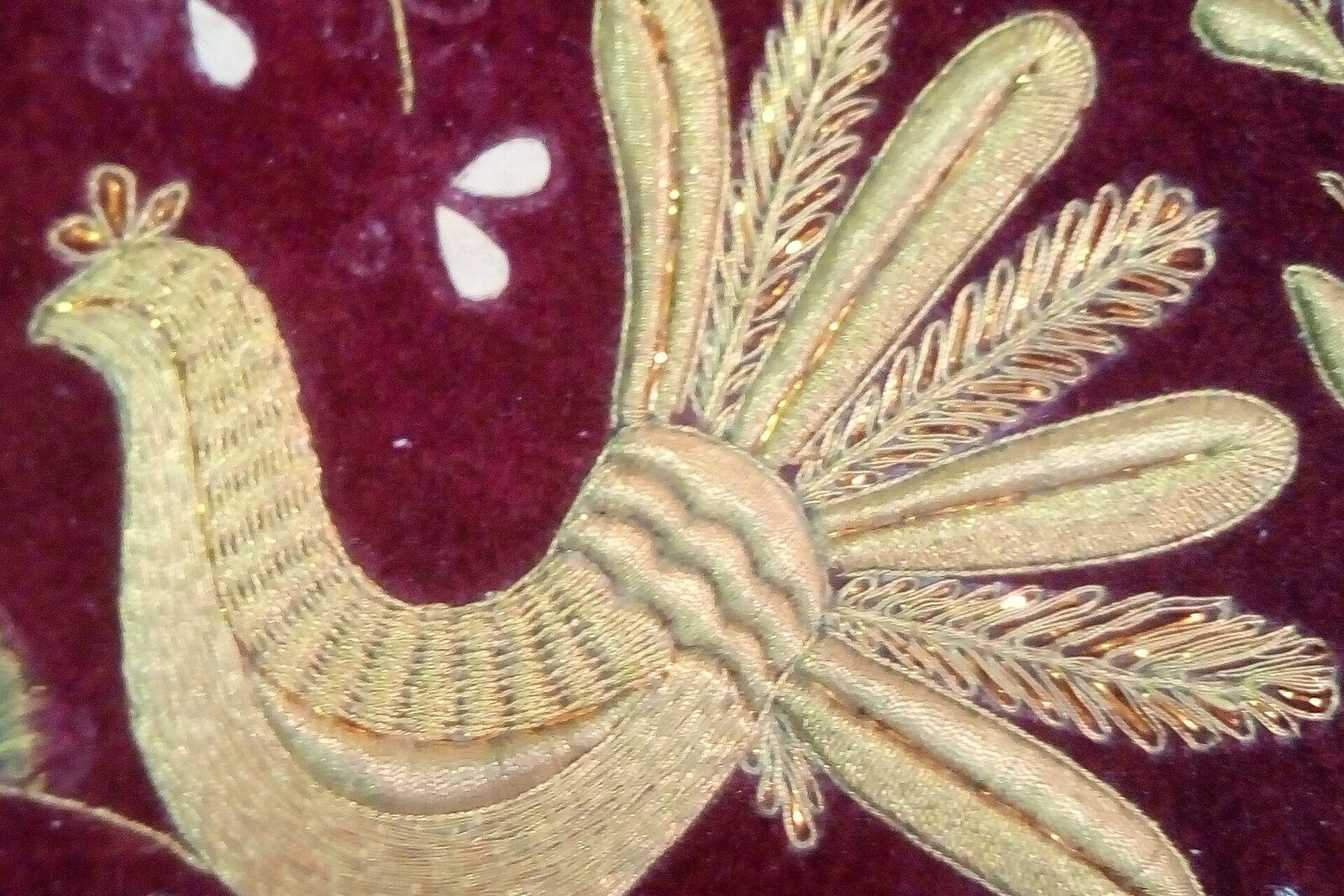
Look around first
What to notice
- Long factory building
- Museum display cases
- Embroidery hoops
- Metallic thread on the front side of the fabric
The story of the place
By the time old Torzhok embroideries began to be collected for the museum, fashion for embroidered boots, sleeves, and headdresses had already passed, and the number of professional craftswomen had fallen by about a factor of three over several decades. The collection served the training workshop: from old specimens, pupils restored forgotten ornaments and methods of laying thread. These works lie in the display cases, and on the embroidery hoops beside them visitors repeat a stitch.
The museum is in the left wing of the long building, while the remaining rooms are occupied by the Torzhok Gold Embroiderers factory. Here, they display items and documents and hold master classes, while next door craftswomen carry out new orders. Gold embroidery is made in an unusual way: metallic thread is not pulled through the fabric. It is laid along the pattern on the front side and secured with an almost invisible silk thread. This way, the costly material breaks less and does not pass to the reverse side.
By the end of the nineteenth century, this skill had nearly been left without work. In the eighteen sixties, there were about three hundred professional gold embroiderers in Torzhok; by the end of the century, there were roughly three times fewer. Fashion for embroidered boots, sleeves, and headdresses had passed. Merchants bought the craftswomen's work cheaply, and there were few new orders. For a woman who lived by her embroidery, the disappearance of the craft meant the loss of income, not merely the loss of an old pattern.
Dmitry Romanov, a member of the Novotorzhskaya Zemstvo Board, pressed for craftswomen to sell their work through the district self-government rather than give intermediaries part of their payment. On February twenty-first, eighteen ninety-four, he headed the cottage-industry department established under the zemstvo. The Ministry of the Navy became its first major customer: gold embroiderers were assigned to make thirty-one thousand nine hundred twenty rank insignia for naval enlisted personnel. There was no gold thread in this order—the insignia were embroidered with red thread. Yet dozens of craftswomen received paid work that required their precision and their familiarity with counted stitch.
Romanov was not content merely to distribute a single order. He opened a training workshop, where girls from peasant families learned to transfer a pattern onto fabric, prepare the padding, and only then take up complex stitches. The work of Torzhok craftswomen won gold medals at exhibitions in Paris and Turin. In nineteen eleven, Romanov began collecting old specimens for a museum: from them, pupils could restore forgotten ornaments and methods of laying thread.
After Romanov's death, the workshop closed, and the work he had created was again under threat. In nineteen twenty-three, training resumed in Torzhok; the graduates formed a gold embroiderers' artel, later converted into a factory. The present enterprise traces its history back to Romanov's cottage-industry department.
Behind the museum door, old embroideries lie in display cases, but the place retains its instructional setup: beside the exhibits stand embroidery hoops on which visitors are invited to repeat a stitch. Romanov collected specimens so that a craftswoman could continue someone else's work; here, this transition from a museum piece to new embroidery takes place within a single factory building.
Useful on site
Official pages conflict: the contacts section lists daily 9:30–18:30, while the visitor rules list weekdays 9:00–18:00 and weekends 9:00–17:00.
Checked: June 24, 2026. Check the official source before visiting.Access to the exhibition is needed to get acquainted with the technique, so it is best to confirm your visit in advance. At the display cases, examine the work from different angles without touching the fabric or metallic details.