 Guide On Map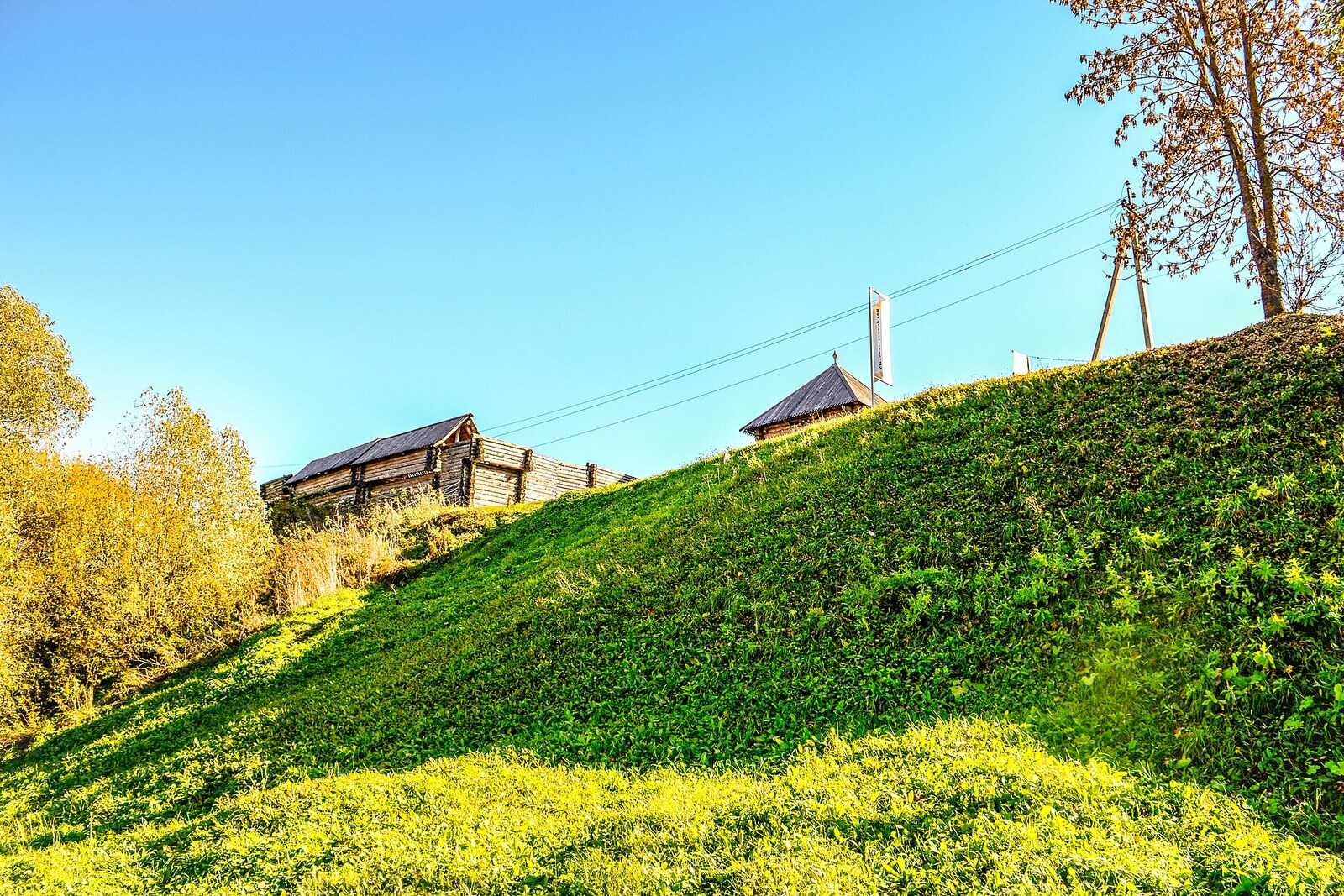
Look around first
What to notice
- Earthen rampart
- Outlines of the ditch
- Wooden tower
- Siege machines
The story of the place
The upper part of the city’s fortifications once stood on a high hill above the Tvertsa. Below, closer to the main cathedral, lay the church and boyar center, while the prince and his deputies lived on the hill. On three sides, the river, a stream, and steep slopes made the approach difficult; on the landward side, the residents dug a ditch and raised an earthen embankment. The fortifications guarded the trading town, through which bread from the Upper Volga lands traveled to Novgorod, together with the road, the courtyards, and the supplies.
The wooden tower, battering ram, and catapult appeared here as museum structures. The medieval fortress has not survived. What remains of it are Upper Hillfort, an earthen rampart, and the outlines of a ditch.
The Kremlin consisted of two fortified parts. Below, near the city’s main cathedral, stood the church and boyar center; on this hill stood the castle of the prince and his deputies. The Tvertsa, a stream, and the slopes blocked the approaches on three sides; on the fourth, people dug a ditch and raised a rampart. In the chronicles, the city was called both Torzhok and New Market. The word “Novotorzhsky” came from New Market, and the residents of Torzhok are still called novotory.
Bread from the Upper Volga lands was transported through the city to Novgorod. Torzhok lived by transporting and selling this bread, while the Kremlin protected the road, the courtyards, and the supplies. In the winter of twelve thirty-eight, Batu’s army, moving farther north, approached the city. There was no prince or his retinue in Torzhok. The defense was led by the posadnik Ivanko, a city administrator who had to replace the military commander. The walls were held by the town militia.
The Mongols surrounded the fortress with a wooden barrier and set up stone-throwing machines. The chronicler calls them “poroki.” For two weeks, they battered the fortifications, while Ivanko and the novotory beat back the assaults, waiting for help from Novgorod. No help came. The people in the fortress grew exhausted, Batu’s army took the city and carried out a mass slaughter. Ivanko died together with the other leaders of the defense. Residents, priests, and monks were killed; those who managed to break out were pursued along the road north. Torzhok burned down.
New wooden walls were not put up until ten years later. They were rebuilt more than once, until another great fire in seventeen forty-two destroyed the Kremlin completely. The townspeople did not rebuild the fortress, which had lost its military importance.
The present complex opened in two thousand twelve in memory of Torzhok’s defenders. The tower here is a model of the seventeenth-century Mikhailovskaya Gate Tower, and the siege machines show what lay behind the chronicle word “poroki.” The real trace of the defense lies below the wooden scenery: it is the rampart and the high edge of the hillfort, behind which Ivanko and the town militia held out for two weeks.
Useful on site
The official page contains the concluded winter schedule, 10:00–18:00 until 17 April 2026; the current summer schedule had not been published as of the verification date.
Checked: June 24, 2026. Check the official source before visiting.Move carefully on the unpaved ground and changes in elevation, especially after rain. Treat the museum objects as an additional part of the visit if their availability has not been confirmed.