 Guide On Map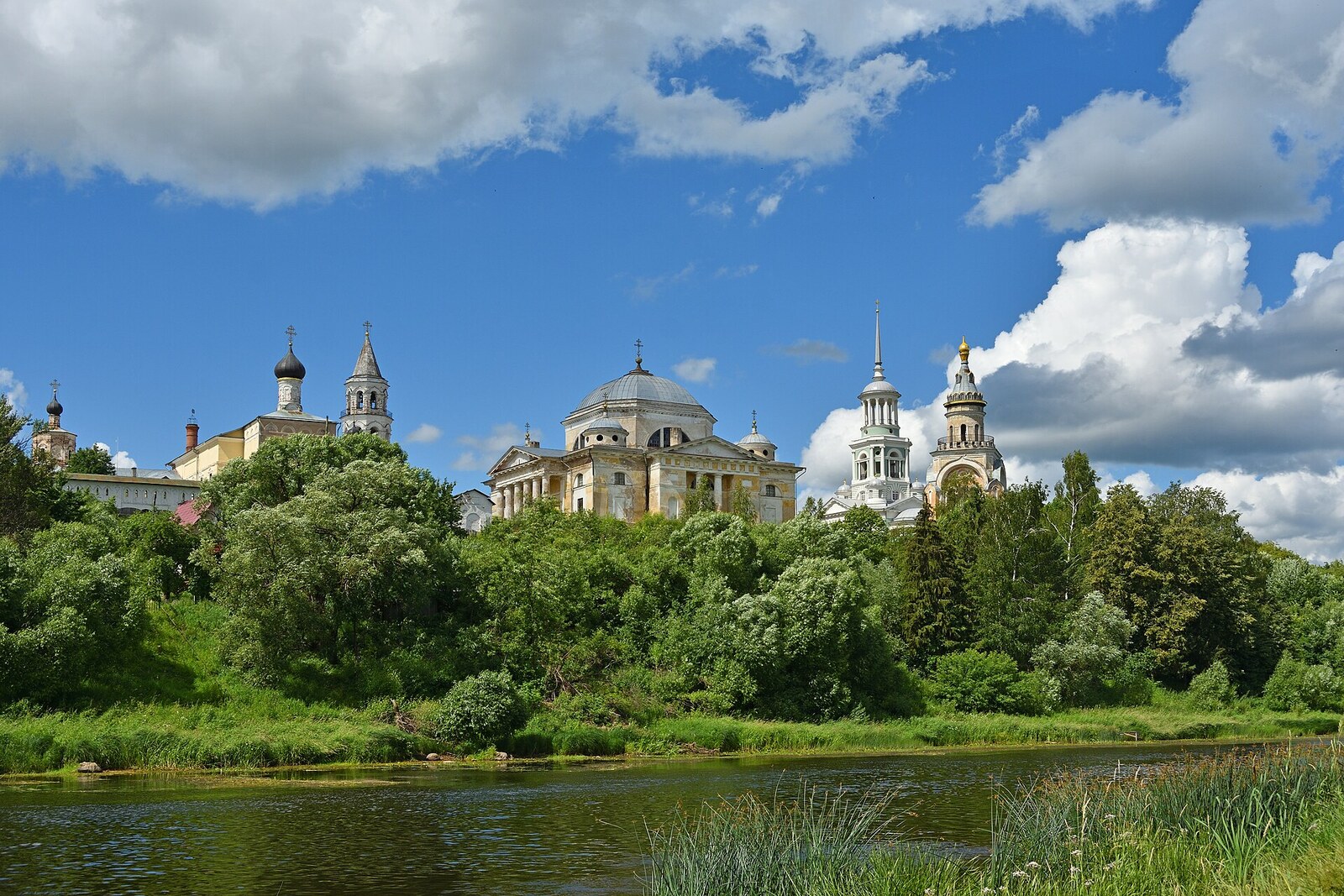
Look around first
What to notice
- The five-domed Boris and Gleb Cathedral
- Vvedenskaya Church
- Monastery walls
- The high bank of the Tvertsa
The story of the place
By the river route, beside a fortified town on the high bank of the Tvertsa, stood a monastery where a traveler could receive shelter and then remain in the monastic community. Its walls and churches stand on a hill above the river; the present five-domed cathedral was erected at the end of the eighteenth century on the site of an earlier church. Vvedenskaya Church keeps a fragment of relics that returned to the monastery after the sacred objects had been absent for a long time.
According to monastery tradition, Efrem came to the Tvertsa carrying the severed head of his brother. He supposedly kept this head until his death and ordered it placed in his own tomb. This is how the story begins from which the name of Borisoglebsky Monastery grew.
Efrem served as the stablemaster of Prince Boris: he managed his horses, lived in the prince’s service, and belonged to his court. Efrem’s brother Georgy was a member of Boris’s retinue. Boris himself and his brother Gleb were sons of Prince Vladimir. After their father’s death, they could have prevented their half-brother Sviatopolk from achieving primacy among the princes. Old Russian saints’ lives place the order to kill both brothers on Sviatopolk.
When the killers came for Boris, Georgy shielded the prince with his own body. Around the retainer’s neck was a gold grivna, a heavy neck ring given by the prince as a sign of closeness and a reward for service. They could not remove it from the dead man, so they cut off Georgy’s head. Boris died with him. Gleb was killed later. Both princes refused to begin an internecine war and, after canonization, became passion-bearers—saints who accepted death without answering violence with violence.
Efrem was absent during the attack. When he returned, he found Georgy’s head, but the body was already gone. In one day he lost his brother, his prince, his occupation, and the entire court on which his position depended. Efrem left his former service and went to Torzhok. At first, he established a travelers’ hospice nearby: he gave lodging to travelers and cared for the sick. Then he moved to this hill by the Tvertsa, gathered monks, and built a church.
This place lay beside a fortified town and a river route along which people and goods passed through Torzhok. The monastery continued the work Efrem had begun at the travelers’ hospice: people could come here from the road, receive shelter, and remain in the monastic community. Efrem himself was buried here after his death. According to his life, Georgy’s head was placed in his tomb as well.
The name is somewhat more complicated than the familiar foundation date. The earliest surviving service to Efrem says that he built the Church of Roman and David. Boris was called Roman at baptism, and Gleb was called David. Researchers suppose that after the slain brothers were canonized, the church began to be called by their usual names, Boris and Gleb, and after the church, the entire monastery became Borisoglebsky.
The personal details of this story were recorded only at the end of the sixteenth century, about five centuries after Efrem’s supposed lifetime. No direct documents from that time about the monastery have survived, and the familiar date—one thousand thirty-eight—appeared in historical literature only at the beginning of the nineteenth century. Therefore, Efrem’s service at the court, Georgy’s death, and the transfer of his head belong to monastery tradition. Archaeologists have confirmed the monastery’s antiquity, but they could not establish the identity of a person from this account.
In one thousand nine hundred nineteen, Efrem’s tomb was opened. The compilers of the report did indeed record that another human head lay beside his remains. The find matched the life, but proving that it was Georgy was impossible. In one thousand nine hundred thirty-one, the reliquary was transferred from the closed monastery to another church in Torzhok, and several years later it was taken away in an unknown direction.
The five-domed Boris and Gleb Cathedral before us was built at the end of the eighteenth century on the site of an earlier church. In Vvedenskaya Church, the monks now keep a fragment of Efrem’s relics that returned to the monastery. Georgy’s head is not among the sacred objects that were returned; from the story told in his life, the monastery’s name and a tomb without its former contents remain here.
Useful on site
Grounds daily 7:00–20:00. The museum site “Strannopriimny Dom” is open Tuesday–Sunday 10:00–18:00; closed Monday and the last Thursday of the month.
Checked: June 24, 2026. Check the official source before visiting.Visit only areas open to visitors and take the monastery schedule into account. Closed churches can still be meaningfully viewed from outside.