 Guide On Map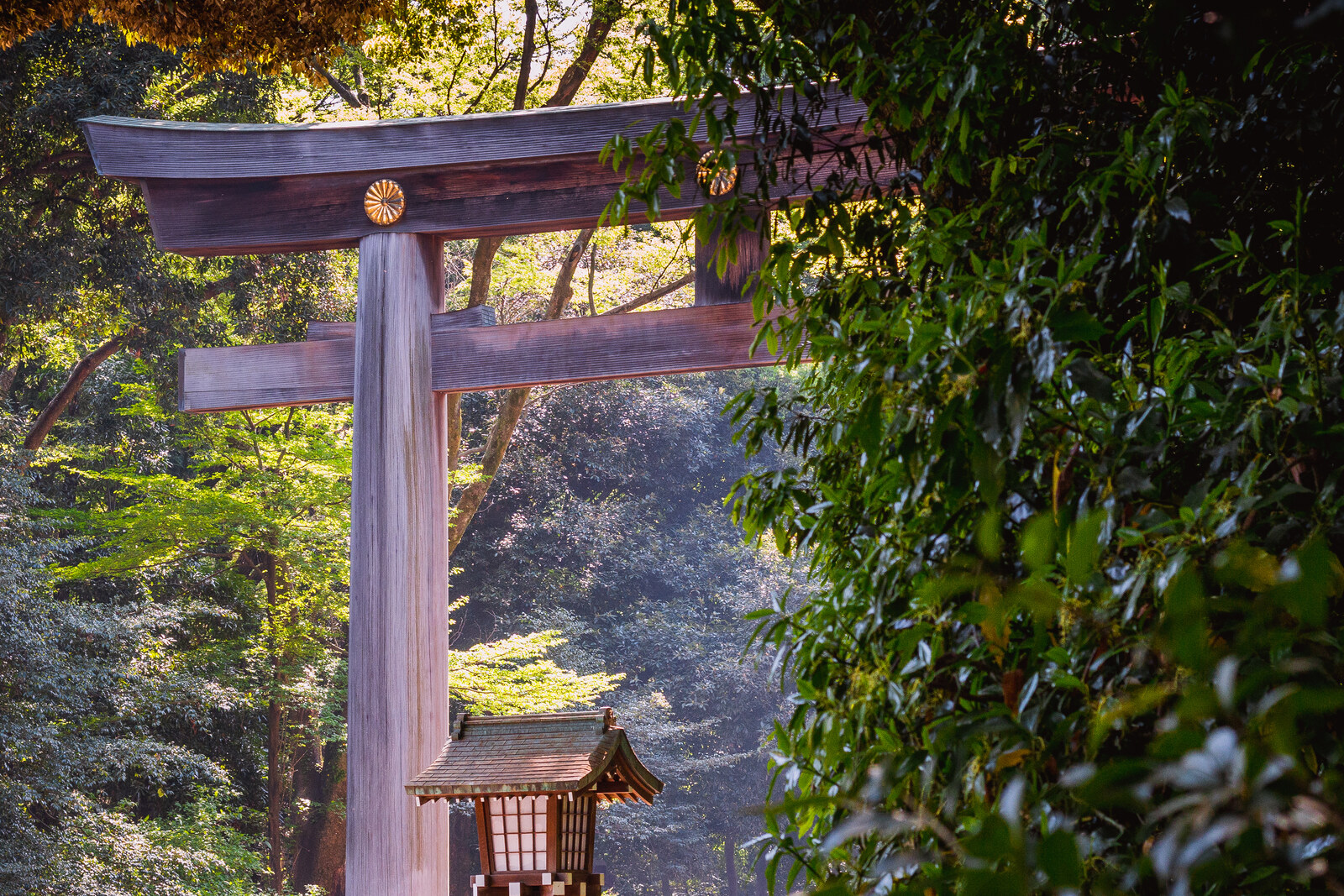
Look around first
What to notice
- Two cedar pillars
- Curved upper beams
- Three gilded chrysanthemums
The story of the place
The torii, made of two cedar pillars and curved upper beams, open the southern approach to Meiji Shrine. Their predecessors stood here for about a century and were made from Taiwan cypress; the current timber came from a forest near the village of Kawakami. Each pillar required a cedar almost fifteen meters long, about five meters in circumference, and without large branches, and the felled trees were dried in the forest for a whole year, with their branches still attached. The three gilded chrysanthemums on the upper beam were moved from the old gate.
On this side of the torii are the bridge and Harajuku Station. On the other begins the southern road to Meiji Shrine. There are no doors here: torii mark the boundary of Shinto sacred ground. That is why some people bow before passing beneath the first crossbeam, and turn back and bow again as they leave. The gates do not block the way—they indicate that from this point on, a person walks as a visitor to the shrine.
Three sixteen-petaled chrysanthemums on the upper beam indicate whom this place honors. Meiji is the posthumous name of Emperor Meiji; the shrine also honors his wife, Empress Shoken, alongside him.
When the emperor died on July thirtieth, nineteen twelve, Tokyo Mayor Yoshiro Sakatani sought to have the monarch buried in the capital. Just two days later, he submitted a petition and gathered Tokyo businesspeople for negotiations. The Imperial Court chose Fushimi-Momoyama Cemetery in Kyoto. Sakatani and the industrialist Eiichi Shibusawa then changed their goal: if Tokyo would not have the grave, a shrine had to be built here.
They prepared a memorandum that immediately named a site in Yoyogi. The government approved the creation of the shrine in nineteen thirteen. After Empress Shoken died, it was decided that she too would be honored here alongside her husband. Meiji Shrine opened on November first, nineteen twenty, and these torii were erected at the start of the southern road.
The current pillars, however, are much younger than the shrine itself. The first gate stood for about a century. It was made from Taiwan cypress—at the time, Taiwan was under Japanese rule, and the timber was brought from there. For the centenary of Meiji Shrine, its administrators decided for the first time to replace the weathered structure completely, preserving its dimensions and curves.
Reproducing the old gate proved difficult. Each pillar required a trunk almost fifteen meters long, about five meters in circumference, and without large branches. By then, logging Taiwan cypress had been banned, and no suitable Japanese cypresses could be found. Laminated beams and wooden pillars with steel cores were discussed, but in the end untreated domestic timber was chosen.
For two years, specialists surveyed forests across the country. Kaimoto, the head of a company that harvested valuable timber, remembered an enormous cedar in a company-owned forest near the village of Kawakami. He made his living specifically from rare large trunks and understood the cost of a mistake: a log of the required length could not be replaced with another from a stockpile. Inspection showed a circumference of four point nine meters. A second cedar was found nearby. One was about two hundred eighty years old, the other about two hundred sixty.
To keep the trunks from splitting as they fell, the lumberjacks removed seven or eight neighboring trees in advance and laid branches over rocks and stumps. After felling, the cedars were dried there in the forest for a whole year, with their branches still attached. The workers then built a road along the slope and transported the logs across the river. They had no spare trunks of that size.
Architect Osamu Kiuchi faced another loss: the drawings from nineteen twenty had not survived. He measured the old torii and used computer calculations to reconstruct the curve of the upper beams and the slight thickening of the pillars. Craftsmen shaped each cedar according to these data, removing wood millimeter by millimeter.
The new torii were installed in two thousand twenty-two. The eastern pillar is made from the two-hundred-eighty-year-old cedar, and the western one from the two-hundred-sixty-year-old cedar. The old metal chrysanthemums were removed from the previous gate, gilded again, and returned to the upper beam. The form here remains from the first entrance of nineteen twenty, the pillars came from the Kawakami forest, and the three crests above the passage now serve the second torii.
Useful on site
Meiji Shrine opens and closes according to a monthly schedule, from dawn to dusk; check the official calendar before an early-morning or evening visit.
Checked: June 27, 2026. Check the official source before visiting.You may stop in front of the arch, but do not block the passage. It is customary to pass beneath torii slightly to one side and to keep your voice low.