 Guide On Map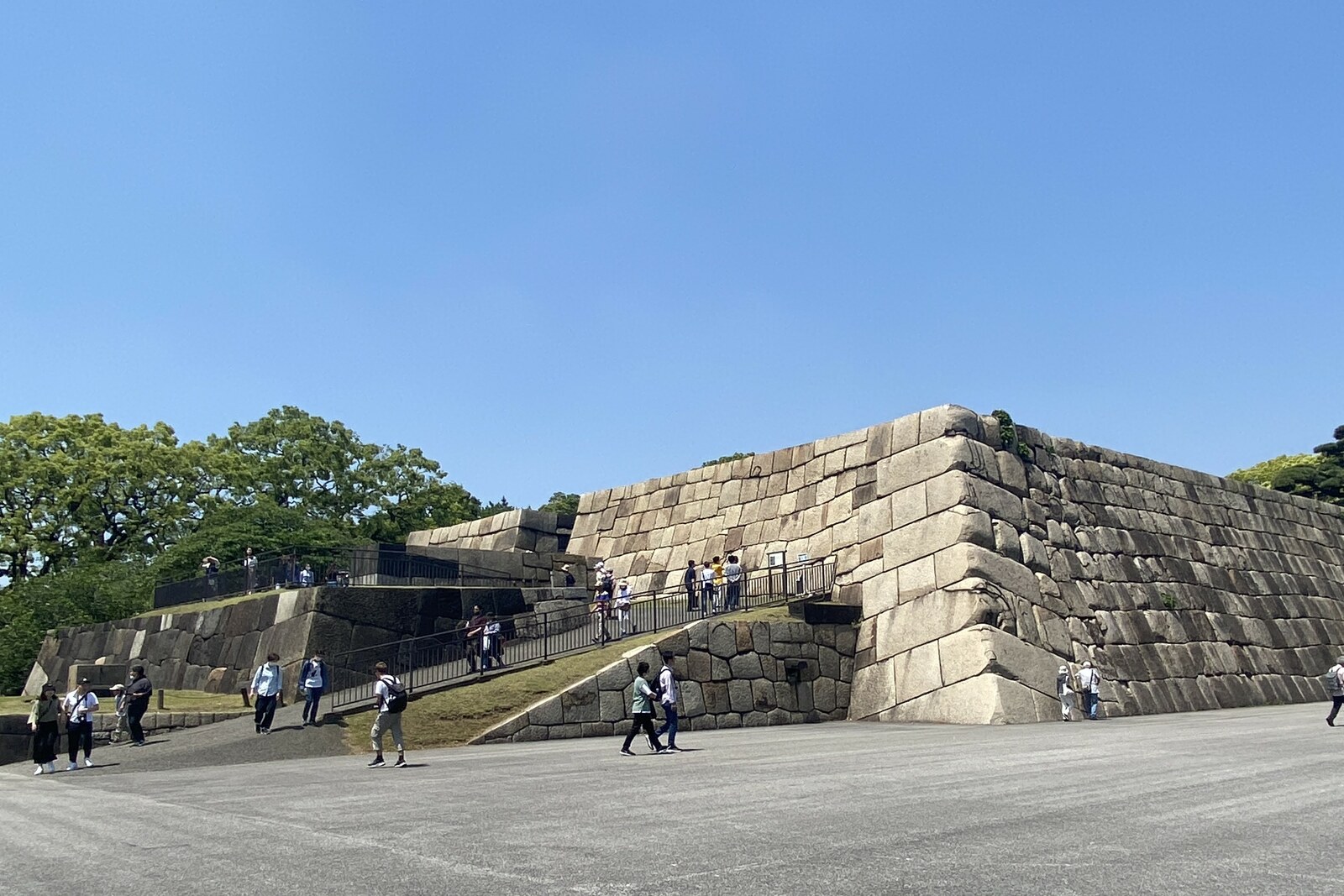
Look around first
What to notice
- Granite blocks in the outer masonry
- The high foundation walls
- The empty upper platform
The story of the place
The empty upper platform above the high granite walls is a foundation prepared for Edo Castle’s main tower. A wooden tenshu with five tiers and six floors, almost sixty meters high, was meant to rise above it. No palace chambers were planned inside: the tower was intended for distant observation and displayed the status of the Tokugawa clan. The Maeda clan of Kaga built the stone base, about twelve meters high.
The stones of Tenshudai were laid after the tower had already been lost. The earlier foundation was badly scorched in the Great Fire of Meireki in sixteen fifty-seven. Damaged blocks were removed: some were hidden inside the new masonry, some were used in other fortifications, and fresh granite was placed on the outside.
Edo Castle’s main tower—the tenshu—rose above the earlier foundation. Five tiers, six floors, almost sixty meters from the ground. The shogun did not live in it: it served as an observation point and a visible sign of the Tokugawa clan’s status. After the fire, the government of the fourth shogun, Tokugawa Ietsuna, immediately began preparing the next tower. The Maeda clan of Kaga was assigned the stonework, and within a year it had completed a foundation about twelve meters high.
All that remained was to put up the wooden floors. But Hoshina Masayuki opposed it—the ruler of Aizu, uncle and chief adviser to the young Ietsuna. Before his death, the previous shogun had entrusted him with helping his nephew govern the country, and now Hoshina determined what money and manpower would be used for after the fire.
The cost was measured in more than the treasury alone. To restore the castle walls, daimyo had to send one hundred workers for every ten thousand koku of rice income from their domains. At the same time, the government distributed rice and money to fire victims, restrained rising timber prices, and relocated entire neighborhoods so that firebreaks would appear between them.
No exact records of the dispute over the tower have survived. The account of Hoshina’s words was recorded much later, in a collection of his sayings from eighteen twenty-eight. According to that record, the adviser pointed out that the tenshu did not help defend the castle and was suitable chiefly for distant observation. He considered spending funds and labor on it after such a disaster senseless.
Hoshina’s view was accepted. The palace inside the castle was rebuilt, Ietsuna continued to rule from here, and the Maeda clan never saw a tower on the foundation it had completed. “Tenshudai” means “main-tower foundation.” No tower ever stood on these granite walls: this is the completed foundation for the fourth tenshu, whose construction was stopped before the first wooden floor.
Useful on site
The same hours as the East Garden: 9:00–17:00 in early spring and September, 9:00–18:00 from 15 April through August, 9:00–16:30 in October, 9:00–16:00 in winter. Closed on Mondays and Fridays.
Checked: June 27, 2026. Check the official source before visiting.Do not hurry on the climb and watch your step; in hot or wet weather, the exposed stones require special caution.