 Guide On Map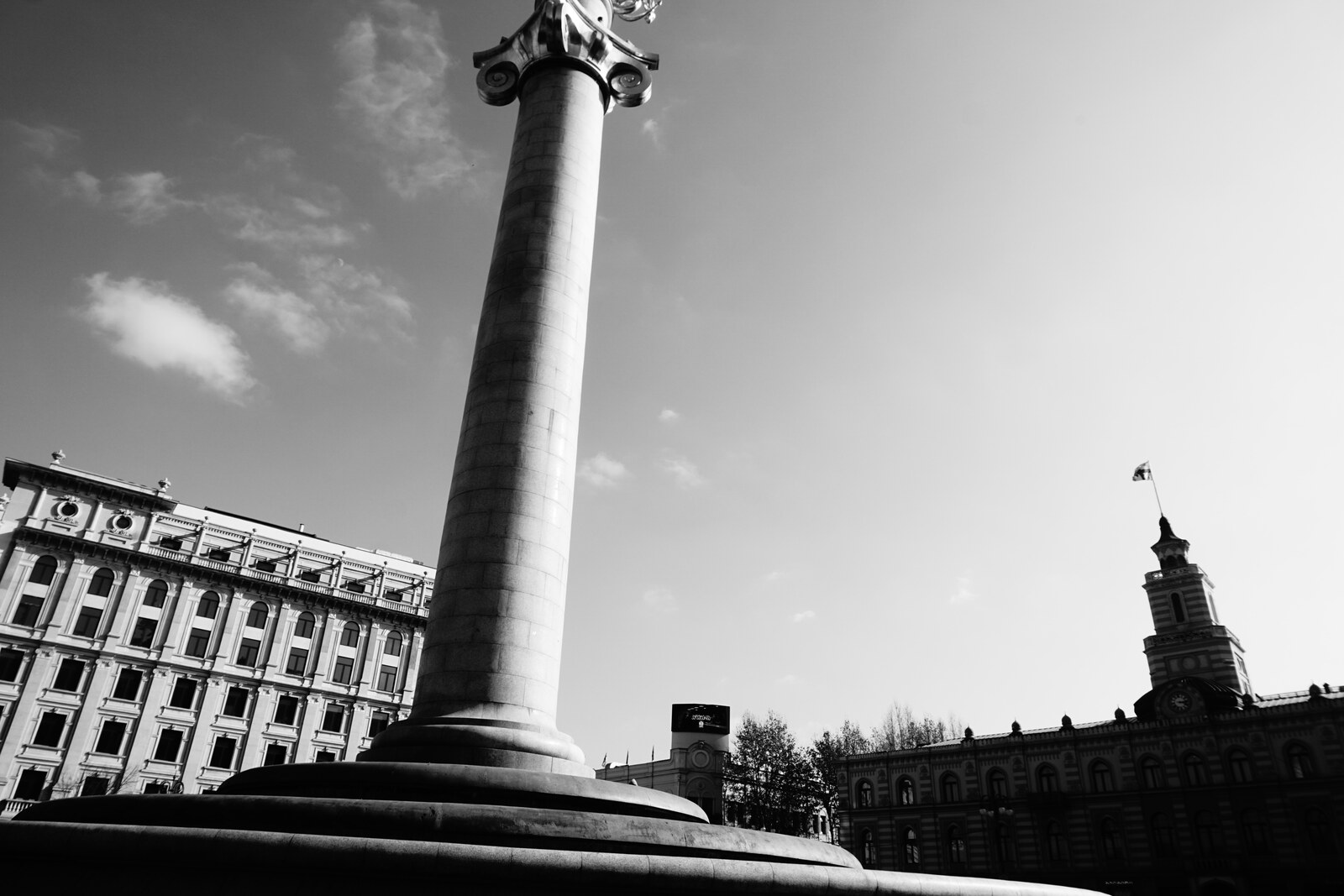
Look around first
What to notice
- City hall clock tower
- The square's open space
- Converging streets
- Pushkin Square
The story of the place
The square received its current name after Georgia proclaimed independence in nineteen eighteen. The open expanse by the clock tower and the converging streets still link the old city, Sololaki, and Rustaveli Avenue. A monument once stood in the neighboring square to a man buried near the square, but both the monument and the grave were later removed.
Several streets from Old Tbilisi and Sololaki, as well as Rustaveli Avenue, converge in front of the city hall building with its clock tower. This junction arose beyond the medieval city wall. By the end of the nineteenth century, banks, hotels, and institutions had moved here, and the route from the post office to the Tiflis Branch of the State Bank passed through the open space.
On June twenty-sixth, nineteen oh seven, a bank carriage carried several hundred thousand rubles along this route. Inside sat a cashier, an accountant, and two armed guards; soldiers and mounted Cossacks escorted the carriage. The square was then called Erivan Square, after General Ivan Paskevich, who commanded the capture of Erivan Fortress for the Russian Empire.
The transport schedule was secret, but an employee of the bank post service passed it on to the underground activists. Several weeks earlier, a congress of the Russian Social Democratic Labour Party had prohibited armed “expropriations,” as revolutionaries called robberies for the party coffers. The leaders of the Bolshevik faction circumvented the ban.
The attack on the square was led by Simon Ter-Petrosyan, nicknamed Kamo, a militant who obtained money for the Bolshevik underground. He had already paid for this trade with his own body: while preparing for a raid, a bomb accidentally exploded in his hands, severely damaging his eye. By the day of the operation, Kamo had not yet recovered, but he rode out onto the square in the uniform of a cavalry officer. The other participants, disguised as peasants, waited at intersections with revolvers and grenades.
When the bank carriage appeared, the conspirators threw bombs and opened fire. A wounded horse dragged the carriage across the square. One attacker stopped it with a grenade, another snatched the bags of money, and Kamo drove up his phaeton and covered the loading with gunfire. According to archival records of the security department, about forty people were killed and around fifty more were wounded.
With the bags, Kamo drove toward a police carriage. The uniform worked: he shouted that the money had been saved and ordered the police officers to hurry to the square. They obeyed, and Kamo had time to escape and change clothes.
Most of the loot consisted of five-hundred-ruble banknotes whose serial numbers were known to the police. It was impossible to exchange them in Russia. An attempt to exchange the banknotes simultaneously in several European cities led to arrests and revealed the Bolsheviks' involvement in the raid. Kamo was detained in Berlin with a forged passport and a suitcase of detonators. To avoid trial for robbery, he feigned insanity for more than three years and endured painful medical examinations. He was later given four death sentences; the execution was commuted to life imprisonment, and Kamo was released after the revolution of nineteen seventeen.
In nineteen eighteen, after independent Georgia was proclaimed, the square was called Freedom Square for the first time. Its current name repeats that very name.
After Kamo's death, he was buried beneath a monument in nearby Pushkin Square, close to the site of the raid. The monument was later removed, and his remains were moved. Neither the bank carriage nor Kamo's grave remains here; the road across the square still runs between the old city, Sololaki, and Rustaveli Avenue—the very urban junction that was why the money carriage took its route here.
Useful on site
An urban point on the route; access to private entrances, museums, and courtyards varies, so check the rules on site and do not enter residential spaces without an invitation.
Checked: date not specified. Check the official source before visiting.The entire story is accessible from outside. Choose a spot at the edge of the square where you do not obstruct pedestrian traffic and can see it clearly in its entirety.