 Guide On Map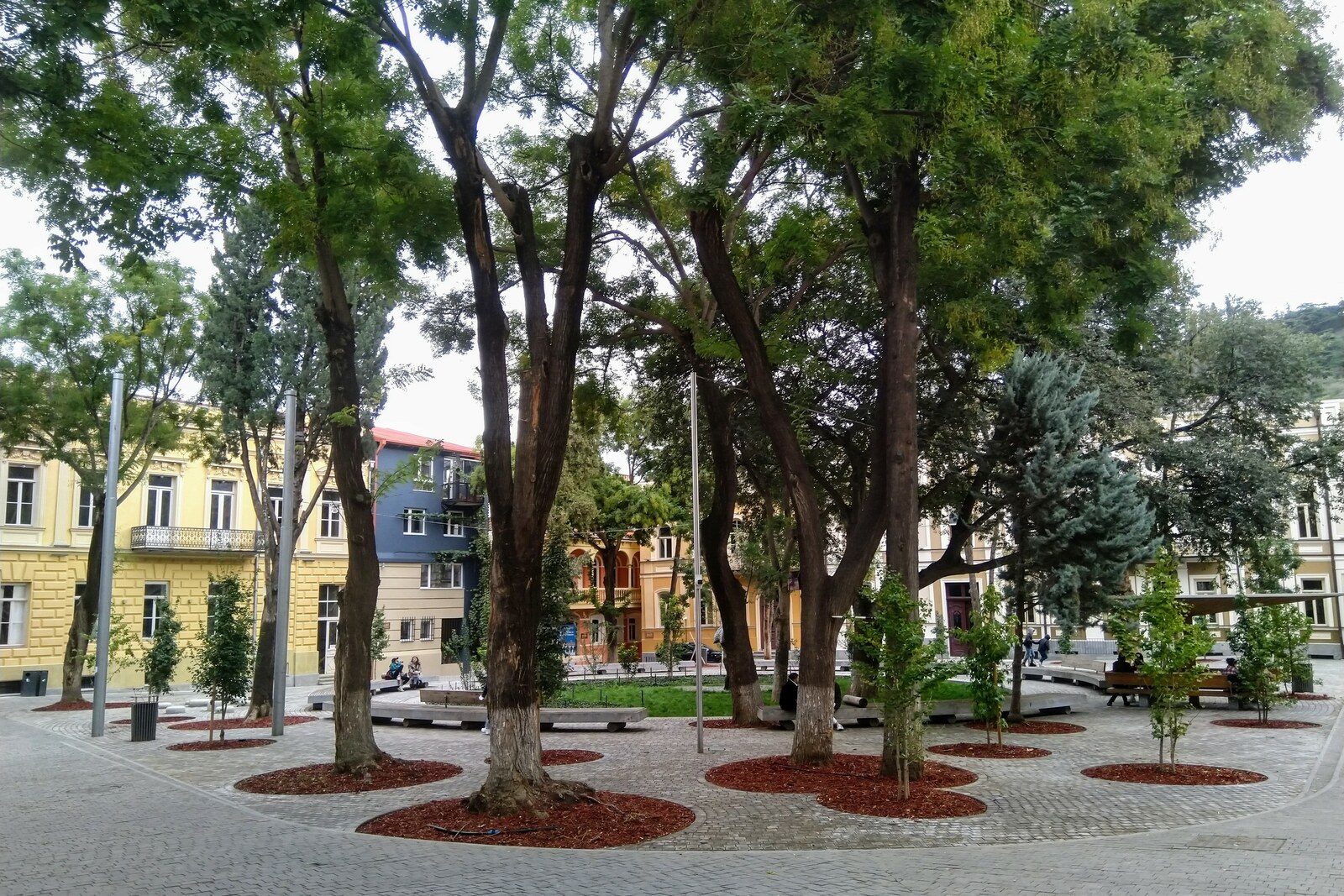
Look around first
What to notice
- Small garden
- Perimeter of low-rise houses
- Restored façades
The story of the place
The square was named after Lado Gudiashvili in nineteen eighty-eight. Lado, or Vladimir, Gudiashvili was a Georgian modernist artist and an honorary citizen of Tbilisi. Old Tbilisi became one of the main subjects of his paintings: revelries, kinto street vendors, and people from houses with wooden balconies. The artist himself lived elsewhere. Here, an old square built up with just such houses was named after him.
Several streets converge on a small garden, while the façades form an almost enclosed perimeter. This layout was definitively established by eighteen forty-four. Of the eleven buildings surrounding the square, nine were later designated monuments. Yet its present-day unity emerged after years of struggle for each one of them.
In the early two thousands, the city fund brought several local houses into its ownership: they were to be reinforced, restored, and then sold. The work was postponed, and the vacant buildings deteriorated. In two thousand eleven, some of the property was transferred to an investor, and the project that won the architectural competition called for a shopping center and for old structures to be replaced with new ones styled after Georgian architecture. Behind the façades, the interiors could be completely altered.
Aleko Elisashvili, head of Tiflis Hamkari, an association of defenders of old Tbilisi, pressed for the restoration of the authentic houses. The word “hamkari” means a fellowship or guild of people in the same trade. Negotiations with the city fund brought no result, and the association’s members began gathering city residents right here.
The task proved harder than stopping construction. Many Tbilisi residents did not know the square’s name and gave directions by referring to the café that was here. So the activists organized a campaign so that people would first come here and spend time here. Once every two weeks, there were exhibitions of old photographs, concerts, and theatrical performances. Money for the next gatherings was raised on site: tea and mulled wine were sold, women brought homemade baked goods, and children donated toys and drawings to sell. Every such item paid for the campaign to continue, while the square once again served the function that an enclosed shopping complex could have destroyed: it remained a shared urban space.
The pressure did not work at once. Two buildings began to be dismantled, but in nineteen thirteen the investor abandoned the project because the parameters previously agreed upon no longer received support. The houses were returned to the city fund. Specialists from the Georgian branch of the International Council on Monuments and Sites (ICOMOS) then prepared a conservation plan. Restoration began in nineteen eighteen, and the renewed square opened in the autumn of two thousand twenty-one.
During the work, builders reinforced the foundations, while archaeologists investigated the basements. Beneath the houses, vaulted cellars from the seventeenth and eighteenth centuries, wine stores with qvevri buried in the ground, and an even older pottery kiln survived. Above them remained the perimeter of low-rise houses, for which members of Tiflis Hamkari had once raised money by selling homemade pies and children’s drawings. The shopping center survived only in the competition drawings.
Useful on site
A city route stop; access to private entrances, museums, and courtyards varies, so check the rules on site and do not enter residential spaces without an invitation.
Checked: date not specified. Check the official source before visiting.For this stop, it is enough to view the square and Lermontov House from outside; there is no need to seek access to the building.