 Guide On Map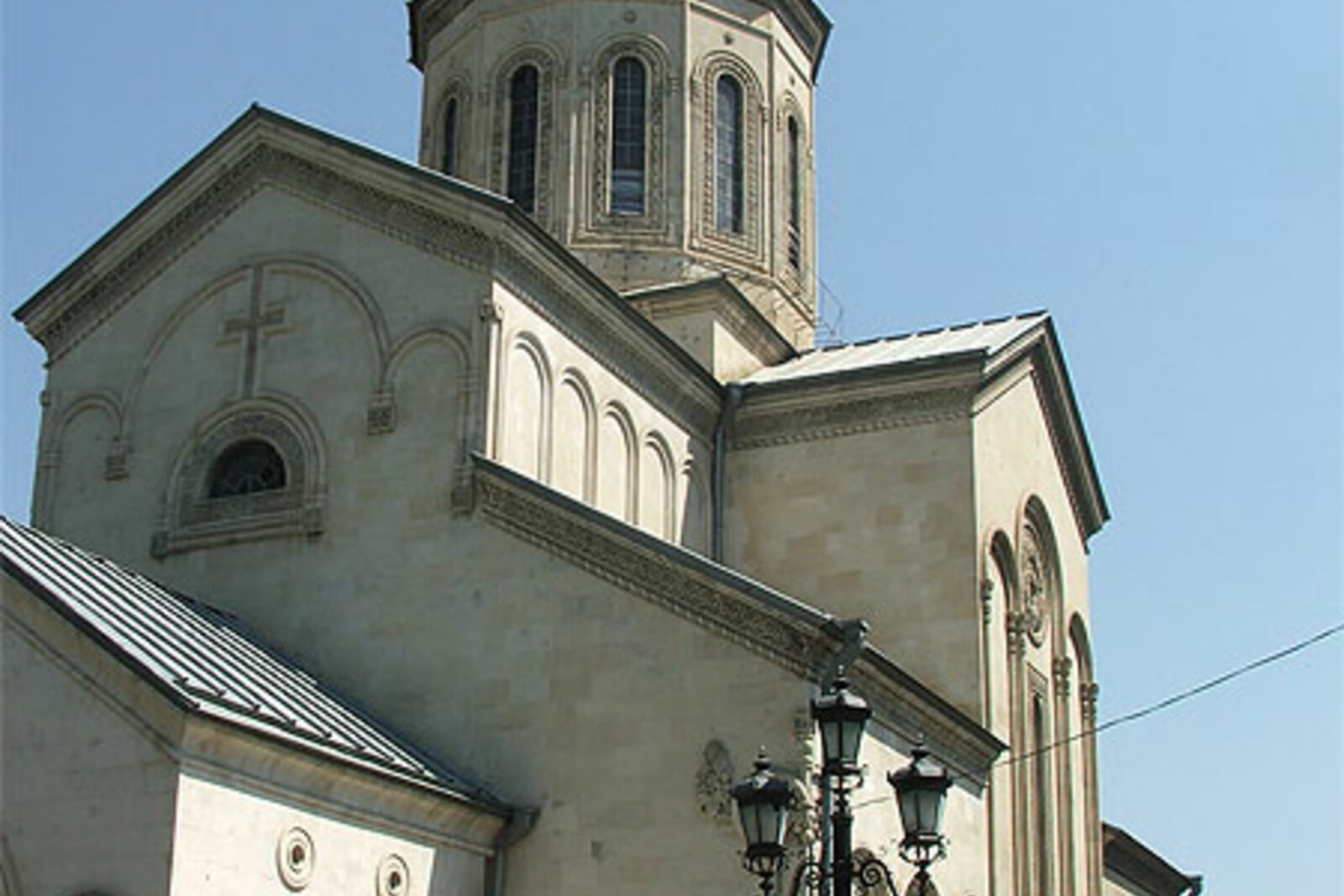
Look around first
What to notice
- White-stone façade
- Carved stone decoration
- Altar painting
- Main apse
The story of the place
Kashveti's white stone and dense carving on the façade set the church apart along Rustaveli Avenue. The present building rose here in the early twentieth century, replacing several earlier churches. It inherited its name from an old church tradition connected with the monk David. Behind the iconostasis, the space ends in the main apse of the altar.
Behind the doors of the active Church of Saint George, above the altar, a work has survived for which the artist lost his teaching position and membership in a professional union.
In nineteen forty-six, Kallistrate Tsintsadze, head of the Georgian Orthodox Church, invited Lado Gudiashvili to paint Kashveti Church. Gudiashvili taught at the Tbilisi Academy of Arts and had long wanted to create church paintings. In his youth, he traveled around Georgian monasteries, copied damaged medieval frescoes, and preserved their images for researchers. Now, for the first time, he was entrusted with a church wall of his own.
State ideology proclaimed atheism, while Soviet artists were required to follow socialist realism—to depict approved heroes and subjects intelligible to society. The church commission put Gudiashvili's official employment at risk. He was warned of the consequences, but he agreed.
In the main apse, the artist painted the Mother of God with the infant and apostles receiving communion, with Archangel Gabriel and the Annunciation beside them. He worked in the ancient technique of encaustic painting: the coloring mixture was combined with wax. Yet the figures did not repeat strict medieval models—Gudiashvili gave them his own faces, lines, and expressions.
He was not allowed to complete the entire cycle he had planned. The work was stopped, and the artist was accused of formalism—the term used for art in which an individual manner was placed above prescribed content. In nineteen forty-eight, Gudiashvili was dismissed from the Academy of Arts and expelled from the Society of Georgian Artists. He continued painting in his studio, while at Kashveti only the altar fragment remained complete.
The church's unusual name appeared much earlier. In Georgian, “kva” means stone and “shva” means to give birth. According to church tradition, in the sixth century the monk David preached here; he later founded the David Gareja Monasteries. People disturbed by his preaching persuaded a woman to declare David the father of her unborn child. The monk replied that the lie would be exposed when she gave birth to a stone instead of a child. Tradition maintains that this is what happened: the accusation fell apart, and the place was called Kashveti—“gave birth to a stone.” This episode is not documented.
The present white-stone church was built in the early twentieth century on the site of earlier churches. From the ancient tradition it received its name; from Kallistrate Tsintsadze's decision, the painting above the altar, which Gudiashvili managed to complete before his dismissal.
Useful on site
active church; entry is usually free, exact public hours are unconfirmed, services may restrict visits
Checked: June 29, 2026. Check the official source before visiting.This is an active church. View the interior without loud conversation, do not disturb services, and do not photograph people in close-up.