 Guide On Map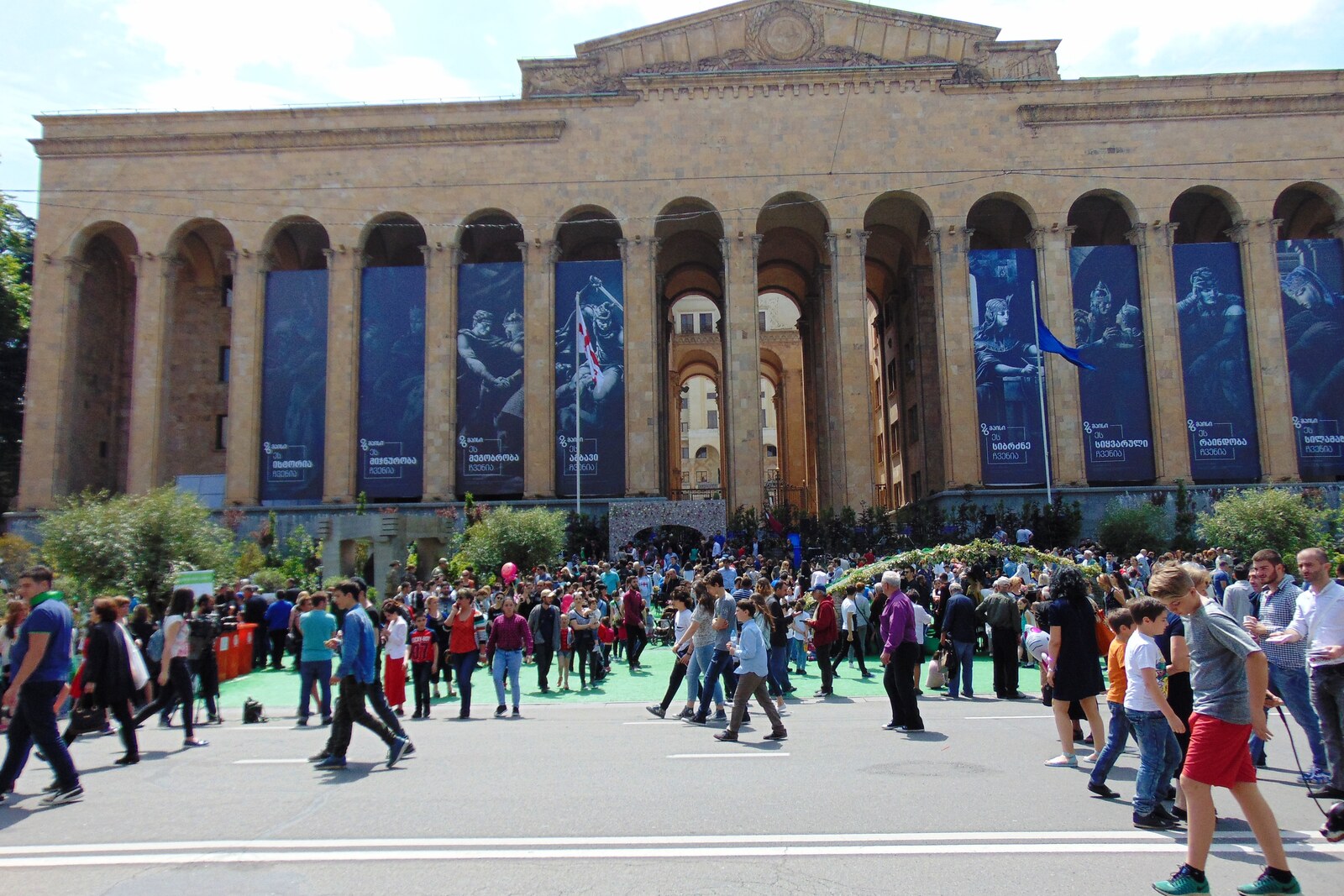
Look around first
What to notice
- Broad staircase
- Façade arcade
- Space in front of the building
- Memorial to those who died
The story of the place
Parliament of Georgia meets behind the façade's arcade. A broad staircase leads up to the space in front of the building, where a memorial to those who died now stands. This space remains both the entrance to a state institution and a place of remembrance.
The broad space in front of the arcade was provided for by architect Viktor Kokorin, who was designing Government House in Soviet Georgia. In nineteen thirty-five, he wrote that widening the avenue would create space for mass gatherings and demonstrations. The building housed the Council of Ministers and the republic's Supreme Soviet.
On April fourth, nineteen eighty-nine, a demand for Georgia's independence was brought here. A hunger strike began on the steps. By the night leading into April ninth, around three hundred hunger strikers and between eight and ten thousand supporters were in front of Government House.
Shortly before four in the morning, Ilia II, head of the Georgian Orthodox Church, came out onto the steps. He came to get the people out of harm's way: he told them they faced immediate danger and asked them several times to disperse. The participants decided to stay. The Patriarch did not leave either. A prayer began to be read in the square.
Afterward, vehicles began moving along the avenue from what is now Freedom Square, then called Lenin Square. The rally's leaders asked people to sit down and not resist. The square was cleared by force, and not everyone had time to disperse.
People died that night; the youngest was fifteen-year-old schoolgirl Eka Bezhanishvili. The next day, Tbilisi ceased work, and forty days of mourning were declared in Georgia.
Exactly two years later, in the same building, Zviad Gamsakhurdia, chairman of the Supreme Soviet, chaired an emergency session. Following the nationwide referendum, the deputies adopted the Act of Restoration of the State Independence of Georgia—and chose April ninth as the date of its signing.
Parliament of Georgia now meets here. In front of the façade stands a memorial to those who died—on the very space where the hunger strikers sat on the steps and Ilia II tried to persuade them to leave.
Useful on site
the façade and memorial are visible from the street; access to the building is restricted by security and the current political situation
Checked: June 29, 2026. Check the official source before visiting.Do not block the passage, and treat the memorial as a living place of remembrance. If there is a gathering or a blockage, view the façade from an accessible distance.