 Guide On Map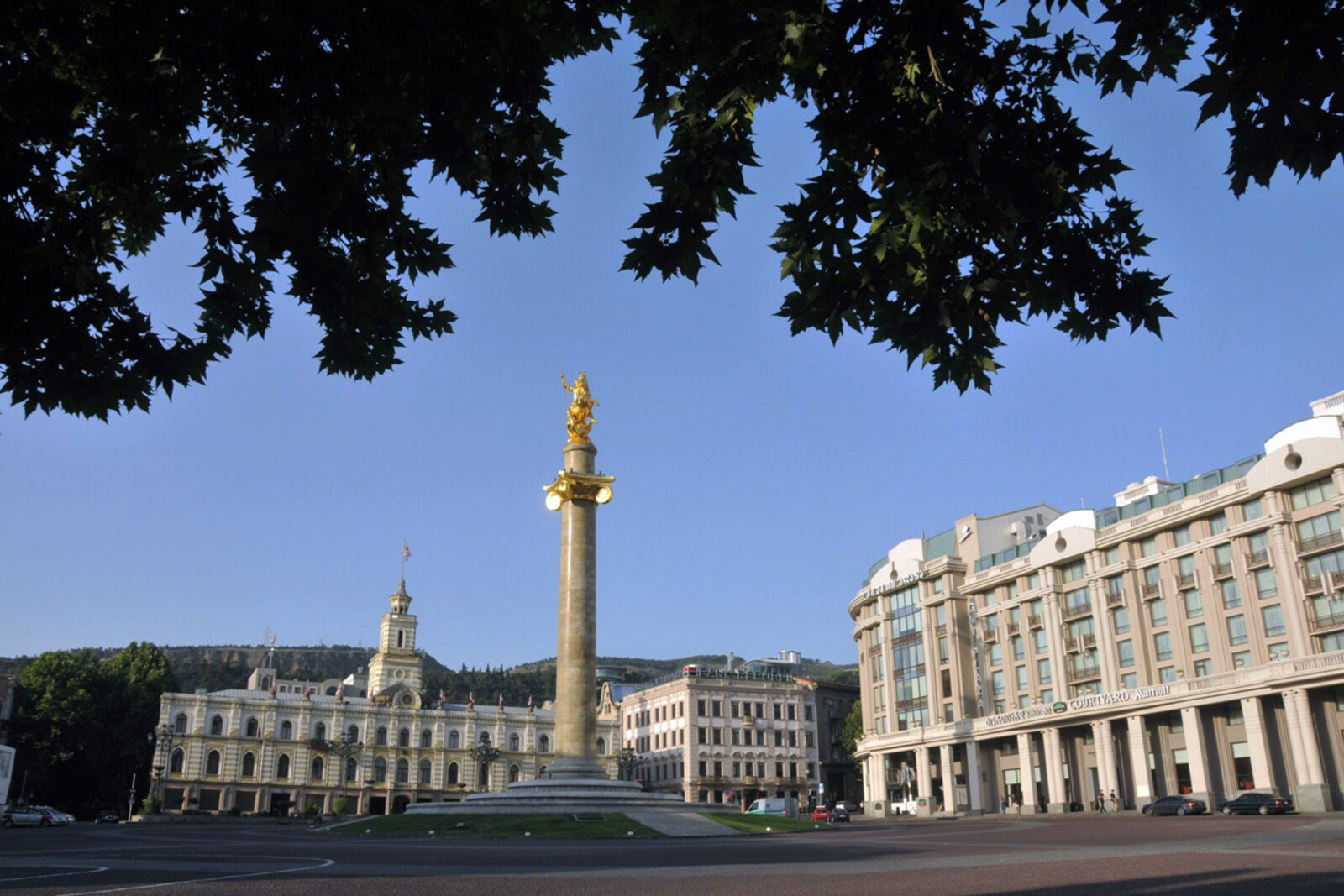
Look around first
What to notice
- The column with St. George
- Pushkin Square
- The beginning of Rustaveli Avenue
The story of the place
A column with St. George stands in the center of the open space; Pushkin Square approaches it at the square's northern edge. Rustaveli Avenue begins here, although its city line once ended at the square. Several roads approach it from different directions, forming an urban intersection.
Twenty-five-year-old Simon Ter-Petrosian, known underground as Kamo, rode into this square in an open carriage wearing a cavalry captain's uniform. He led a Bolshevik combat group and was planning to rob a state cash-collection carriage. The other participants, dressed as peasants, waited at the corners with revolvers and bombs. The column with St. George in the center was not there yet.
The square was called Erivan Square. This name referred not to the city of Erivan itself, now Yerevan, but to the Russian commander Ivan Paskevich: for taking Erivan Fortress for the Russian Empire, he received the title Count of Erivan, and the square received his name.
It was chosen for the robbery precisely because of the city's layout. Golovin Avenue, now Rustaveli Avenue, ended here; roads from the post office and the State Bank converged on the square. An employee of the bank post passed the underground group a secret schedule for transporting money. On June twenty-sixth, nineteen oh seven, the carriage was to cross the square carrying a cashier, an accountant, armed guards, and a Cossack escort.
The Bolsheviks called such robberies expropriations: the money was taken for weapons, illegal printing presses, and supporting the underground. Only a few weeks before the attack, a party congress resolved to disband the combat units, but Kamo continued the preparations. While setting a fuse, one of the bombs exploded prematurely and severely damaged his eye. For a month, he barely left his bed, and he came onto the square before he had recovered. If arrested, he faced a military trial and a death sentence.
When the carriage reached the square, the group members threw bombs and opened fire. One wounded horse carried the money carriage farther on. The attackers stopped it with another bomb, pulled out the bags, and threw them into Kamo's carriage. He rode away in the officer's uniform. On the way, he encountered a police carriage. Kamo ordered the police officers to hurry to the square, assuring them that the money had been saved. They obeyed the man in uniform and realized their mistake when he had already disappeared.
The group made off with more than a quarter of a million rubles. The square was left with dead and wounded people; a later count from the archives of the tsarist secret police gives around forty dead and about fifty wounded. A substantial part of the loot consisted of five-hundred-ruble banknotes whose serial numbers had been recorded. When attempts were made to exchange them simultaneously in several European cities, bank employees checked the numbers, arrests began, and the robbery caused an open quarrel among the revolutionaries.
Kamo was detained in Berlin with explosives for the next operation. To avoid trial and extradition to Russia, he pretended to be insane for more than three years, enduring examinations by prison doctors. After escaping, he was caught again and sentenced to death four times; the execution was then commuted to lengthy hard labor. He was released only after the revolution of nineteen seventeen.
The square first received its current name a year later, when, after the collapse of the Russian Empire, the independent Georgian Republic was proclaimed. After his death in nineteen twenty-two, Kamo was buried very nearby, in Pushkin Square, and a monument was erected over his grave. The monument was later removed, and his ashes were transferred to Vake Cemetery. Pushkin Square, a small public garden, remains at the northern edge of Freedom Square; the grave of the man who carried the bank bags away from here is no longer there.
Useful on site
open urban space around the clock
Checked: June 29, 2026. Check the official source before visiting.Listen to the story from the edge of the square: there is a roundabout in the center, and there is no need to approach the column.