 Guide On Map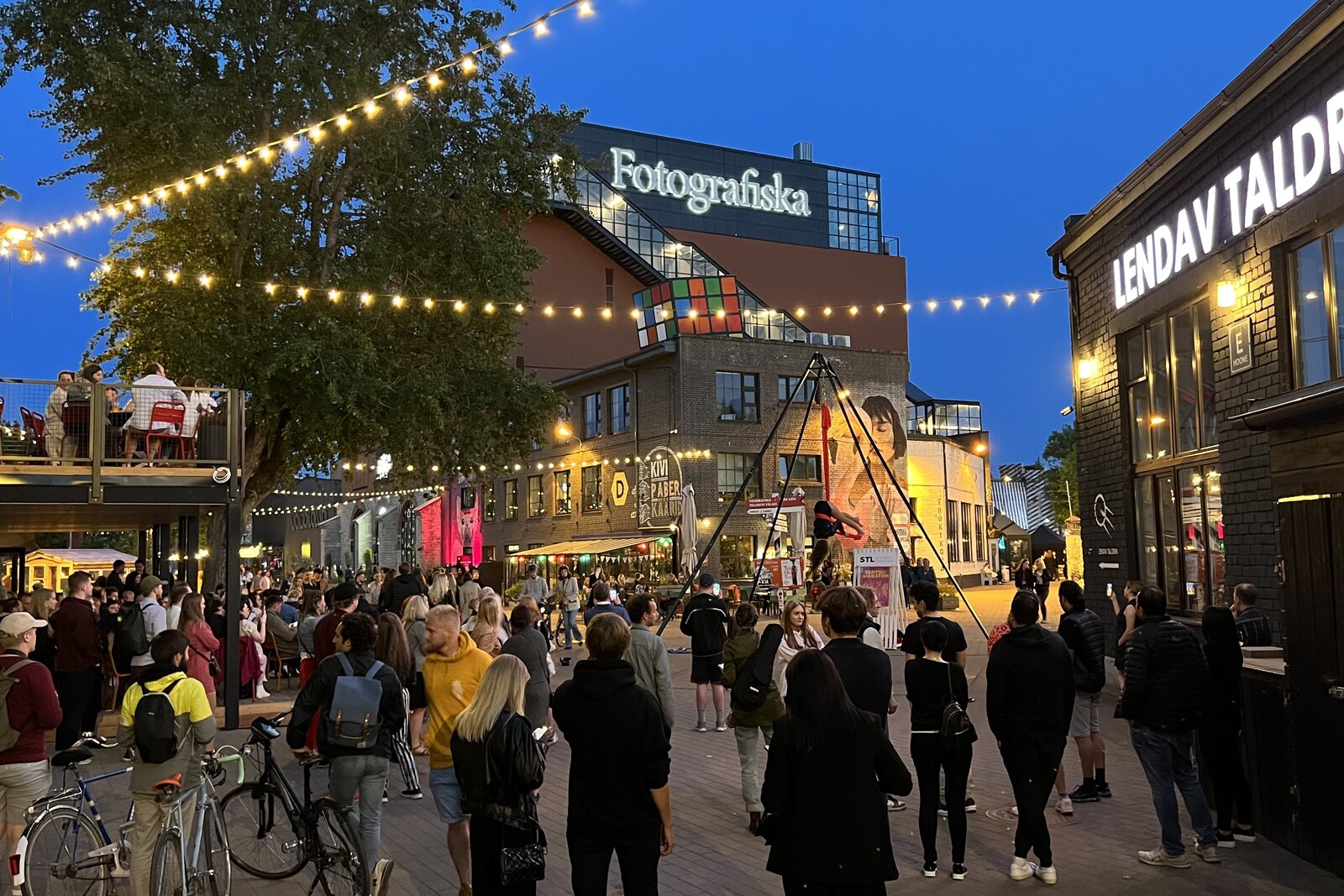
Look around first
What to notice
- Red House
- Former factory buildings
- Factory courtyard
- Photography center building
The story of the place
Telliskivi is made up of former industrial buildings around a shared courtyard; the Red House is still visible among them. The plan called for an underground parking garage and a tall glass tower on the site of the old buildings, while the Red House was to be demolished. The tower never appeared: the Red House was preserved, and a photography center now operates inside it.
When the Baltic Railway Company opened a station nearby, locomotives needed workshops right beside the tracks. By eighteen seventy, steam locomotives and railcars were already being repaired here, and ten years later about five hundred people worked at Reval's largest industrial enterprise. Later, the buildings were occupied by the Kalinin Electrical Engineering Plant. After privatization, production was gradually moved away from here; the fences remained, and the workshops stood empty.
Jaanus Juss entered the closed-off site as an employee of the real estate fund that owned the plot. He was pursuing a new detailed plan: most of the old buildings were to be demolished, two levels of parking built underground, and a glass tower taller than the then-head office of a major bank erected on the site of the Red House. Juss made money from this, and it was exactly what was expected of him.
The approval process dragged on. While the land was not bringing in the expected income, Juss looked for a temporary use for the empty buildings. After the Berlin Marathon, he ended up at Tacheles—an abandoned department store occupied by artists, musicians, and owners of makeshift workshops. They had no common plan, many ignored rent, and the building was barely standing. What struck Juss was something else: people with similar interests had managed to fill a huge building with activities that made people want to come there.
After returning to Tallinn, he proposed bringing together a similar community here, but with contracts, tenant selection, and self-sufficiency. The fund's investment committee doubted that artists would pay at all. They searched for the first permanent tenant for more than a year. The Black Nights Film Festival agreed. Its office was assigned a floor in a building with no windows and moss growing on the floor. The premises were renovated; following the festival, the ground floor was taken up quite quickly, and then a flea market, a skate park, and rehearsal rooms appeared.
The fund provided almost no money to turn the factory into a finished cultural district. The team reinvested what it was already earning here. They cleared the courtyard together with the tenants: they put on work overalls, carried trash, and the organizers bought food for the participants. When the first restaurant was needed, its founders had to invest in it—the fund refused again. That was how F-Hoone opened in a former factory building, giving people a reason to come here not only for work or a concert.
After three to four years, it became clear that the risk had paid off: tenants were paying, and Telliskivi had made it through the economic crisis without city subsidies. Juss and his team kept this arrangement. They select workshops, theaters, galleries, shops, restaurants, and public organizations so that some bring visitors to others; they may reduce the rent for new and fragile projects, and they direct the profits back into the district.
The Red House, on whose site Juss once included a high-rise tower in the plan, still stands in the courtyard. The Fotografiska photography center now operates inside it.
Useful on site
The courtyards are accessible without a ticket. Shopping streets: usually Mon–Fri 11:00–19:00, Sat 11:00–17:00; in summer, some places are open until 19:00 on Saturdays, and some streets are open on Sundays 11:00–17:00. Restaurants and events have separate hours.
Checked: June 30, 2026. Check the official source before visiting.Feel free to explore the shared courtyards, but keep in mind that businesses, studios, and venues inside have their own visiting conditions.