 Guide On Map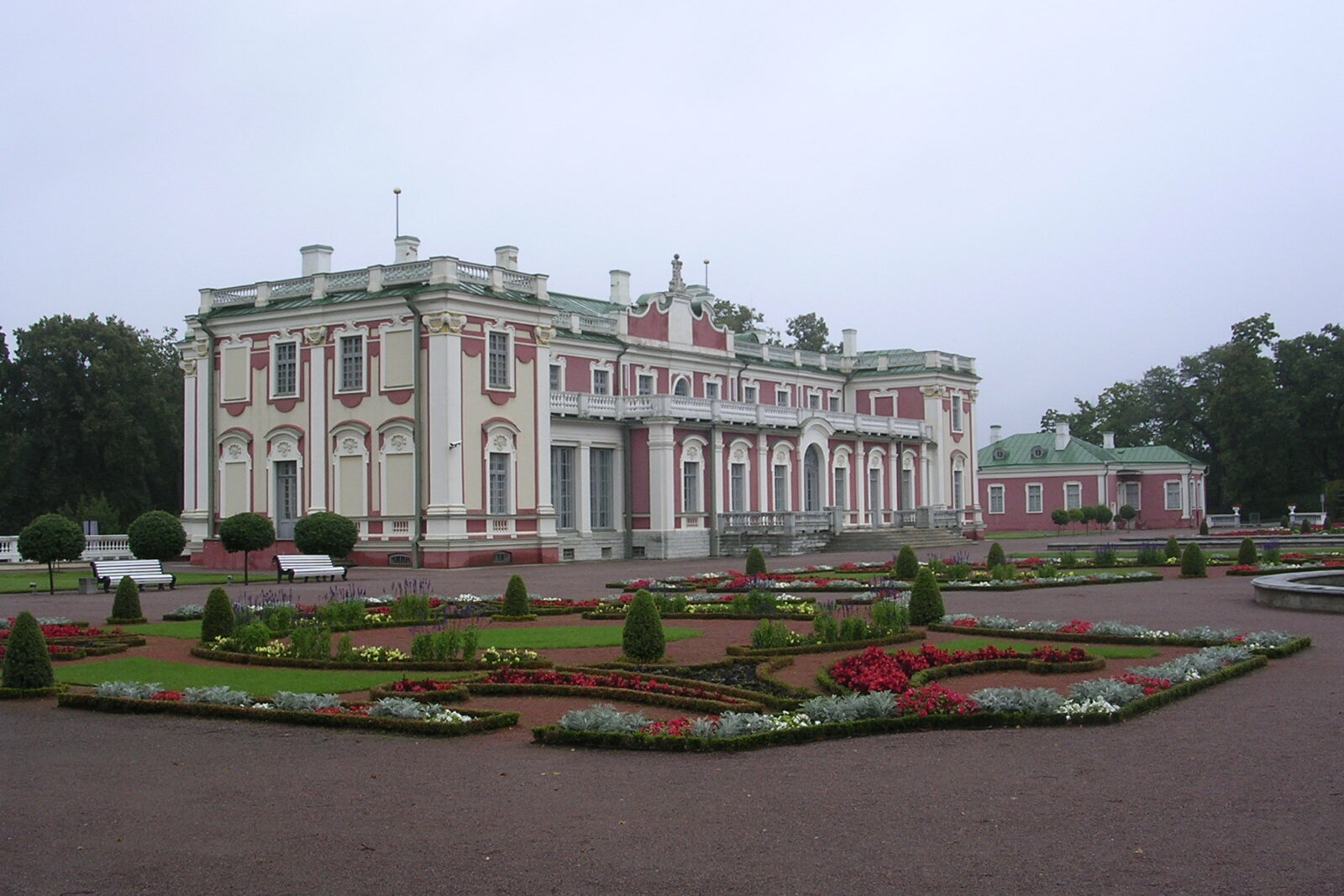
Look around first
What to notice
- Peter's monogram
- Golden letter “E”
- Stone slab with the date when work began
- Ceremonial hall
The story of the place
The garden before the palace descends toward the sea, while terraces by the limestone escarpment begin behind its walls. The whole ensemble is arranged this way: the ceremonial building stands between the garden and the slope, and the main hall rises two stories high. The name Kadriorg came from the old name Catharinenthal, Catherine's Valley, and then passed to the park and the city district. The palace rooms are now occupied by an art museum with Estonia's largest collection of old Western European and Russian painting, sculpture, and decorative arts.
In July seventeen eighteen, the Great Northern War was still under way when Peter the Great, the Russian tsar, ordered a summer residence to be built here. Reval—the name Tallinn had at the time—had been occupied by Russian troops eight years earlier. The tsar now needed to consolidate his acquisition on the Baltic Sea with a palace that would look at home among European residences.
Peter entrusted the design to the Italian architect Nicola Michetti. Michetti placed the building between the sea and a limestone escarpment, so that a formal garden descended before the facade while terraces rose behind the palace. Stonemasons were brought from Russia; heavy work was done by soldiers of the Reval garrison and forced laborers. The city, almost deserted after the war, was still recovering from devastation, while beside its modest country houses they were building a ceremonial hall two stories high.
The ensemble was named Catharinenthal, meaning Catherine's Valley, in honor of Peter's wife, the future Empress Catherine the First. Over time, the German name was adapted to Estonian: Kadri corresponds to the name Catherine, and org means valley. Thus a woman's name passed from the palace to the park, and then to the city district.
Peter and Catherine came to the unfinished residence, but did not have time to live in the completed palace. Peter died in seventeen twenty-five, the craftsmen abandoned some of his plans, and the palace stood empty for a long time. Fully decorated rooms were prepared only for their daughter, Empress Elizabeth, who came here in seventeen forty-six.
Inside, this family history is recorded without portrait likenesses. In the ceremonial hall, Peter's monogram is placed above one fireplace; above the other is a golden letter E in a blue oval, the initial letter of Catherine's name. In the vestibule, a stonemason carved the month and year when work began into a slab. Catherine did not receive a permanent home here, but her name remained on the wall and on the map of Tallinn.
In that same ceremonial hall, firewood was chopped two centuries later. After the fall of the monarchy, the palace was occupied by the Tallinn Council of Workers' and Soldiers' Deputies; axe marks appeared on the parquet floor, and almost nothing remained of the former furnishings. When the building was handed over to the city, the young Republic of Estonia had to decide what to do with the empty imperial residence.
August Weizenberg, the first professional Estonian sculptor, was the first to bring art here. He returned to his homeland to spend his final years here, received rooms in the seaside wing, and placed his figures in the palace, including those already acquired by the city. There was not yet an art museum in the building: Weizenberg's works entered it before the institution did.
In nineteen twenty-one, the palace was given to the Tallinn Estonian Museum. The first exhibition opened here in September, and Weizenberg died in November. Six years after repairs, his sculptures stood in the vestibule; nearby, old European painting, works by Baltic Germans, and works by contemporary Estonian artists were displayed.
Today the palace is occupied by the Kadriorg Art Museum, a branch of the Art Museum of Estonia with the country's largest collection of old Western European and Russian painting, sculpture, and decorative arts. Estonian art is now displayed separately at the Kumu Art Museum, while here the museum galleries begin with the golden initial of the woman for whom the summer house was built, though she never moved into it.
Useful on site
Museum: May–September Monday–Tuesday and Thursday–Sunday 10:00–18:00, Wednesday 10:00–20:00; October–April Monday closed. Adult ticket — 15 euros.
Checked: June 28, 2026. Check the official source before visiting.The facades and the palace's connection with the park can be understood without entering. Plan a separate visit to see the interiors and the museum collection.