 Guide On Map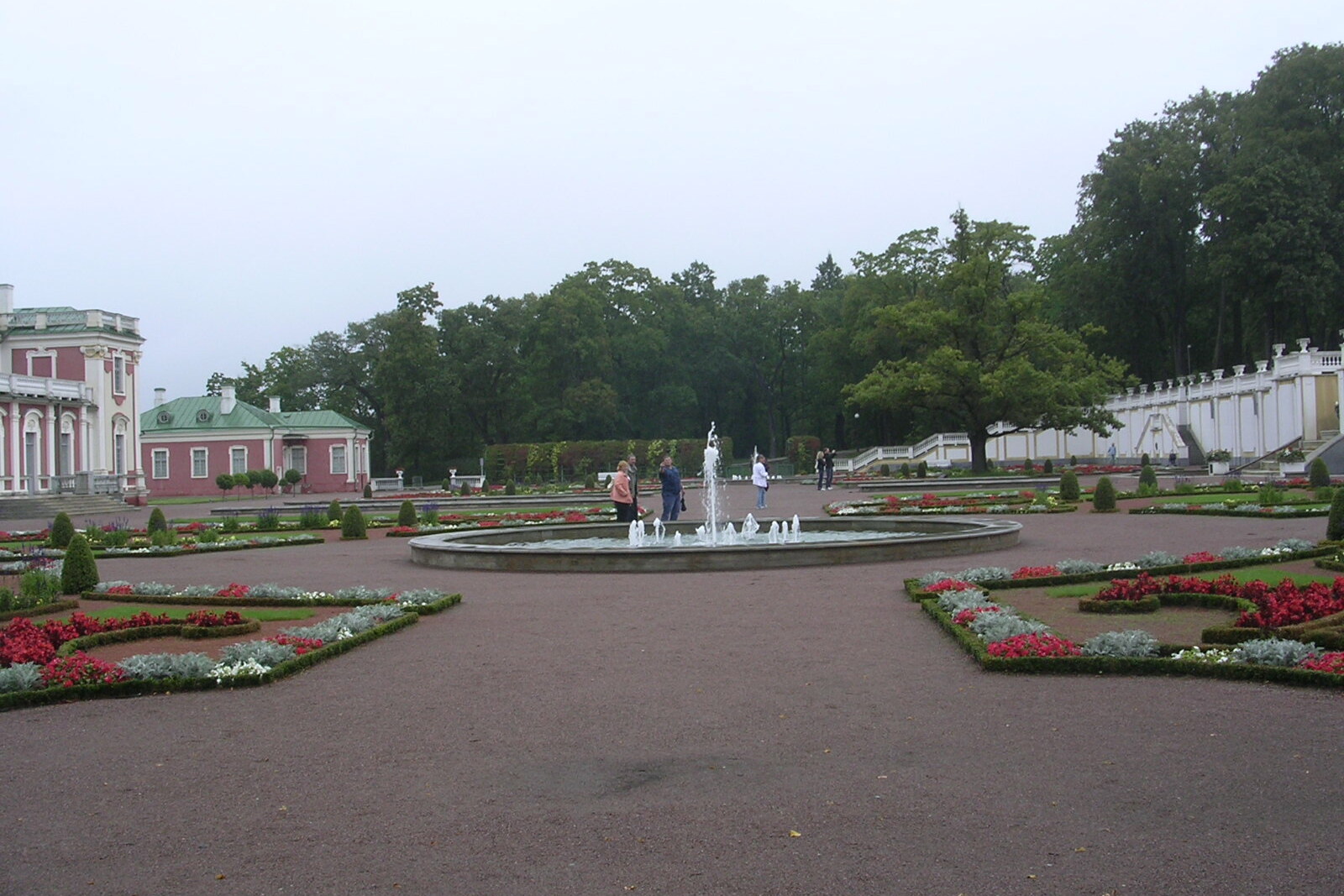
Look around first
What to notice
- Symmetrical parterres
- Fountains
- Mirage Wall
- Royal Oak
The story of the place
This garden was called the Upper Garden because of its position behind the palace: it rises up the slope in two terraces. The lower one is occupied by the Flower Garden, with symmetrical parterres, fountains, and the Mirage Wall. The upper terrace once contained the Mirage Pond, hidden by rows of trees; it now belongs to the garden of the neighboring Presidential Palace.
Large doors from the palace hall led directly to the flowerbeds. The stone flowers of the stucco decoration continued as living plants outside, while walls and green galleries screened the garden from the rest of the park. Here the owner could bring guests out from the ceremonial hall, preserving both the formality of the reception and the chance to speak in a small circle.
The garden proved useful for precisely such a conversation at the end of June nineteen twenty-nine. The government of State Elder August Rei, head of the young Republic of Estonia, received Gustav V, King of Sweden and the first monarch to arrive in the country on a state visit. Estonia's leaders sought closer ties with Scandinavia. Sweden had recognized Estonia's independence only in nineteen twenty-one and still considered the states on the eastern shore of the Baltic Sea unreliable partners for whom it would have to assume commitments.
Gustav V was housed in the palace's seaward wing. In the Upper Garden, he planted an oak. The ceremony was meant to turn a brief visit into a sign of lasting friendship: the tree remained after the speeches, lunches, and the departure of the royal ship. However, the Swedish government limited itself to developing trade and cultural ties. The alliance Tallinn had hoped for did not emerge. The visit became the high point of relations between the two countries in the interwar years, but it did not change their political course.
The Royal Oak still grows here. A stone bearing Gustav V's monogram stood beneath it; later, it was believed lost. In nineteen ninety-nine, workers found the stone while restoring the garden. The Baroque parterres around it were recreated from eighteenth-century drawings and excavation data and opened in two thousand one. Amid the restored geometry of the garden remained the oak planted by the king and the stone bearing his name, found in the ground.
Useful on site
Open area of Kadriorg Park; the park is open around the clock every day.
Checked: June 28, 2026. Check the official source before visiting.Do not limit yourself to the flowerbeds: step back to the edge of the terrace and follow the entire axis. If necessary, the steps can be bypassed using the accessible side paths.