 Guide On Map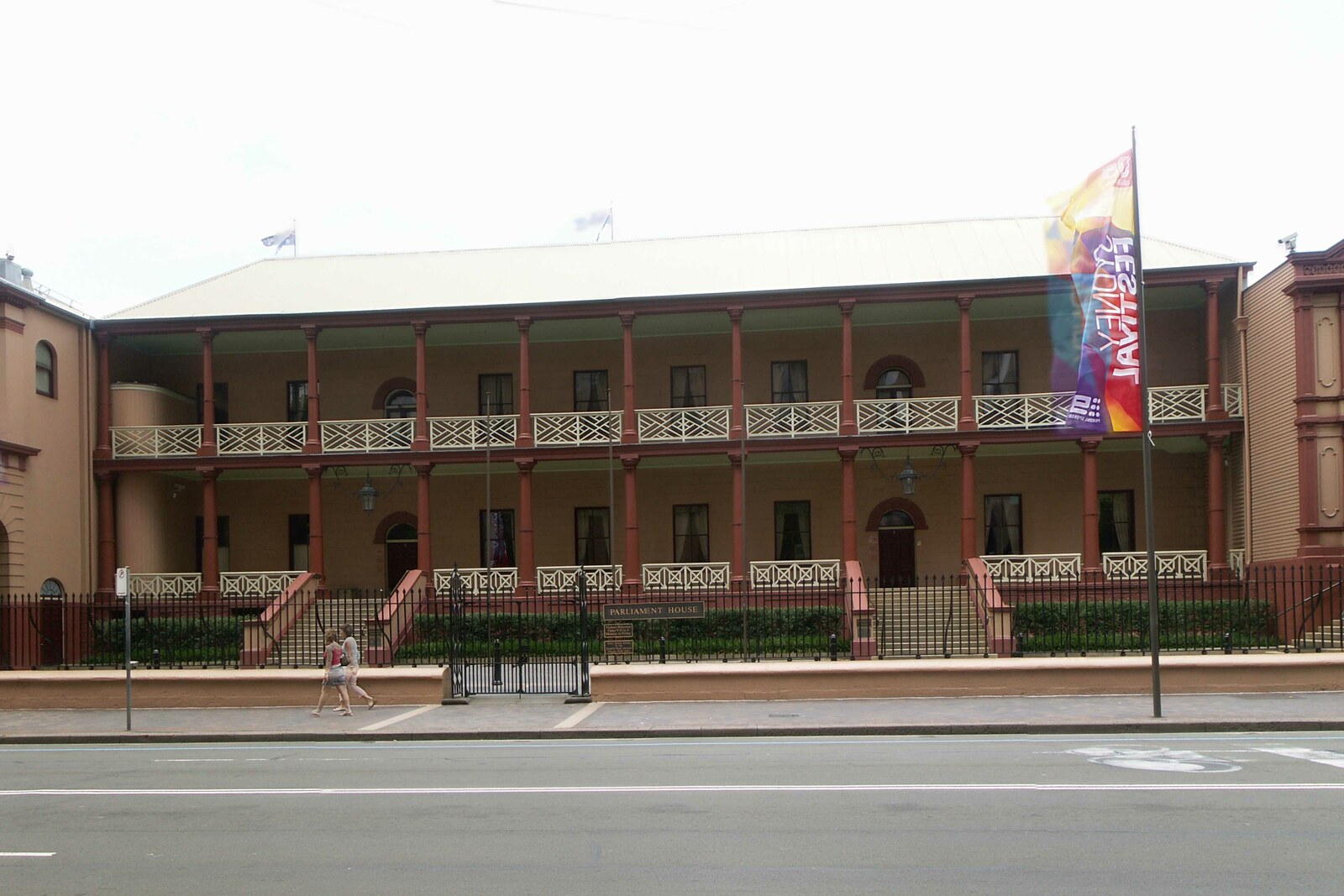
Look around first
What to notice
- The colonnade
- The first Legislative Council chamber
- Casement windows
- Painted imitation wooden panels
The story of the place
In eighteen fifty-three, William Charles Wentworth submitted a draft constitution for New South Wales to the Legislative Council of New South Wales, which met here. Wentworth, chairman of a special committee and a wealthy landowner, sought self-government for the colony. Ministers were to be chosen from the parliamentary majority rather than appointed at the governor's discretion; local laws would no longer have to be sent through London.
The Council came to occupy this building almost by accident. The colonnade on Macquarie Street belonged to the northern wing of the colonial hospital. The British government refused to pay for its construction, and Governor Lachlan Macquarie made a deal with three contractors: they would build the hospital and, in return, receive a monopoly on importing forty-five thousand gallons of spirits. One of the contractors was Chief Surgeon D'Arcy Wentworth, William's father; the northern wing was intended for the chief surgeon. In eighteen twenty-nine, some of its rooms were given to the expanded Legislative Council of New South Wales.
D'Arcy's son's proposal provided for two chambers. The lower one was to be elected—although only men who met the property qualification were allowed to vote. Wentworth proposed that membership in the upper chamber be inherited, like the titles of British lords. He apportioned the electoral districts so that rural areas and large graziers would have an advantage. For Wentworth himself, this was a very tangible stake: he owned extensive lands and led the Conservatives in the Council, who defended landowners' interests.
The proposal was opposed by Daniel Henry Deniehy, a twenty-five-year-old Sydney lawyer. He earned his living through legal practice, wrote for newspapers, and argued that landowners should not receive hereditary seats in the legislature. At a meeting in the Victoria Theatre, Deniehy called the proposed nobility the Bunyip aristocracy—a mythical water creature from the traditions of the Indigenous peoples of southeastern Australia. The newspapers took up the nickname. Both the hereditary peers and the apportionment of districts in favor of graziers disappeared from the final draft.
Wentworth retained the rest of the framework. He resigned his seat in the Council and went to England to seek approval for the revised document. On July sixteenth, eighteen fifty-five, the Parliament of the United Kingdom passed the act, and on May twenty-second of the following year, the two new chambers met here for the first time. The lower chamber became fully elected; members of the upper chamber were appointed. The government now remained in office as long as it was supported by a majority in the Legislative Assembly of New South Wales. A year later, Deniehy himself was elected to this lower chamber.
This is still how Parliament operates today: the Legislative Assembly of New South Wales forms the majority and votes on laws, while the Legislative Council of New South Wales considers the same bills as the upper chamber. Behind the colonnade, the first Council chamber has been preserved, where members sat from eighteen twenty-nine. It was immediately named the Wentworth Room in honor of both D'Arcy, the contractor and chief surgeon, and William, chairman of the constitutional committee. Inside, the original casement windows and painted imitation wooden panels have survived, while a portrait of William Wentworth has hung in the neighboring Assembly chamber since eighteen fifty-nine.
Useful on site
Parliament remains a working, guarded institution. Do not linger at controlled entrances; visit the interior chambers only under the current rules or on a separate tour.