 Guide On Map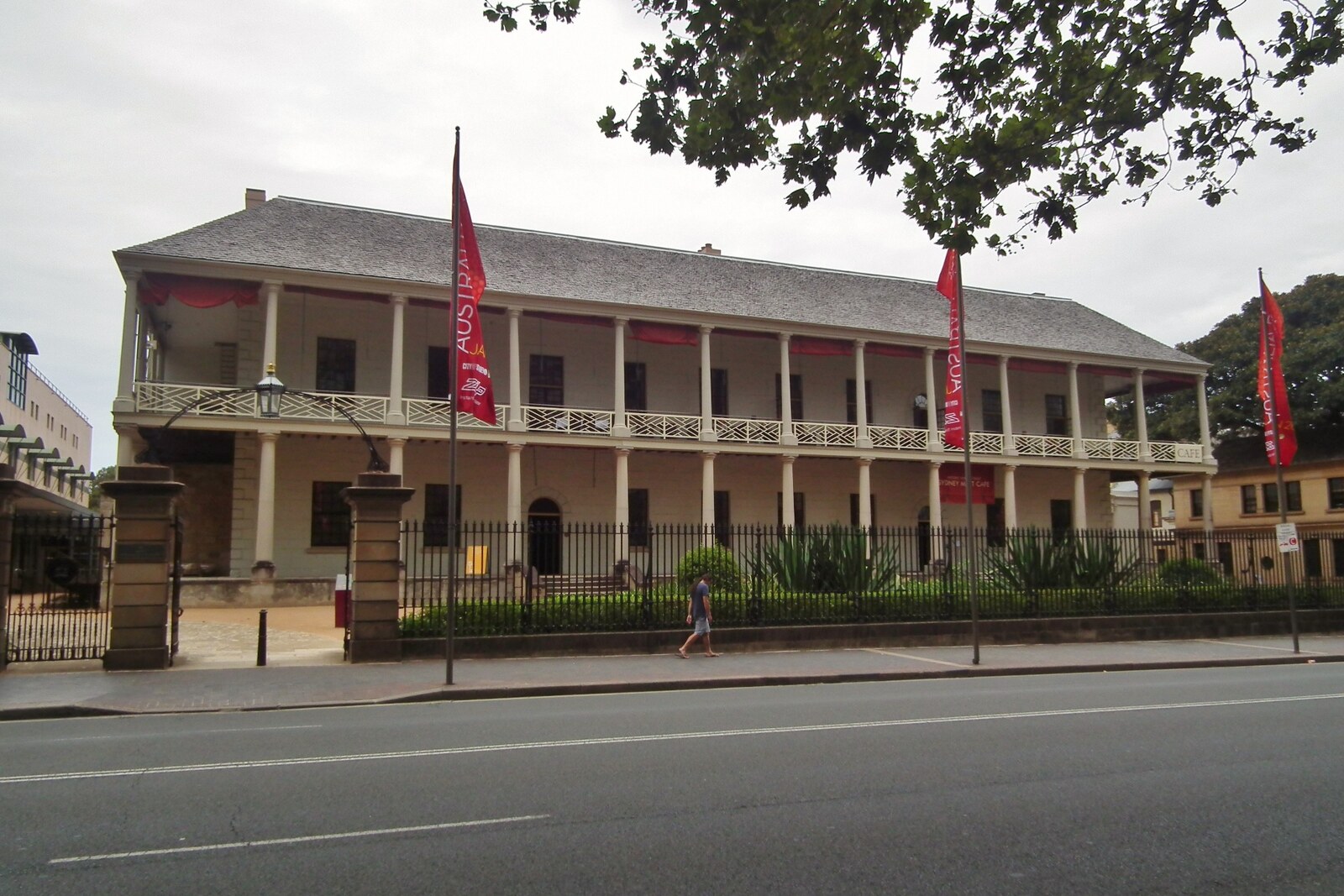
Look around first
What to notice
- Stained-glass doors with the inscription
- Northern entrance
- Southern wing of the former hospital
- Former receiving office
The story of the place
The English words “The Mint” can still be read in the stained-glass doors on the Macquarie Street side. On October twenty-eighth, eighteen sixty-nine, Andrew George Scott came through this entrance. He brought a horseshoe-shaped ingot of gold dust and wanted to receive money for it without explaining where the gold had come from.
Visitors like him came here all the time. After deposits were discovered near Bathurst, colonial legislators asked the British government to allow coins to be minted in Sydney: gold dust and nuggets had flooded the market, while the colony lacked ordinary money. In eighteen fifty-five, the first overseas branch of The Mint began operating here. To save money, officials occupied the southern wing of the old hospital and assembled workshops brought from England in the courtyard. Anyone could bring gold to the receiving office; employees weighed it, assessed its fineness, calculated its value, and sent the metal for melting and minting into sovereigns.
Scott knew that this procedure would give his haul a lawful appearance. A few months before his visit, he had served in the mining settlement of Egerton as a paid Anglican reader—a layman permitted to conduct church services. He became friends with Ludwig Bruun, who managed the local bank branch, and learned how its vault was arranged. On May eighth, a man in a mask and cloak forced Bruun to open the safe and hand over the gold. The attacker even made him write a note saying that the bank employee had resisted, then signed it with the name “Captain Moonlite.” Later, all of Australia knew Scott by that nickname.
In the Sydney receiving office, an employee placed the ingot on precision scales: one hundred twenty-nine troy ounces, about three kilograms six hundred grams. Scott was given a blue receipt. On the back, he instructed that the money be transferred to Union Bank in the name of J. Scott, and received five hundred three pounds, six shillings, and one penny. No mask or weapon was needed here: The Mint served him as an ordinary owner of gold.
Scott quickly spent the money and began paying with checks backed by no funds. His final purchase was the yacht Why Not—“Why not?” He planned to leave for Fiji in it, but the water police detained him before departure. While Scott was serving a sentence for fraud, Bruun secured the continuation of the search. After Scott was released, he was arrested for the robbery in Egerton.
At the trial in eighteen seventy-two, Edward Offord Heywood, a melter at The Mint in Sydney, presented the receipt and the other papers concerning the sale of one hundred twenty-nine ounces. The record that had allowed Scott to receive the money linked him to the stolen gold. The jury found him guilty; he received ten years of penal servitude and another year for escaping from prison before the trial.
Minting ceased here in nineteen twenty-six. The rooms are now occupied by the state museum service, a research library, and a café. But the northern stained-glass entrance has survived, and just beyond it you can still identify the site of the receiving office, where an employee weighed the horseshoe-shaped ingot and issued the blue receipt.
Useful on site
The building's hospital exterior is clearly visible from the street. Access to the rooms and courtyard depends on current access arrangements and events taking place.